
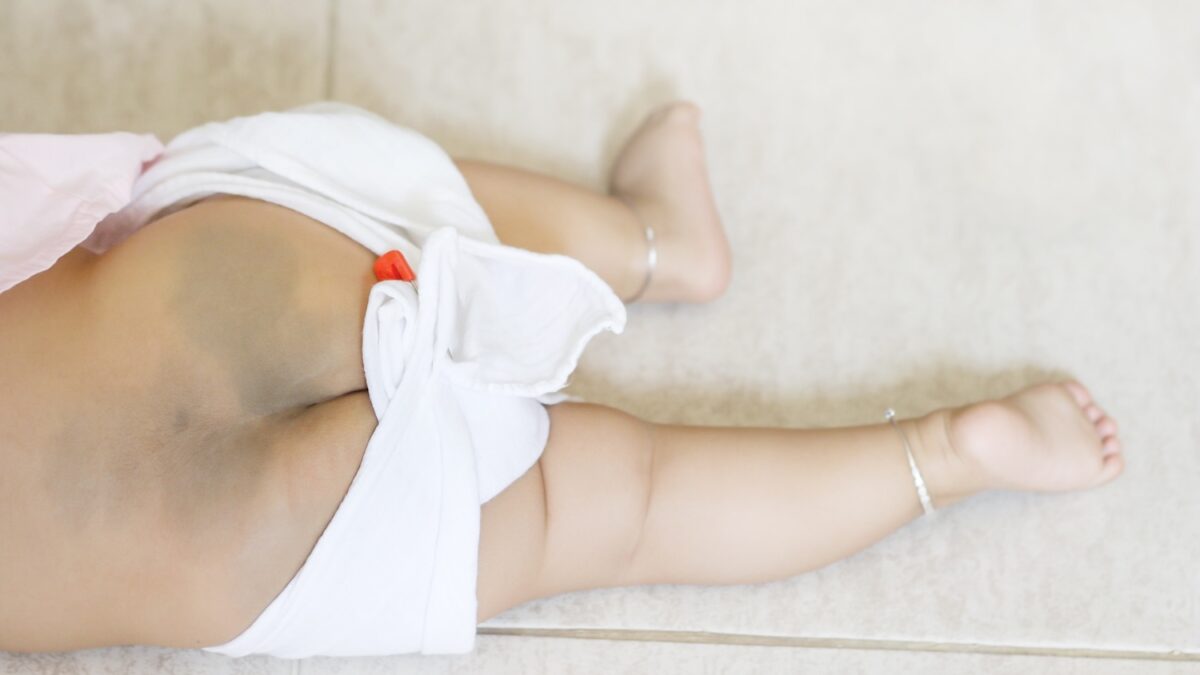
On Instagram, Dr Sermed Mezher warns of a possible confusion: a blue-gray spot on a baby’s skin can look like a bruise, while it is sometimes congenital dermal melanocytosis, a benign birthmark.
A birthmark that can look like a bruise
“Mongolian blue spot” is a term still used in common parlance, but it is misleading. The current medical name is
congenital dermal melanocytosis. It designates a
flat, blue-gray birthmarkpresent at birth or appearing in the first weeks of life.
This coloring comes from pigment cells, melanocytes, located deeper in the skin. It therefore does not have the same origin as a bruise. In its usual form,
it’s not a hematomait is benign and does not require treatment.
It is most often located in the lower back, at the level of the sacrum or buttocks. It may also be visible on the back, shoulders or other areas. For parents, it is one of the possible skin marks at birth, in the same way as the blue mongoloid spots on the buttocks or lower back described in certain newborns.
The British doctor influencer emphasizes two useful points: the word “Mongolic” comes from an old classification and does not mean that this stain would only concern babies of Mongolian origin; and this mark may be mistaken for a sign of trauma if it has not been noticed before.
Medical sources confirm this nuance: this spot can be observed in several populations. It is more common in Asian children and in dark-skinned children, especially of African, Polynesian, Indian, Native American, or Hispanic ancestry, but it is not restricted to any group.
Why it is better to note it from the start
The most practical information is simple: if this stain is noticed at birth or during a consultation, it is preferable that it be noted in the medical file or health record of the child. The goal is not to minimize real bruising, but to prevent a known birthmark from being mistaken for a bruise later.
This distinction matters because bruises in an infant, especially when they are not yet moving, should be taken seriously. A recent, painful, changing, unexplained or absent skin mark from previous findings should not be interpreted alone at home as a simple birthmark.
- If the mark has been present since birth, ask that it be shown and identified during a medical examination;
- If it appears suddenly, changes in appearance, or seems painful, seek medical attention. medical advice;
- If your baby is a infant who is not yet moving and presents a mark resembling a bruise without a clear explanation, it must be evaluated;
- If you have any doubt between the different types of birthmarks and a bruise, the clinical examination will help you decide.
The doctor suggests that it disappears around 1 to 2 years of age, but the medical references indicate rather that congenital dermal melanocytosis often fades over the first few years and most often disappears before adolescence. However, certain spots may persist, particularly when they are located elsewhere than in the buttocks-lower back area.
In practice, the right reflex is therefore neither to worry systematically, nor to trivialize any bluish mark. A stable blue-gray spot, known since birth and identified by a professional, can simply be monitored during regular visits. A new or unexplained mark must be shown, like any situation where a birthmark must be differentiated from a bruise or hematoma.