
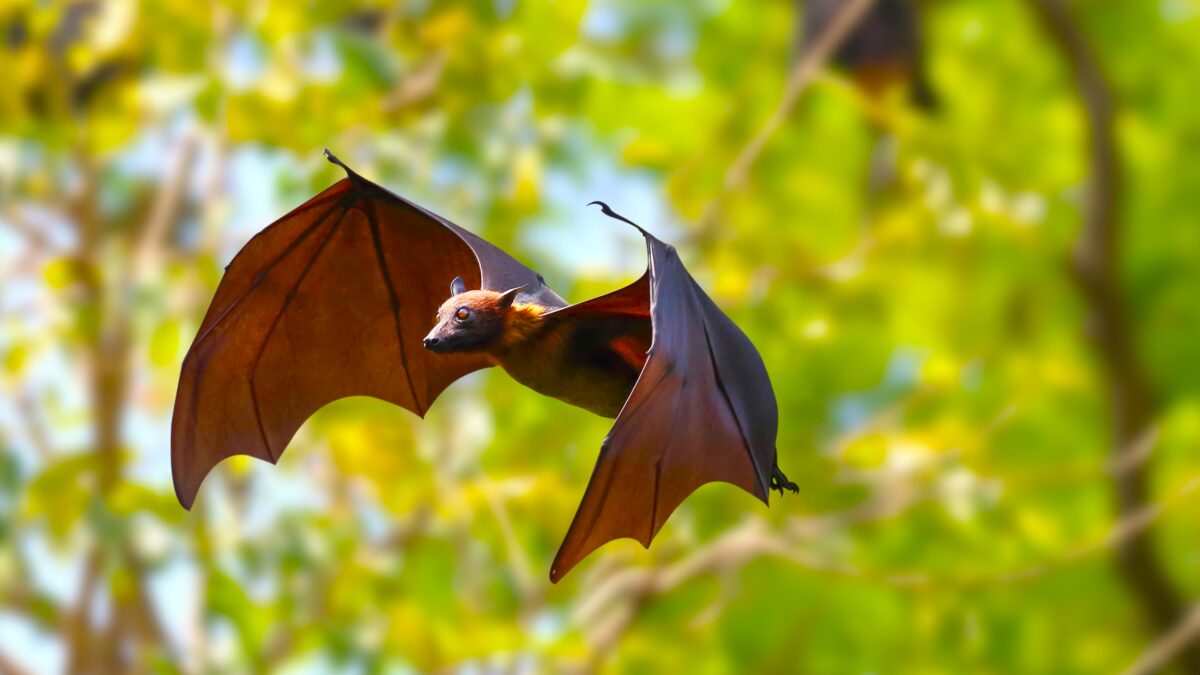
Every year, the surveillance of animal viruses delivers its share of discoveries. This time, it is in Brazil that researchers have identified a new subgenus of coronavirus, called BRZ batCoV, in Parnell’s mustachioed bat (Pteronotus parnellii). According to their study, published on the scientific server bioRxiv and for the moment not validated by their peers, this virus has a particularity close to that of SARS-CoV-2: a furin cleavage site, a key zone which facilitates the entry of the virus into human cells.
An animal virus studied for its structure, not its immediate danger
Japanese and Brazilian scientists believe that this virus has probably been circulating for some time in Latin America, without having been detected, due to lack of sufficient sampling in the region.
Moreover, BRZ batCoV was detected from samples taken between May and August 2019 from 70 bats from three different regions. Analysis of its genetic sequence revealed that it is a distinct subgenus of the Covid-19 virus.
It has a functional furin cleavage site and a single amino acid difference with SARS-CoV-2. Researchers see this as a new piece of the vast puzzle of coronaviruses present in wildlife.
Should we be worried about this new discovery?
For Dr. Gérald Kierzek, emergency physician and medical director of True Medical, this discovery should not worry the general public. “BRZ batCoV is a strain of coronavirus discovered in bats in Brazil. It’s an animal virus, not a human virus. The vast majority of bat coronaviruses circulate only between bats and cannot directly infect humans.”
The study also specifies that several bat coronaviruses have this type of cleavage site, suggesting that this area of the protein is a “hot spot” favorable to mutations. However, these variations do not mean that a transition to humans is imminent.
Surveillance and prevention: a global public health issue
For virologists, identifying these viruses in nature is a crucial step in pre-pandemic prevention. As Dr. Kierzek reminds us, “by studying viruses like BRZ batCoV, researchers seek to understand the immense diversity of coronaviruses, to identify those which could, one day, cross the species barrier and to anticipate possible epidemics. This is a scientific approach, not a warning signal”.
The specialist also insists on the fact that “species jumping”, or spillover, remains a rare phenomenon.
“For a bat virus to become a danger to humans, several complex events must occur: contact between the animal and humans, mutations or recombinations of the virus… The mere discovery of BRZ batCoV does not mean that it represents an immediate threat.”
This work is therefore part of ongoing international surveillance, supported by the “One Health” principle, which links animal, human and environmental health.
In-depth research work, essential for health security
Since the Covid-19 pandemic, every mention of a “novel coronavirus” has attracted attention. Yet, as Dr. Kierzek points out, “these discoveries are part of the routine work of virologists. They are used to map viruses in nature and strengthen our preparedness. This should not be seen as a cause for concern, but rather as progress for global health security.”
For researchers, these discoveries are essential to understanding living things and preventing future health crises. The BRZ batCoV will remain, for the moment, another scientific curiosity in the immense library of bat viruses.