
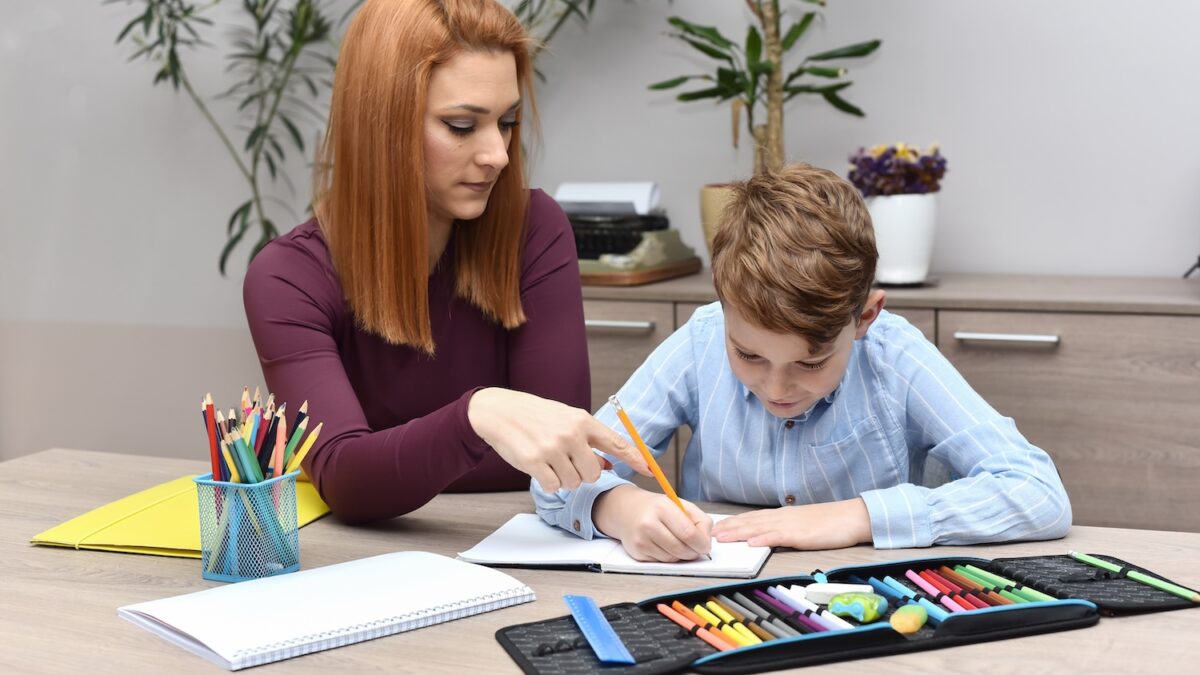
Your child already comes home tired from school, but you wonder if he or she needs an extra hour of lessons? The answer is not yes or no. Academic support can help if it meets a specific, limited need that the child understands.. It becomes more questionable when it mainly serves to calm the worries of adults.
Why do primary school children find themselves with extra lessons?
An article from Aujourd’hui en France/Le Parisien describes an earlier use of private lessons, with children in CE2, CM1, CM2 or the very beginning of middle school. The figures cited come from private players in tutoring: Acadomia says it sees requests for CE2-CM1-CM2 double in four years, Groupe Réussite mentions an annual increase of 40% for this public, Superprof speaks of an average age falling below 10 years since 2020. These data are market signals, not an independent measure of the phenomenon in France.
The reasons reported by the parents are concrete: fear that the fundamentals will not be acquired, absences of teachers, classes considered too busy, dyslexia or special needs, conflicts around homework, screens that take up too much space, anticipation of future school selection… In the document, a father explains having sought help after repeated absences and the difficulty in resuming what he had learned at home:
“With my wife, we tried to get him to review what he had learned, but it takes time and we cannot improvise as a teacher.”
This point deserves to be heard without making families feel guilty. When homework damages the parent-child relationship, a third party can sometimes calm the exchanges. But the same course, placed at the wrong time or experienced as a sanction, can add load to an already long day.
Signs that support mostly adds pressure
For a primary school child, after-school is not just an available slot. It is also used to recover, play, move, dream, produce nothing… If each academic difficulty triggers an additional hour of work, there is a risk of confusing help with overbidding.
The signals to be observed do not prove that private lessons are to blame. Rather, they indicate that it is necessary to review the organization and, if in doubt, seek advice from a professional. Health Insurance cites in particular non-specific signs such as fatigue, sleep problems, irritability, anxiety, withdrawal, loss of interest in favorite games or activities, or even repeated headaches and stomach aches.
In this context, it can be useful to spot the signs of school stress in children and to monitor in particular:
- Repeated seizures before homework or before class;
- An excessive fear of making a mistake or disappointing;
- Fatigue that sets in despite regular schedules;
- Disturbed sleep on extra work days;
- A disappearance of time for play, free reading or relaxation.
Screens can also become a subject of family battle. But a sentence from an exasperated parent should not become a diagnosis. The real benchmark remains overall balance: sleep, mood, confidence, pleasure of learning and quality of family bond.
Decide without feeling guilty, with a short and revisable framework
Before adding class hours, it is better to formulate the problem. Is it a targeted difficulty in reading, calculation, method? A one-off delay after an absence? Tension around homework? A learning disorder already identified?
Support has more meaning when its objective is contained in a simple sentence.
A few points of reference can help you choose without entering into permanent competition:
- Define a short objective, for example covering a concept or organizing homework;
- Limit the duration and plan a progress update after a few weeks;
- Maintain evenings without added school work;
- Discuss with the teacher to check what is really expected;
- Adapt help if a learning disorder is suspected or already known.
In the event of dyslexia or other special needs, private lessons do not replace identification, evaluation or adapted accommodations. They can complement support, but should not become the only answer. For families, the challenge is also to prevent homework from becoming a family conflict.
A good indicator is how the child comes out of the lesson. If he feels a little more capable, if the session remains short and if it doesn’t eat up all his free time, help can support confidence. If he cries, shuts down, sleeps less well or repeats that he is bad, we need to lighten up and resume the discussion. Parents can also consult the signs of fatigue to look out for in a child at school to distinguish a simple sluggishness from an overload that is setting in.
Academic support does not need to be a lasting commitment or a verdict on the child’s abilities. It can be one-off, re-evaluated, and interrupted if the cost in fatigue or tension becomes greater than the benefit..