
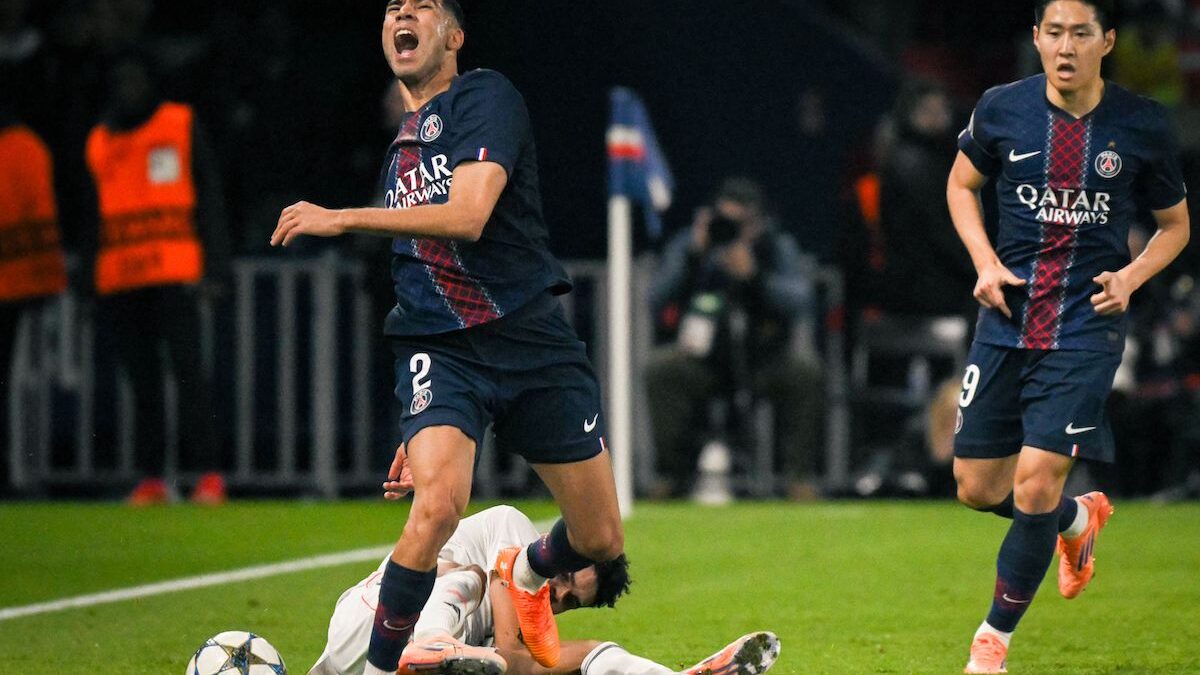
Between severe sprain and risk of fracture, the precise diagnosis must still be confirmed by imaging. Medical decryption with explanations from Dr Gérald Kierzek.
The shock at the Parc des Princes
This Tuesday, November 4, 2025, the Parc des Princes holds its breath. Against Bayern Munich, the Moroccan defender of PSG collapsed after strong contact with Luis Díaz. The scene is brutal: twisting of the left ankle, immediate pain, tense face.
Hakimi tries to get up, then collapses again. Limping heavily, supported by two members of the staff, he leaves the field to applause. The image of his marked features, limping, is imprinted on people’s minds.
A little later, the cameras showed him leaving the Parc des Princes with a walking boot and crutches, signs of rapid immobilization and serious injury.
Sprain or fracture: diagnosis under tension
The first analyzes point to a trauma combining shock and torsion. For Dr. Gérald Kierzek, emergency physician, “the images show a direct impact and a twisting of the left ankle which can lead to a more or less serious sprain (bone tearing, ligament rupture, etc.) or even a malleolar or bimalleolar fracture“.
A sprain, he recalls, “generally manifests as sharp and immediate pain, rapid swelling, difficulty walking or putting the foot down, and often a hematoma (bruise), especially if the injury concerns the lateral ligaments following a twist or sudden inversion of the foot“.
In the case of the Parisian side, these symptoms seem to correspond: intense pain, swelling, inability to support. But another hypothesis cannot be excluded: “A fracture causes severe pain, visible deformity, swelling, redness, warmth to the touch, and difficulty moving or supporting the weight of the limb“.
At this stage, medical imaging – x-ray or, more likely, MRI – is essential to decide: “X-ray, ultrasound or more likely MRI will clarify the lesions (at the level of the ligaments or the bone) and guide the rest of the treatment“.
First aid and high-risk recovery
The immediate intervention of the medical staff made it possible to stabilize the ankle and limit the inflammation. As Dr. Kierzek explains, “Immediate post-injury treatment consists of immobilization. We see the footballer going out with a walking boot, which protects, stabilizes the foot and promotes recovery, especially in the event of a fracture or serious sprain, avoiding overload and allowing suitable immobilization“.
The first examinations could suggest a moderate to severe sprain, which would imply an absence of between four and six weeks, depending on the severity of the ligament damage. The coming weeks will be decisive for assessing recovery: immobilization is often followed by a rehabilitation protocol focused on walking, mobility and proprioception.
Poorly managed recovery exposes you to relapse or chronic instability. The PSG medical teams should favor a progressive approach, between immobilization then rehabilitation (drainage and supervised muscular work).