
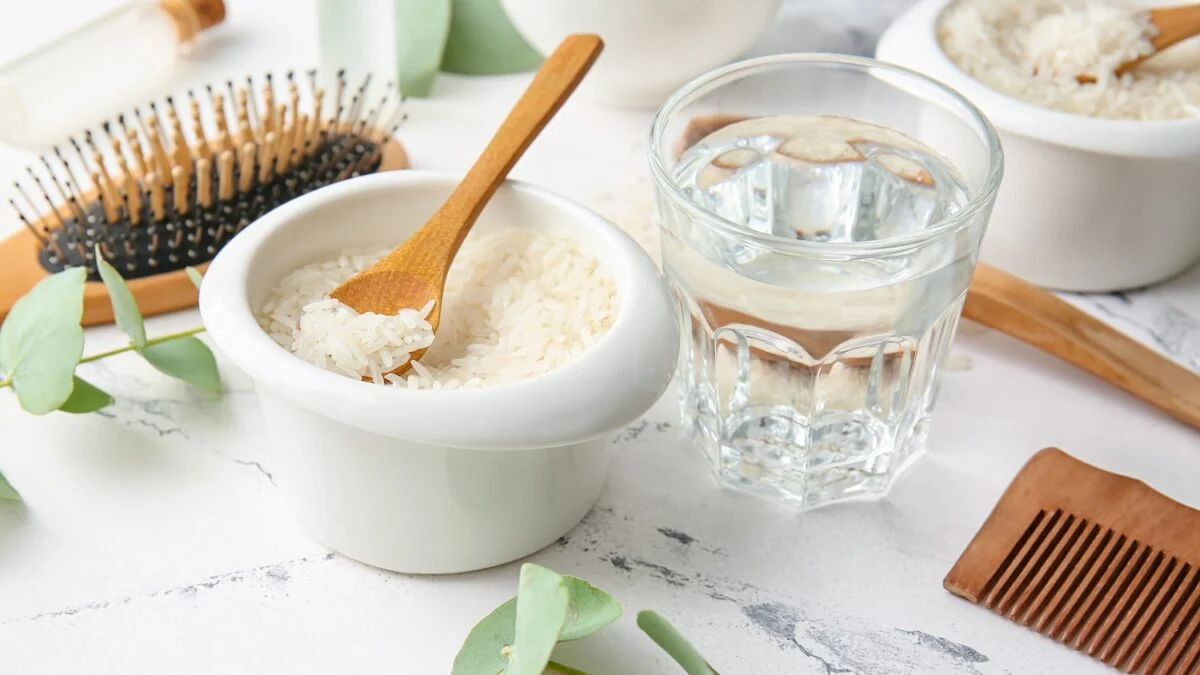
On Instagram, Dr Marie Jourdan, dermatologist (@dr_marie_jourdan) discusses the buzz around the “rice hack” with 2.5 million likes supposed to improve acne scars. The answer is clear: white rice applied to the face has not been shown to be effective in erasing real acne scars.
Why Rice May Sound Interesting…Without Treating Scars
As a preamble, in the commented viral video, it is white rice. However, white rice is not whole grain rice: the bran has been removed. This detail matters, because it avoids mixing talk about the compounds in brown rice and the very simple use of a white rice paste on the skin. What mostly remains is the starch.
The dermatologist describes it as a large molecule that loves water, capable of giving the impression of softer or more comfortable skin on the surface. This idea is not absurd: a small old study evaluated rice starch as a bath additive in contexts of irritated or atopic skin, with a favorable effect on barrier function.
But this is precisely where the nuance is important:
a skin comfort effect does not mean an anti-scarring effect. Skin that feels less tight, appears softer or better hydrated after a home treatment is not necessarily skin whose relief has been repaired. The immediate sensation does not prove that the dermis, the deep layer affected by some acne scars, has been modified.
And as Dr Marie Jourdan points out, virality is not proof. Millions of likes can make a gesture visible, not demonstrate its effectiveness.
An acne scar is not just a mark on the surface
To understand why the “rice hack” disappoints, we must distinguish two often confused situations. Post-inflammatory pigment marks are flat: they correspond to a color left after a pimple and can fade over time. Real scars, particularly atrophic or hollow scars, modify the relief of the skin.
A deepened acne scar corresponds to a “collapse” of the dermis, with tissue becoming fibrous after the inflammation.
A hollow scar is not just a blemish, it is a lasting irregularity in structure. Applying starch to the surface is therefore not enough to reconstruct this relief.
When acne scars are severe and persistent, the options discussed involve specialized treatment: certain lasers, medical peels or procedures adapted to the type of scar. Dr Marie Jourdan particularly discusses fractional lasers, which create tiny controlled impacts to stimulate skin repair.
To go further, True Medical details the truly effective treatments against acne scars and how the fractional CO2 laser works on acne scars.
Be careful, however: this does not mean that you should embark on powerful active ingredients or aesthetic procedures alone. Scar treatments depend on the type of mark, skin, active acne and risk of side effects. They should be discussed with a trained professional, especially in the case of deep, numerous or poorly experienced scars.
- Do not confuse stain and hollow scar : they do not evolve in the same way;
- Don’t delay treatment for active acne by banking on a viral home hack;
- Keep the rice in its place : it may give a feeling of comfort, but it is not a validated treatment for acne scars.
If the pimples continue to appear, the challenge is also to limit new marks. Appropriate care, acne management and non-aggressive actions are more important than a very popular recipe. You can also consult our advice for adopting the right actions to treat acne-prone skin.