
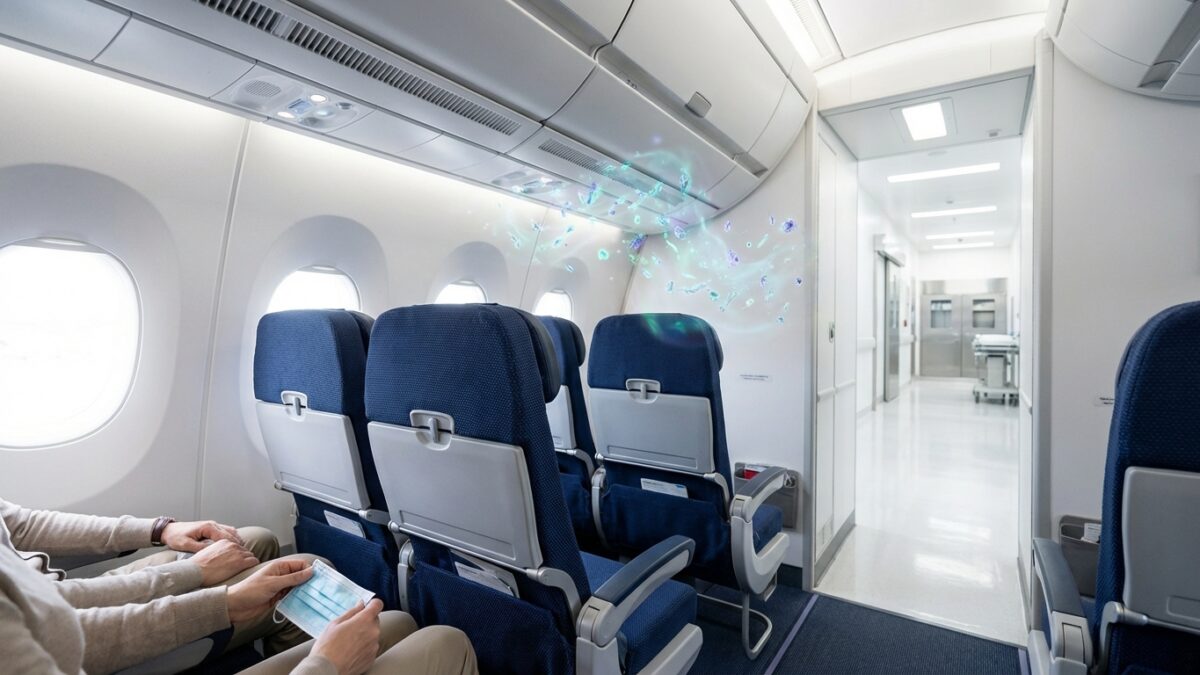
Does breathing in an airplane cabin still make you a little anxious, even after the Covid pandemic? Many imagine theair in planes like a cocktail of viruses and bacteria, stuck in a metal tube. Hospitals are often seen as places saturated with invisible germs.
A study conducted by Northwestern University and published in the journal Microbiome Yet paints a very different picture. By analyzing used surgical masks from travelers and caregivers, as well as a cabin filter after more than 8,000 hours of flight, the researchers mapped the microbes that actually float in this highly filtered air. The portrait that emerges is surprising.
Air on planes: what bacteria really say
To sample theair in airplane cabin
Without disrupting operations, Erica M. Hartmann’s team transformed disposable masks into passive sensors. She summarizes the process as follows: “We realized we could use face masks as a cheap and easy sampling device to measure personal and general exposure. For the comparison group, we thought of another population who were likely already wearing masks. We chose healthcare workers“, explains Erica M. Hartmann.
In total, scientists identified 407 different microbial species on the masks and filter, 99.6% of which were bacteria. The dominant ones have names familiar to skin microbiologists: Cutibacterium acnes,
Staphylococcus epidermidis, Staphylococcus hominisor even environmental bacteria like
Sphingomonas hankookensis And Methylobacterium radiotolerans. “We extracted DNA from these masks and examined the types of bacteria present. Not surprisingly, these were bacteria that we generally associate with indoor air. Indoor air has a composition similar to that of human skin“, adds Erica M. Hartmann. Potentially pathogenic microbes, such as Escherichia coli Or
Pseudomonas aeruginosawere indeed spotted, but in extremely low quantities and without sign of active infection.
Planes and hospitals: an especially human indoor air
A key result of the study lies in the comparison between
air quality in airplanes and in hospitals. The bacterial communities are very similar, regardless of the location, which indicates that the main source of airborne microbes remains… the occupants themselves. In other words, the air in the cabin or in a hospital ward resembles the microbiome of our skin and theindoor air
classic, not a cloud of aggressive hospital germs.
Ventilation systems play an important role in this reassuring observation. The cabins are equipped with HEPA filters comparable to those used in operating theaters, capable of capturing 99.97% of airborne particles, including bacteria and viruses. Researchers have nevertheless detected resistance genes in the air to major families of antibiotics, such as beta-lactams, fluoroquinolones or tetracyclines. Although these genes do not indicate the presence of dangerous microbes in the air, they highlight the extent of the phenomenon of antibiotic resistance.
Risk of contamination: the air, but especially the hands
For travelers and patients alike, these results suggest thatpressurized air in airplanes and hospital air are less threatening than is often thought on a microbial level. The researchers point out, however, that their work only concerns what floats in the air, not what is on surfaces or passes through close contact. For many common infections, these routes remain more decisive than the inhalation of a few airborne skin bacteria.
The practical priority emerges clearly from Erica M. Hartmann’s speech: “Hand hygiene remains an effective method for preventing infections“insists the researcher. Masks are especially useful here as a discreet and inexpensive monitoring tool for the microbiological quality of the air in planes and hospitals. An approach which could, in the future, help detect more quickly the appearance of truly problematic microbes in these busy enclosed spaces.