
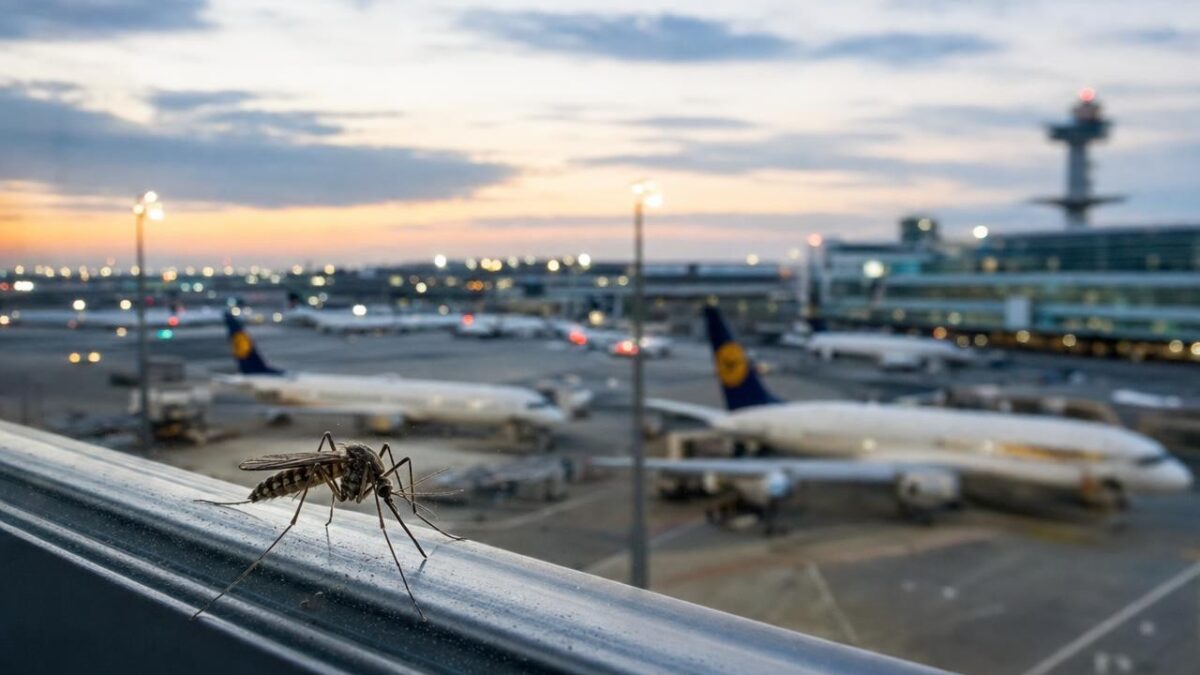
During the summer of 2026, eight cases of malaria were detected around Frankfurt Airport, Germany, three of which resulted in one death. None of the patients had traveled to an endemic area or received a transfusion, which raised fears of a local outbreak of this rare disease in the country, described as
airport malaria. After laboratory analyses, the city’s health authorities obtained an answer on the origin of these infections.
According to the Frankfurt public health service, which relies on the work of the Institute of Tropical Medicine in Antwerp, the responsible parasites come fromWest Africa and may have been imported by infected mosquitoes traveling by air. “Genetic analyzes suggest that malaria agents originally came from West Africa and were likely introduced to Frankfurt by infected mosquitoes“, explains Professor Peter Tinnemann, director of the Frankfurt health service. This genomic investigation actually reconstructs three separate introductions, and not a single chain of transmission.
What genetic analyzes say about airport malaria
The biologists of theAntwerp Institute of Tropical Medicine sequenced the genome of the parasite Plasmodium falciparum found in all eight patients. “The malaria agents studied could be linked genetically to three different groups. This supports the hypothesis that the transmissions occurred by three separate mosquitoes. They also contradict the suspicion that local mosquitoes were the vectors of the malaria agent Plasmodium falciparum“, explains Professor Peter Tinnemann, director of the Frankfurt health service. Each outbreak corresponds to the arrival of a different infected mosquito, not to lasting spread on site.
The three genetic groups correspond to the successive episodes of July, August and September 2026 described by the city of Frankfurt. Six people who worked or were on airport grounds developed malaria tropica in early July or mid-August, and two died. In September, two residents of the district of
Schwanheimlocated right next to the slopes, were infected in turn, one of them fatally, even though they had never stayed in an endemic area.
An imported disease rare in Germany but common elsewhere
For theRobert Koch Institutewhich tracks infectious diseases in Germany, a comparable episode of airport malaria has not been recorded since 2023. In a country where this infection remains exceptional, doctors think less spontaneously of malaria, which can delay the diagnosis and worsen the prognosis.
This series of cases remains tiny when compared to the global situation. Malaria kills hundreds of thousands of people every year, the vast majority in Sub-Saharan Africawhere Plasmodium falciparum circulates endemically and where the bite of an infected Anopheles mosquito is part of everyday life.
Increased vigilance around Frankfurt airport
“Plasmodium falciparum malaria is “completely curable” if it is detected and treated in time,” insists the town hall. The public health service thus informed the Hesse Association of Convention Physicians and the health authorities so that they could relay a simple instruction: think about malaria in the event of suggestive symptoms in a person passing through the airport or living nearby.