
From Portuguese wine to Czech beers, Europe likes to tell its story through alcohol. Behind these images of conviviality, statisticians nevertheless measure very precisely what the inhabitants of each country drink, year after year. L’European Union even appears, according to the World Health Organization, as the region where alcohol consumption is the highest and where the
cancer has become the leading cause of death.
A new panorama published by the Organization for Economic Cooperation and Development, through the report Health overview 2025 based on Health at a Glance 2023puts recent figures on this reality. We see that habits have changed a lot in ten years, that a trio of countries clearly stand out in terms of drinking volumes while a Mediterranean state brings up the rear, and that the differences begin from adolescence: enough to wonder where each country is located in this ranking, and at what age Europeans really start drinking.
Who are the biggest consumers of alcohol in the EU?
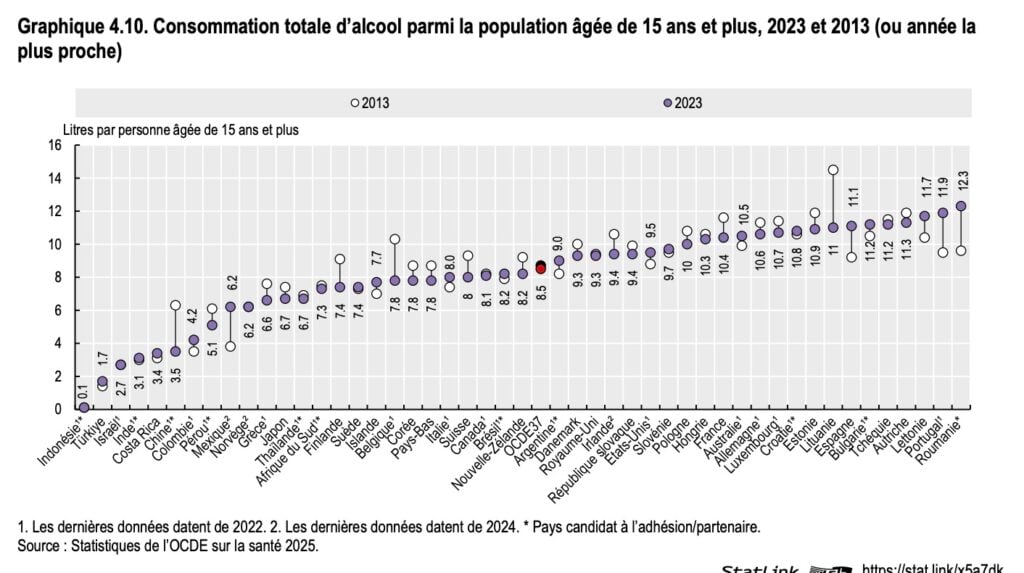
In 2023, according to the report Health overview 2025 of theOECDaverage annual consumption reaches 8.5 liters of pure alcohol per capita in all the countries studied. Inside theEuropean Unionsome Member States remain below this level while others clearly exceed it, drawing a very contrasting map. Here is what the figures for 2023 show:
- There RomaniaTHE Portugal and the Latvia are among the biggest consumers, with more than 11.5 liters of pure alcohol per inhabitant per year;
- Six European Union countries record consumption below the average of 8.5 liters per person;
- There Greece displays the lowest quantity, with 6.6 liters per inhabitant.
 © OECD
Screenshot
Over the period from 2013 to 2023, most countries saw their consumption decline. There Belgium and the
Lithuania show the largest declines, with reductions of at least 2.5 liters of pure alcohol per capita. On the other hand, the PortugalSpain and Romania experienced an increase of at least 2 liters per person over the same period. In this context where the European Union remains the region of the world where people drink the most, the World Health Organization recalls that alcohol consumption is associated with an increased risk of several cancers, in particular those of the mouth, throat, liver, colorectal cancer and breast cancer.
Too early an introduction to alcohol in France
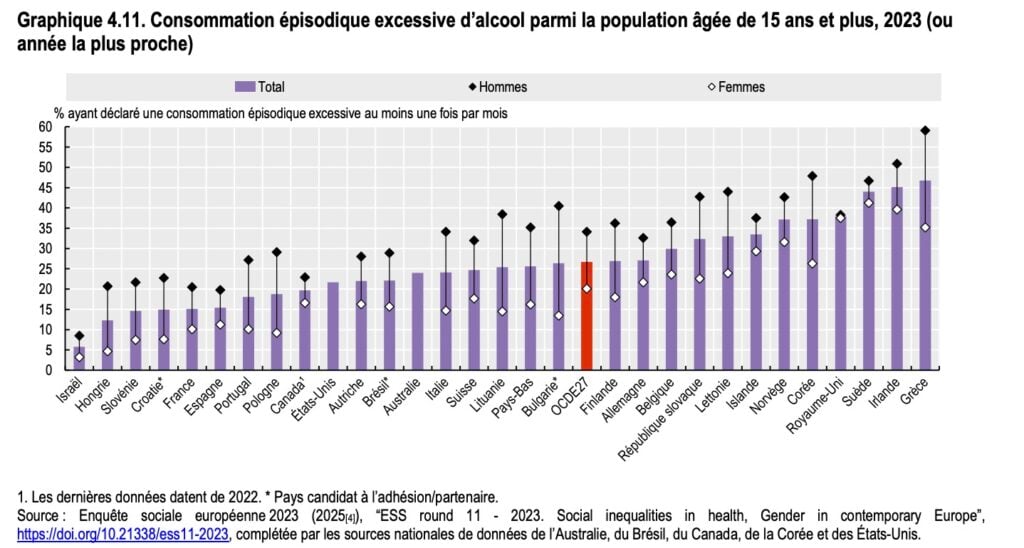
Annual volumes don’t tell the whole story, because the way you drink matters too. In 2023, 27% of people aged 15 and over consumed large amounts of alcohol in a short period of time (binge drinking) at least once a month in the past year, on average across 27 countries.OECD. Greece, Ireland and Sweden have the highest rates, with more than 40% of people reporting a excessive consumption monthly, while Hungary, Slovenia and Croatia remain below 15%. At the broader OECD level, almost one in five adults, or 19%, report an episode of heavy alcohol consumption at least once a month, with levels above 30% in Germany, Luxembourg, the United Kingdom and Denmark.
 © OECD
Screenshot
Among the young peoplethe data shows an early onset of consumption. Between 2018 and 2022, the share of 11-year-olds who consume alcohol increased slightly on average across OECD countries, from 4% to 5%. On average, 5% of 11-year-olds and 15% of 13-year-olds report having drunk in the last month. In the European Union, the highest rates, starting at 10% of 11-year-olds, are observed in the Czech Republic, In Francein Hungary, Bulgaria and Romania. According to the OECD, this early and repeated initiation is associated with deterioration in mental health, including anxiety, a decline in cognitive functions and higher consumption in adulthood.
At 15, more than 35% of adolescents report having been drunk several times in Denmark, Hungary and Bulgaria, while Portugal is below 10%. The lifetime prevalence of drunkenness is decreasing on average, but the trend has stabilized among boys, with 22% in both 2019 and 2022, while it increased among girls, from 19% in 2018 to 22% in 2022, even if, in twenty-five countries of the European Union, the proportion of boys having been drunk more than once remains higher than that of girls.
To try to slow down the progression of this behavior among minors, several States are relying on regulatory strategies, such as Belgium which adopted an alcohol action plan for the period 2023 to 2025, notably prohibiting the sale of alcohol in vending machines, in service stations along motorways between 10 p.m. and 7 a.m., as well as in hospitals.