
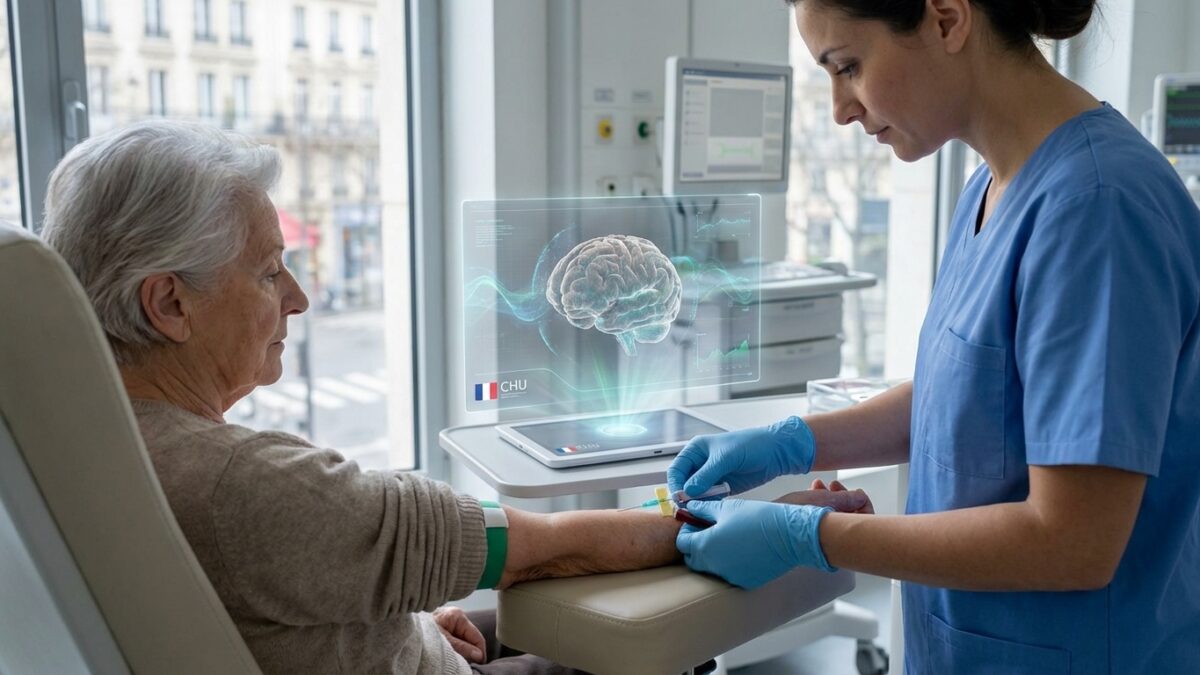
Memory loss, attention problems, slower gestures: in an elderly person, these signs can suggest depression as well as Alzheimer’s disease, vascular damage or Parkinson’s disease. For doctors, untangling these paths remains long, expensive and sometimes uncertain, especially when several brain lesions overlap.
Researchers from the University of Lund, in Sweden, have just taken an unexpected step: a model ofAI able to read, in a simple blood testthe signature of several neurodegenerative diseases at once. Their work, published in the journal Nature Medicinedescribes the model
ProtAIDe-Dxbuilt to identify different forms of dementia in parallel from a single tube of blood. An ambitious promise, which comes with many precautions.
ProtAIDe-Dx, an AI powered by blood data from more than 20,000 people
The model is based on the Global Neurodegenerative Proteomics Consortium (GNPC), a database bringing together blood data from more than 20,000 people, including more than 17,000 used to train the algorithm. Using SomaLogic 7k technology, researchers measure approximately 7,600 proteins in each sample, a true biological “fingerprint” of brain activity. “Our hope is to be able to accurately diagnose multiple diseases at once with a single blood test in the future,” says Jacob Vogel of Lund University, who led the study.
The authors use “joint learning”: instead of looking for an isolated marker for each disease, the AI learns a general pattern of brain degeneration, then estimates the probability of several diagnoses at the same time. According to the team, ProtAIDe-Dx outperforms prior models and achieves balanced accuracies ranging from approximately 70% to 95% depending on pathology, with performance confirmed in several independent datasets, including the Swedish BioFINDER-2 memory cohort.
Alzheimer’s, Parkinson’s, ALS… 5 diseases detected in a single blood test
Concretely, the model distinguishes five conditions linked to dementia: Alzheimer’s, Parkinson’samyotrophic lateral sclerosis (ALS) or Charcot disease, frontotemporal dementia and history of stroke, in addition to healthy controls. It can therefore detect combinations of diseases in the same patient, a frequent situation but difficult to identify in the clinic. “We also found that protein profile predicted cognitive decline better than clinical diagnosis, and it appears that individuals with the same clinical diagnosis may have different underlying biological subtypes.,” Lijun An explains.
The researchers observed that many people labeled Alzheimer’s had a protein profile closer to other brain disorders, for example vascular. “This could mean they have more than one underlying disease, that Alzheimer’s disease can develop in more than one way, or that the clinical diagnosis is incorrect. However, I do not think that current protein measurements from blood samples alone will be sufficient to diagnose multiple diseases, we need to refine the method and combine it with other clinical diagnostic tools,” warns Jacob Vogel.
Towards a “multi-dementia” blood test still to be refined
Beyond diagnosis, many proteins highlighted by ProtAIDe-Dx open avenues to better understand the mechanisms that damage the brain in these diseases. The next step will be to add more markers using mass spectrometry, in order to identify even more specific patterns for each pathology. “We hope to get closer to a blood test that can make reliable diagnoses across disorders without help from other clinical instruments“, summarizes Jacob Vogel, while recalling that it is still a research tool, intended for the moment to complement, and not replace, classic neurological examinations.