
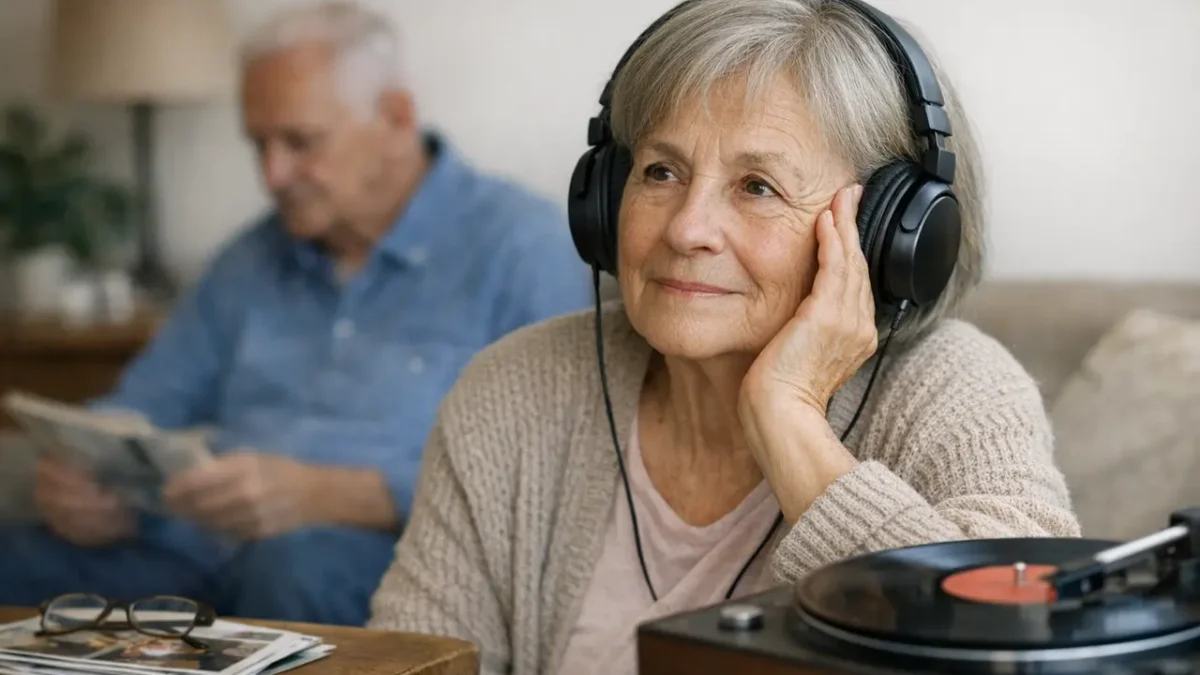
In the middle of a visit, a few notes are sometimes enough to change the atmosphere: a glance passes, a smile appears, a person suffering from dementia suddenly seems more present. Many loved ones have already observed it, without always knowing what it means. A study published on June 1, 2026 in Brain Communications provides a nuanced answer: favorite music can still elicit a brain responsebut this response varies depending on the type of dementia.
The researchers compared people with Alzheimer’s disease, patients with frontotemporal dementia in its behavioral variant, and people without dementia. Their goal was not to show that a song heals or restores memory, but to observe what happens in the brain at the time of listening.
What does the brain show when music is personal?
The study included 60 participants aged 52 to 81: 22 with Alzheimer’s disease, 13 with behavioral variant frontotemporal dementia, and 25 controls. All underwent a functional MRI during three situations: listening to their favorite music, listening to unknown music chosen by the researchers, and periods of silence.
The choice of personal music is central. It was not just a randomly chosen pleasant piece of music, but a favorite music self-selected by the person. In families, it is often this type of song that seems to provoke a reaction: a clearer attention, an emotion, sometimes a moment of easier contact.
In this small functional MRI study, the researchers observed brain activations while listening to favorite music in the different groups. In other words, even in the presence of a neurodegenerative disease, the brain can still respond to familiar or emotionally charged music.
Why do Alzheimer’s and frontotemporal dementia not react the same?
The most interesting result is the comparison between the diseases. The activation profiles were not identical. People with behavioral variant frontotemporal dementia had less activation overall when listening to their favorite music than people with Alzheimer’s disease and controls.
The researchers also report, in the contrast between favorite music and unknown music, reduced activation in a region called the supplementary motor area in patients with behavioral frontotemporal dementia. This difference contributes to the idea that music processing is not altered in the same way depending on the disease.
This distinction matters to loved ones. We often speak of “dementias” as a single unit. Gold, Alzheimer’s disease and frontotemporal dementia do not affect the same brain networks in the same way. A reaction to a song should therefore not be interpreted in the same way by all people, and its absence does not necessarily mean indifference.
For families looking for guidance on the possible place of music, this study is part of a field already explored around music therapy and aging. Also read on True Medical: what if music could slow down the cognitive decline of elderly people?
What can we learn from it to support a loved one?
This study does not show that music restores memory, nor that it lastingly improves symptoms, autonomy or quality of life. She observes brain activity at the precise moment of listening, in a brain imaging framework.
The main reservation to keep in mind is simple:
the sample is limited, especially for frontotemporal dementiawith only 13 participants in this group. The results are therefore useful for understanding the mechanisms, but they are not sufficient to establish a standardized therapeutic intervention.
The most reasonable guideline is to start from the person’s history: the music they loved, the songs associated with important moments, the tunes that already had a place in their life. Then observe the response, without forcing, and without expecting the same effect from one day to the next.
Personal music can create a moment of connection, but it must remain a respectful experience. If it soothes, attracts attention or facilitates exchange, it can be offered. If it agitates, tires or does not provoke anything, it is better to accept it too: in dementia, a song is not a proof to obtain, but a possibility to adjust to the person.