
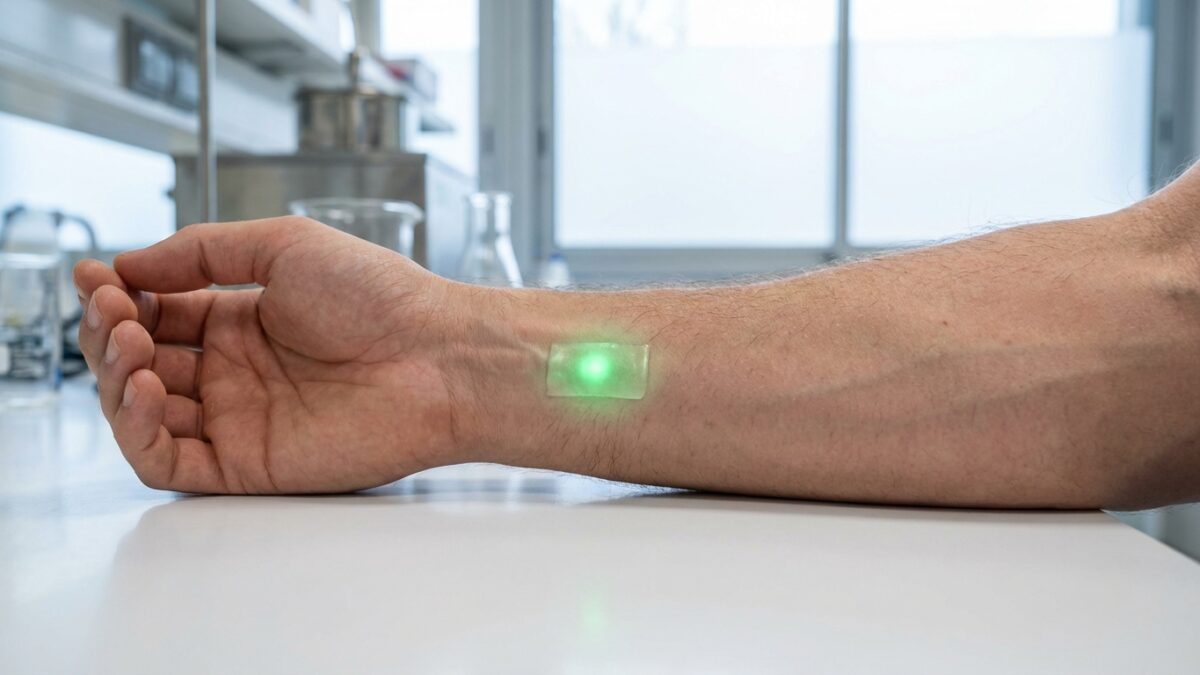
A body that monitors itself like a modern car, with a light that comes on as soon as a problem looms: the image looks like science fiction. Smartwatches and fitness bracelets already measure our activity, but they stay stuck to the surface of the skin and miss part of the body’s inner story.
In Japan, researchers have taken a symbolic step with a light implant under the skin designed as a biological “engine light”. They developed a living skin artificial capable of shining when certain internal biomarkers, linked to inflammation or stress, go beyond expected values. For the moment, these tests are limited to mice, but the idea of a permanent health indicator is already intriguing the medical world.
Why smartwatches aren’t enough, according to the Tokyo team
Wearable health devices, such as smartwatches, are now common and can track steps, heart rate or blood pressure, but not proteins that indicate inflammation or incipient disease. “Conventional approaches are often invasive or only provide point-in-time data“, specified Hiroyuki Fujita, professor emeritus at the University of Tokyo. Repeated blood tests remain cumbersome, especially for detailed daily monitoring.
The Japanese team wanted a sensor as close as possible to biology, readable almost at a glance. Their goal was “to develop a biologically integrated system allowing continuous detection and intuitive interpretation, even at home“, explained Hiroyuki Fujita. In other words, a body light that lights up when something is wrong inside, without a laboratory or complicated application.
Living skin that glows green when inflamed
The University of Tokyo team, in collaboration with RIKEN and Canon Medical Systems Co., unveiled a living sensor: an artificial skin graft that fluoresces in response to specific biomarkers, such as inflammation. To achieve this, scientists used epidermal stem cells, those that naturally renew the skin. By genetically modifying them, they programmed them to react to the NF-κB pathway, activated in the event of inflammation, and then produce a green fluorescent protein (EGFP). Grafted onto mice, this artificial skin integrated into the tissues, then emitted green light when the researchers triggered an inflammatory response.
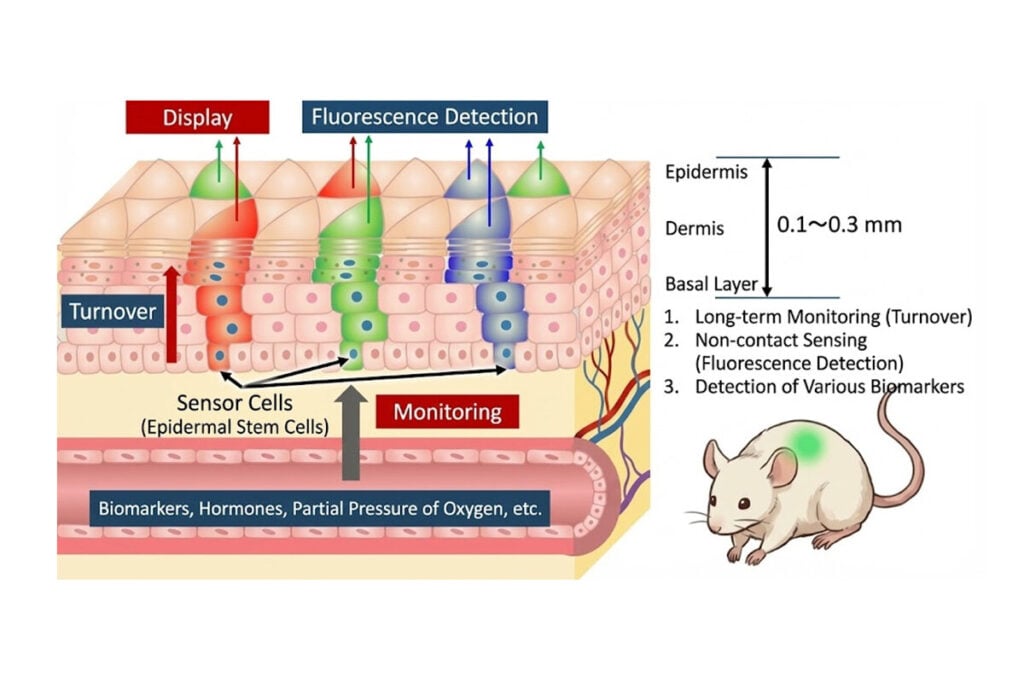 © University of Tokyo
The device therefore resembles an entirely biological biosensor, nourished by the organism itself. “Unlike conventional devices that require a power source or periodic replacement, this system is maintained biologically by the organism itself“, explained Professor Shoji Takeuchi of the University of Tokyo. Experiments showed that the sensor function could last more than 200 days, without battery or recharging, because it exploits the natural regeneration of the skin to enable long-term monitoring of biomarkers.
What are the uses for this luminous implant under the skin?
Researchers imagine this system for the continuous monitoring of biomarkers in high-risk patients, the elderly or those suffering from chronic diseases. After implantation, the epidermis would become a sort of discreet screen, capable of signaling an inflammatory outbreak without taking blood. The team also discusses veterinary medicine or breeding, where animals unable to describe their symptoms could “speak” through light.
Another accepted path: high-level athleteswhich could more closely monitor the physiological stress linked to training. The authors remain cautious and speak of a preclinical stage, a simple proof of principle. “This study demonstrates proof of concept for long-term, biologically integrated sensing without batteries, wiring, or active user operation“, they explained. It remains to be seen if, one day, everyone will agree to wear a health indicator under their skin ready to light up green.
Although this project is still in its preclinical stages, it offers a biology-based method for connecting living tissues with sensing capabilities, blurring the line between biological systems and artificial devices.