
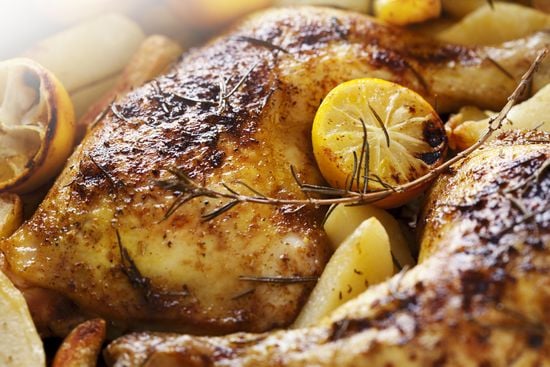
Eating the skin of roast chicken: what do the numbers say?
Per 100 g, roast chicken skin provides around 450 kcal and nearly 40 g of lipids, according to data reported by Santé Magazine. This is a lot, but these figures must be placed in the context of the quantity actually consumed: a portion of skin rarely represents 100 g on its own.
The skin concentrates a large part of the chicken’s fat, which explains its taste and crispy texture. But not all of these fats are necessarily saturated. The Harvard TH Chan School of Public Health website reminds us that a large part of the lipids present in chicken skin are unsaturated fats.
In other words, no need to feel guilty about a few bites. The most important thing remains the overall balance of the meal and the frequency with which we consume this type of food.
Chicken skin: should you really worry about cholesterol?
For a healthy person, occasionally eating chicken skin alone is not a problem. On the other hand, caution may be required when the diet is already rich in saturated fats or when one must monitor one’s lipid intake.
In this case, removing the skin simply reduces the amount of fat consumed. The same goes for people looking to reduce their calorie intake: the skin is particularly energetic and can quickly add to the bill when combined with a rich sauce, fries or a very sweet dessert.
The idea is therefore not to systematically ban chicken skin, but rather to avoid accumulating very fatty foods during the same meal.
Roast chicken: cooking matters too
Another element deserves to be given importance: the way the chicken is cooked. When meat or poultry is exposed to very high temperatures, particularly on the barbecue or directly in contact with flames, certain substances can form on its surface.
The National Cancer Institute explains that heterocyclic amines and polycyclic aromatic hydrocarbons appear particularly during cooking at high temperatures. The first form when certain components of the meat react under the effect of heat. The latter can in particular form when fat and juices fall on the flames and produce smoke, which is then deposited on the meat.
This doesn’t mean we should ban grilled chicken. The National Cancer Institute points out that human studies have not established a definitive link between exposure to these compounds from cooked meat and cancer.
But to limit exposure, it is best to avoid grilling meat directly in the flames and consuming the heavily blackened parts.
The National Agency for Food, Environmental and Occupational Health Safety recommends in particular favoring the heat of the embers rather than direct contact with the flames. She also advises not to exceed 220°C and to place the grill at least 10 cm from the embers for a horizontal cooking barbecue.
How to enjoy chicken skin without feeling guilty?
For a healthy adult, a few pieces of roast chicken skin can fit perfectly into a varied diet. The main thing is to look at the whole plate: vegetables, a low-fat side dish and a reasonable amount of chicken to keep the meal balanced.
On the other hand, if the chicken is accompanied by fries, a rich sauce and a very sweet dessert, the skin is not necessarily the only element to watch out for. Above all, it is the accumulation that can make the difference.
Finally, if you particularly like the skin for its crunchy side, there is no need to eat a large quantity of it to please yourself. A few bites are often enough to rediscover that much appreciated grilled taste.