

In young children, exceeding a certain threshold of very industrial products seems to be enough to increase the risk of asthma during the primary school years. In Spain, a cohort of 691 children aged 4 to 5, followed for more than 3 years, showed that beyond a critical proportion of processed foods on the plate, asthma became significantly more frequent.
Childhood asthma: a quadrupled risk due to ultra-processed foods
Researchers have observed that although genetic predisposition remains a key element in the development of asthma, environmental and lifestyle factors, such as diet, are increasingly considered modifiable. Previous studies linking ultra-processed foods (such as soda, sugary cereals or packaged snacks) to allergic diseases have been mainly cross-sectional, making the prospective approach of the SENDO study original.
The SENDO project researchers classified the 691 children into three groups according to the proportion of ultra-processed foods in their diet, assessed using a frequency questionnaire of 147 subjects, then re-evaluated after three years. The lowest group (T1) consumed less than 30% of its energy via these products, the other two (T2 and T3) 30% or more. The adjusted asthma risk reached 2.6% in T1 compared to 9.9% and 7.6% in T2 and T3, with a significant trend between categories.
In contrast, the authors found no significant association between ultraprocessed food consumption and allergic asthma, atopic dermatitis, aeroallergen sensitization, food allergy, or atopy. While recalling that this is an observational study, the authors declare:
“Our results suggest that consumption of ultra-processed foods may represent a particularly potent modifiable risk factor for childhood asthma in certain populations or contexts.“.
According to the results, beyond 30% of daily energy intake from ultra-processed foods, risk of asthma is almost quadrupled
(3.76).
Why ultra-processed foods could promote asthma
The team points out that these products are distinguished by a cocktail of saturated fats, added sugars, salt, additives and intense thermal processes. This profile promotes low-grade inflammation. In detail, saturated fats activate the Toll-like receptor 4 (TLR4) and the NF-κB pathway, which leads to the release of cytokines like TNF-α, IL-6 and IL-8; at the same time, advanced glycation end products (AGEs) bind to the RAGE receptor and increase oxidative stress and bronchial remodeling.
The fact that the study did not find an increase in eczema, food allergies or atopy points towards a rather non-allergic asthma. The authors evoke an intestine–lung axis: by modifying the intestinal microbiota and chronically exposing children to additives, ultra-processed foods could make the respiratory tract more sensitive.
What should we change in the face of this risk linked to ultra-processed foods?
In France, INCA 3 data indicates that 26% of the energy of those under 17 comes from industrial foods, close to the threshold of 30%. The authors plead for reducing these ultra-processed foods by family policies and choices.
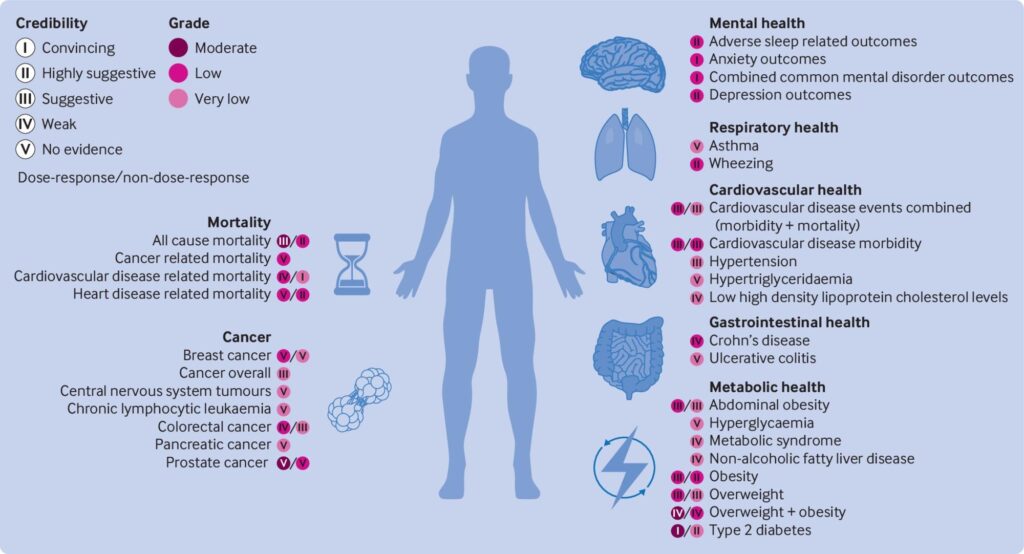 © BMJ 2024
A large study, involving 10 million participants, found that consumption of ultra-processed foods is linked to 32 health problems, such as cancer, diabetes, cardiovascular disease, sleep disorders and depression. These results underline the importance of reducing the consumption of these products.