
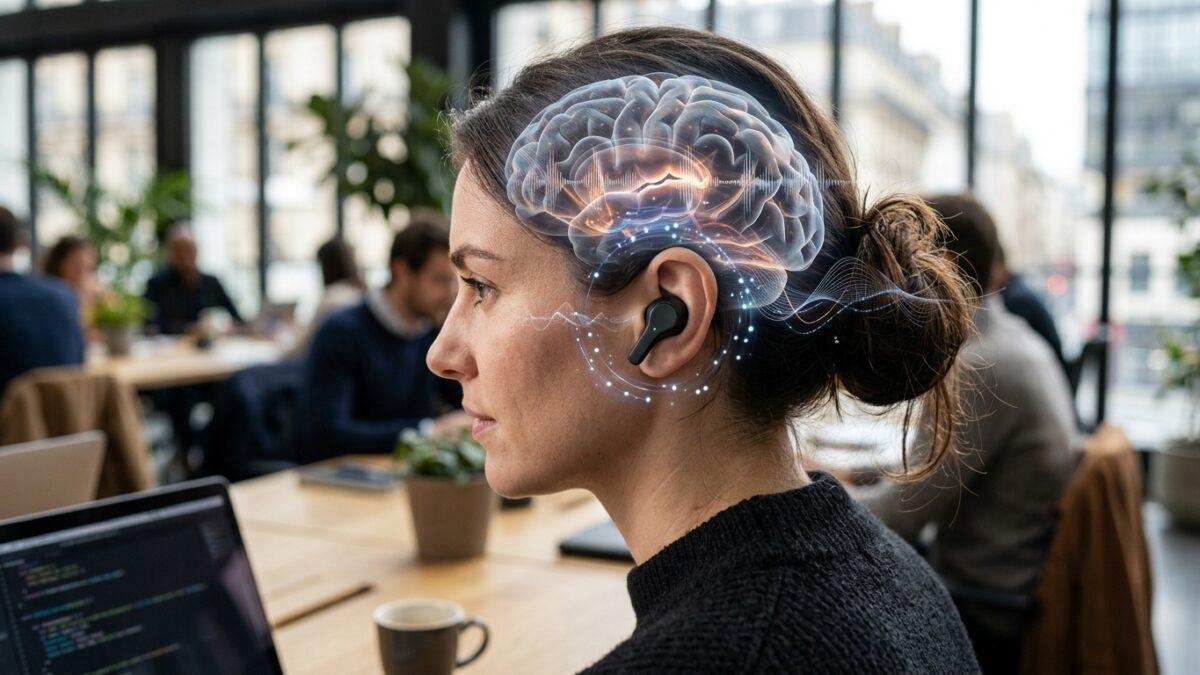
What if your headphones could signal a racing brain before you even knew it? An international team shows that by tracking tiny variations in hearing, headphones modified general public can track activity related to mental effort, the first step towards discreet monitoring of brain health.
This work, presented in 2025 at an international scientific conference, is based on earpieces equipped with a 10 mm speaker and an internal microphone which capture “otoacoustic emissions”, these tiny sounds returned by the cochlea. By connecting these signals to the cognitive loadresearchers are imagining headphones capable of sensing when the brain is failing.
How headphones become a tool for monitoring brain health
To test this idea, the team used sensors built into commercially available headphones to measure weak cochlear responses (otoacoustic emissions), which indicate excessive strain on the brain and central nervous system. They attached a 10mm speaker and a sensitive microphone to a prototype earphone and designed listening tasks to induce different levels of cognitive load. In total, 19 volunteers aged 20 to 55 wore this prototype coupled with an electroencephalography (EEG) headset.
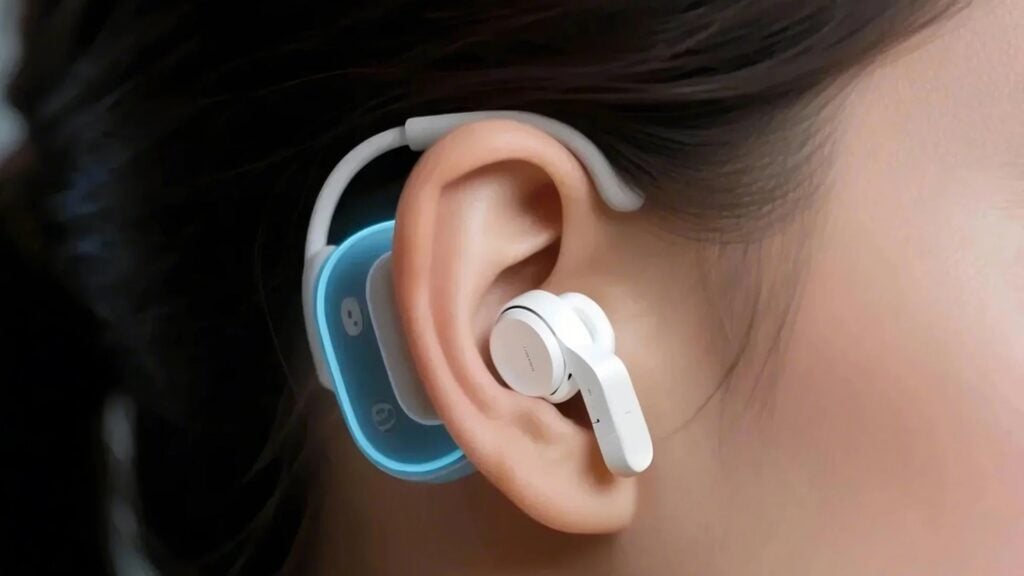 © University of Melbourne
Scientists from the University of Melbourne, University College London, Nokia Bell Labs in Cambridge and the University of Washington designed four listening tasks, from the simplest to the most demanding. The first task was to remain relaxed while a pure sound was played, serving as a reference. Then came natural noises to recognize, a voice reading numbers, finally two voices speaking at the same time in the noise. Each time, participants answered questions and researchers recorded ear and EEG signals.
An international study deciphers the cognitive load via the ear
Analyzes show that as tasks become more difficult, the strength of EEG signals increases and responses become slower and less accurate, evidence that cognitive load rises. The researchers trained an artificial intelligence model to classify these states into four levels based only on data captured by the headphones at the cochlea. The team found that increased cognitive load led to greater hearing sensitivity, with patterns varying across demographic subgroups, such as age and gender, which could provide additional opportunities for personalized monitoring.
“This work hints at a future where your headphones become personalized, real-time cognitive monitors, tailoring lessons to your mental abilities, improving productivity, helping workers manage work overload, or providing early warnings of brain health issues.”said Dr Ting Dang, senior lecturer in digital innovations at the University of Melbourne.
She thinks this is just one of the many possible applications for the headphones of tomorrow: “Ear devices could be used to reduce mental fatigue and improve efficiency, safety and overall human-machine interaction. They are quietly establishing themselves as the next big health platform, with a booming market and tech giants investing heavily in this area.”.
What applications for these headphones that track brain health?
Biologically, the team observed that increasing mental load was accompanied by significant changes in otoacoustic emissions at 1, 2 and 3 kHz. In 63.2% of participants, the maximum sensitivity was at 3 kHz. Researchers are now calling for studies on larger cohorts and with more varied sound signals.
This advance could make it possible to develop new approaches to optimize performance in fields such as education, aviation, health, user experience design or the armed forces, by detecting moments of cognitive overload or identifying individuals capable of assimilating more information.