
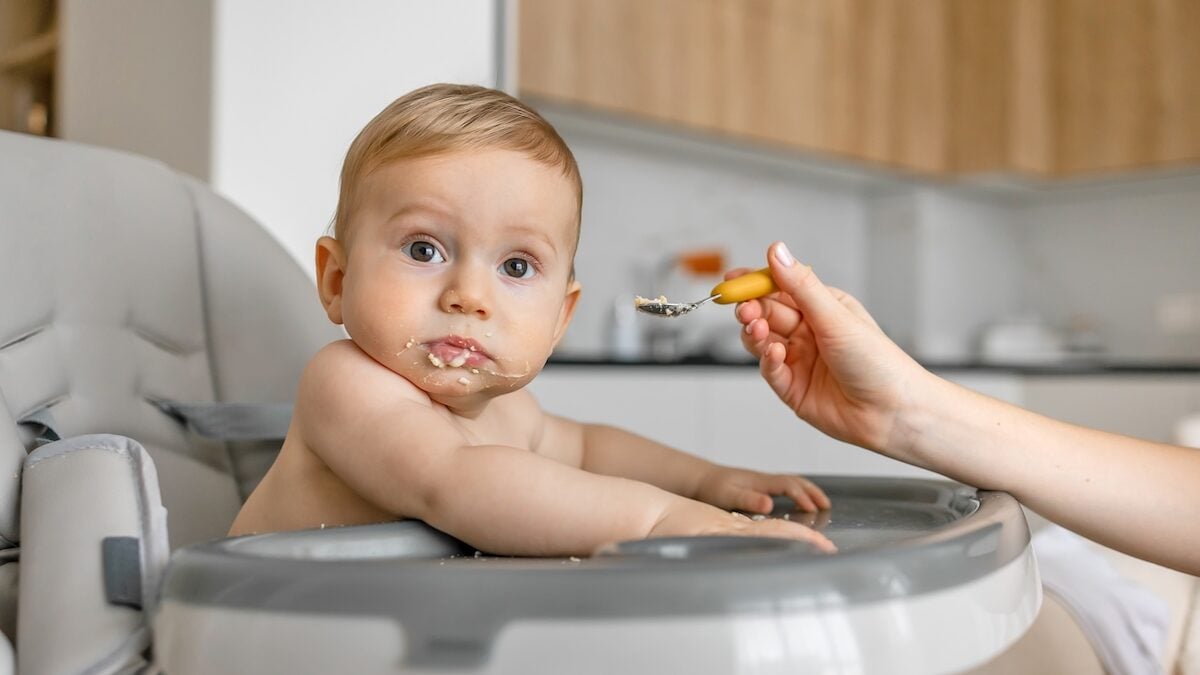
Give the best to your baby. This concern, almost universal among young parents, today comes up against a plethora of food options, attractive… but sometimes misleading. In his latest special issue, 60 Million consumers
warns of the growing place of ultra-processed foods in the diet of toddlers, sometimes offered from the age of 4 months.
Products not always as healthy as they seem
“Organic”, “no added sugar”, “rich in calcium”… Baby food packaging is full of reassuring words. However, according to the investigation carried out by 60 Million consumers out of 165 common products (small pots, compotes, dairy desserts, biscuits, etc.), 58% can be considered ultra-processed.
The categories most affected?
- Dairy desserts, almost 97% ultra-processed;
- Infant biscuits, more than 90%
“We find many markers of ultratransformation in infant food“, underlines Anthony Fardet, nutrition researcher at INRAE, quoted by the magazine. Among them: modified starches, concentrated fruit juices, flavors, emulsifiers or texture agents.
An important point to remember: ultra-processed does not mean prohibited. But these products raise questions about learning taste, dietary diversity and the habits that are built from the first months.
Baby snacks: when marketing gets carried away
Mini soufflés to grab with your fingers, “meltful” biscuits, snacks that look like baby chips… Manufacturers have clearly invested in the infant snacking niche.
Problem: out of 15 baby snacks studied, 12 are ultra-processed and present little nutritional benefit, according to 60 Million consumers. Not to mention the claims that are, to say the least, creative: “encourages autonomy”, “develops fine motor skills”… promises mainly intended to convince parents.
However, these products encourage consumption “on the go”, sometimes in a stroller or in the car, and establish the habit of snacking early. A major challenge, when we know that 84% of children already consume food outside of meals.
Water bottles: practical, but not trivial
Very popular, fruit or vegetable gourds are not necessarily ultra-processed in terms of composition. But their use raises questions.
“In terms of learning to chew, water bottles are catastrophic“, alerts Sophie Nicklaus, scientific director of Food and Health at INRAE, quoted by 60 Million consumers. Swallowed in a few seconds, they do not learn to chew or discover different textures, which are nevertheless essential between 6 and 8 months, according to the recommendations of Public Health France.
Here again, no ban, but a simple principle: vary the formats, also offer foods with a spoon, crushed, then in small pieces.
The key issue: building taste, without pressure
Babies are born with a natural attraction to sweets. To accept more bitter or more vegetal flavors, they must be exposed to them several times, sometimes up to ten times. However, ultra-processed products tend to standardize tastes, often softer and sweeter.
Possible long-term result: more selective children, less inclined to accept certain vegetables or complex flavors. Homemade purees can then be a good option, without aiming for perfection: broccoli, green beans, turnip or fennel can be introduced gradually, even in a very simple version.
How to limit ultra-processed foods… without complicating life?
Completely avoiding industrial products is often unrealistic – and unnecessary. The idea is not to be perfect, but to arbitrate when possible:
- Read the ingredient list: the shorter it is, the better;
- Be wary of ingredients “unknown to home cooking” (modified starch, flavorings, concentrated juice);
- Reserve biscuits and snacks for special occasions;
- Alternate store-bought products with homemade preparations;
- Favor varied textures rather than everything smooth.
Good news: 60 Million consumers also shows that certain brands do very well without it, particularly in savory meals, including in mass distribution.
No guilt: it’s the habits that count
The studies are clear: it is not a food that provides balance, but repetition. As Sandrine Monnery-Patris, researcher at INRAE, reminds us, “too strict parental control can have a deleterious impact“. It is better to propose, vary… and set an example.
Future health is not at stake in a bottle or a biscuit, but in a global, caring and pressure-free food environment. And that’s often already a lot.
Ultratransformation: largely absent from official recommendations
At the end of November, the government announced the upcoming publication of the National Food-Nutrition-Climate Strategy, a plan supposed to guide the French towards a healthier diet by 2030. But one point surprised many experts and associations: ultra-processed foods do not appear there as a reduction objective, even though they are raising growing concerns. This absence is particularly noteworthy since around forty international researchers recently published a vast study highlighting the deleterious effects of ultra-processed foods on health. Faced with criticism, the government finally procrastinated. Matignon indicated that the document presented had not yet been validated, suggesting that the final version could include clearer objectives on reducing ultra-processing. To be continued.