
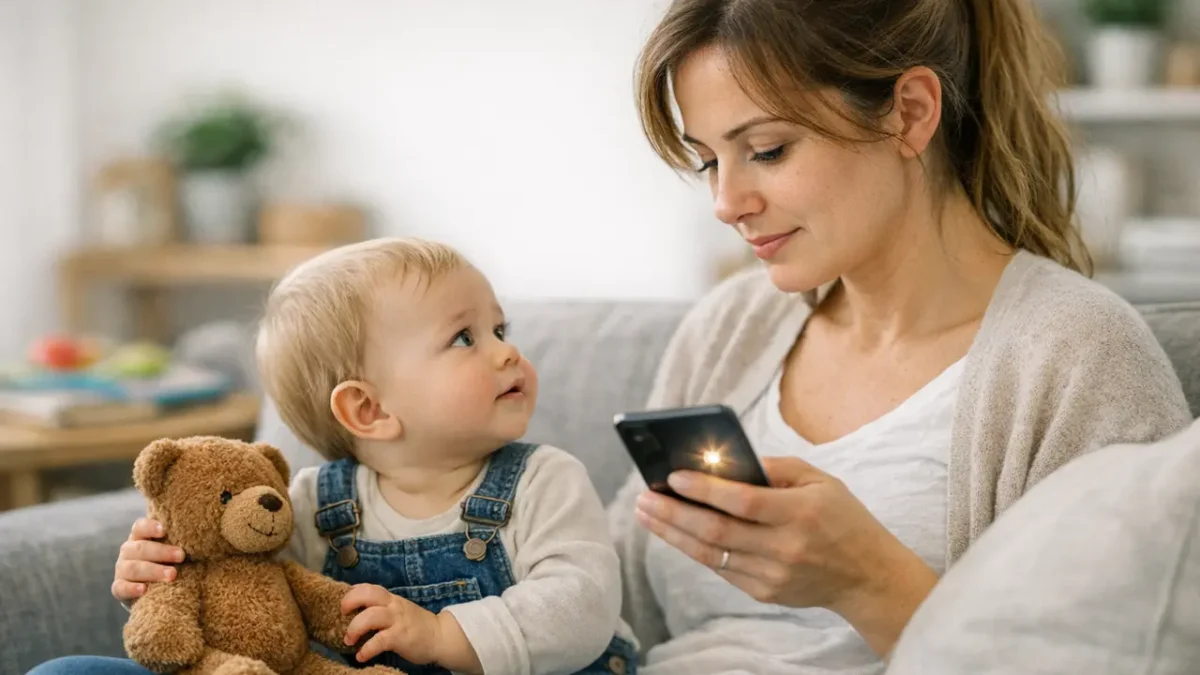
Your baby seeks your gaze. At the same time, a notification appears, and your hand goes to the phone. The scene is banal, almost automatic. Dr Gérald Kierzek puts a word on this interruption: technoference. The bottom line is not that an isolated message would create a danger, but that the parent’s telephone can, through repetition, take a place in the exchanges with the toddler.
Dr. Gérald Kierzek thus reminds us of simple advice: observe these interruptions, then arrange a few moments when the telephone remains aside. Public Health France highlights this subject in its file Growing up with screensnumber of Health in action dated July-September 2026. Important feature: here, the baby does not necessarily have a screen in front of him. It is the screen of the adult who invites himself into the relationship.
What is parental technoference?
Technoference designates the interference of digital technology in a moment of connection. For a parent, it might be an interrupted glance to read a message, a delayed response because an alert arrives, or a game paused for a few seconds to check their phone.
The problem is therefore not to demonize each use. A parent may need to answer a call, organize a day, or manage an unexpected event. What the Public Health France file invites us to look at is the repetition of these micro-cuts and the place they take in shared moments.
With a baby, communication involves much more than words. The looks, facial expressions, sounds, gestures, smiles and responses of the adult gradually build the exchange. When the phone often captures attention, it can change the parent’s availability to these cues.
Can notification harm baby’s development?
You have to keep measure. The work synthesized by Public Health France does not allow us to assert that an isolated notification causes a developmental disorder. It’s not the one-off scene that should make parents feel guiltybut the place taken by interruptions in daily life deserves to be questioned.
The reservation is important: the file brings together several research studies on parental technoference and early interactions, but it does not transform each smartphone consultation into proof of direct damage. The context matters: the frequency, the moment, the duration, but also the overall quality of the exchanges around the child.
This framing joins a broader reflection on screens in the family. True Medical has already addressed the risks linked to screens in children, but the point here is slightly different: it is also a question of looking at our own uses as adults. Another article already mentioned this daily reflex which can keep parents and children apart.
What moments to protect without putting pressure on yourself?
Dr. Gérald Kierzek’s advice is very concrete: choose a few protected moments. Not all day, not an impossible rule to follow, but simple guidelines in which the adult tries to be fully available.
- The mealeven short, can become a time without unnecessary notifications;
- The gamewhere the parent follows the child’s gestures, looks and sounds;
- The evening storywhich often offers a quiet moment of shared presence.
During these times, the phone may remain remote, in silent mode, or with some alerts muted. The idea is not to disappear from the outside world, but to reduce avoidable interruptions. What if a call needs to be taken? The suggested solution is simple: then return to the child and resume the exchange. A look, a few words, a gesture, and the thread can be reconnected. This way of doing things avoids transforming the recommendation into an unrealistic injunction.
Basically, the question posed by technoference is less “should we ban the telephone?” that “what moments do we want to preserve?”. To think about children’s screens,
let’s also start by looking at the place of our own phones.