
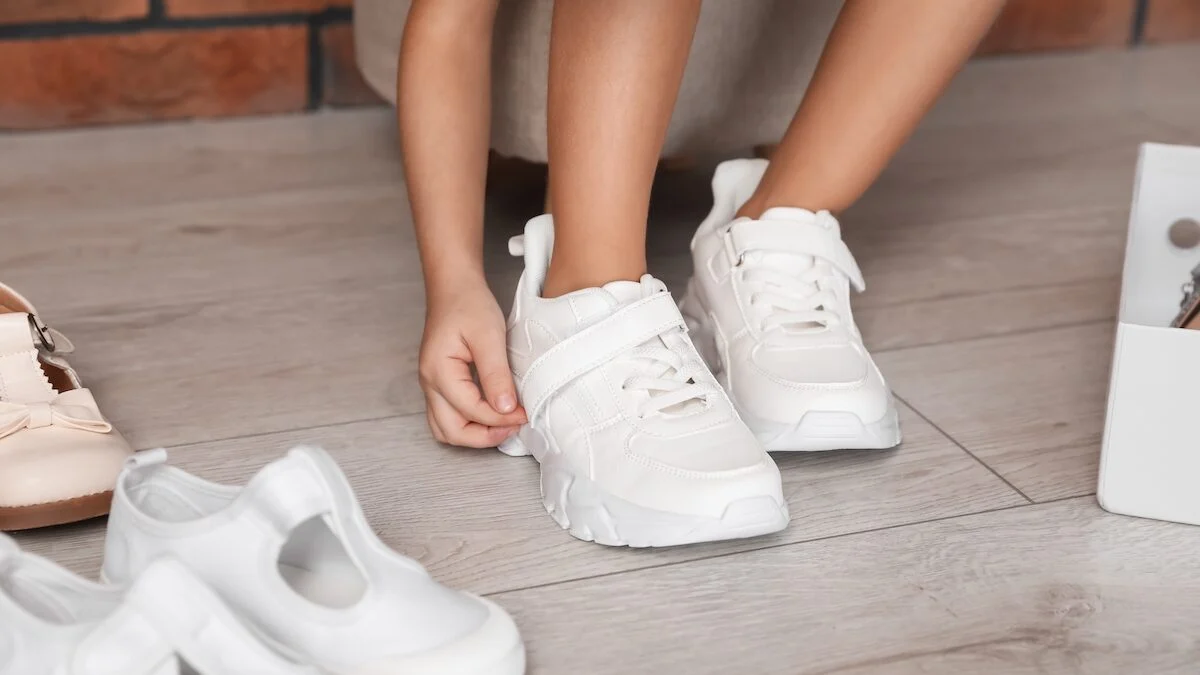
Your child wears size 30, the box says size 30… do I need to validate the purchase? Not so fast. For back-to-school shoes,
the detail to check is not just the size, but the actual space around the toes : front, on the sides, and child standing with his usual socks.
The right size is not enough: toes must have room
A shoe can be the right size and still be too short, too narrow or poorly suited to the shape of the foot. This is the central point reiterated by the rapid review of the framework published in 2025 by Liam Hughes, Mark I. Johnson, Nic Perrem and Peter Francis: there is a consensus to recommend well-fitting shoes for children, but the precise criteria are not completely standardized and are often based on expert opinions.
In practice, this vagueness does not change the re-entry reflex:
you have to check the fit on the child’s foot, not just read the size.
Sizes vary depending on brands, shoe shapes and sometimes even models. This is even more true if the purchase is made online, because the fitting can be less rigorous.
The Canadian Pediatric Society advises checking the shoe while the child is standing, with about 1.25 cm between the longest toe and the tip of the shoe, as well as a little space on either side of the toes. The review by Hughes et al. also finds variable recommendations, often around 10 to 15 mm in front of the toes. So remember a simple guideline:
aim for about 1 to 1.5 cm in front of the longest toe, without buying too big.
The control must cover several very concrete points:
- Have both shoes tried on, standingbecause the foot lengthens slightly under the weight of the body;
- Check the space in front of the longest toe, often the big toe but not always;
- Make sure the toes can move, without being compressed at the sides;
- Observe the absence of rubbing, marks or redness after a few minutes of walking;
- Choose a comfortable shoe immediately, without counting on a “break-in” period.
To prepare for the purchase, you can also regularly measure the size of your child’s feet, especially before the start of the school year or after several months with the same pair.
Width, heel, comfort: other checks to do in store
The most common trap is to add length to “make” the pair last. However, a shoe that is too big can fit poorly, cause the foot to slip and cause friction. Conversely, a shoe that is too narrow can compress the forefoot.Width therefore matters as much as lengthespecially if the child has a strong foot, a high instep or toes that touch the edges.
The American Podiatric Medical Association recommends measuring both feet before purchasing and choosing the size based on the larger foot. She also advises against betting on a shoe that “will wear” over time.
For parents, it comes down to a simple rule: if the child complains as soon as they try it on, it is not the right model.
The heel must be held, without coming out with each step. The shoe should not pinch or interfere with walking. A sufficiently flexible sole can support the natural movement of the foot, a criterion regularly cited in recommendations, even if the levels of evidence remain uneven. To go further, here are the criteria for a suitable shoe for children.
We must also avoid transforming this advice into excessive warning. Shoes that are too short or too narrow can cause discomfort, friction and stress on the forefoot, but we cannot say that they alone cause permanent deformations. Hallux valgus, for example, also depends on family and anatomical factors.
For toddlers, the choice deserves even more attention: the foot is developing and the shoe is mainly used to protect when walking outside. When taking the first steps, trying on the shoes while standing to check the position of the foot remains the most meaningful action. If the child walks less well with the pair than with his free feet, if the toes are tight or if the heel floats, it is better to try another model.