
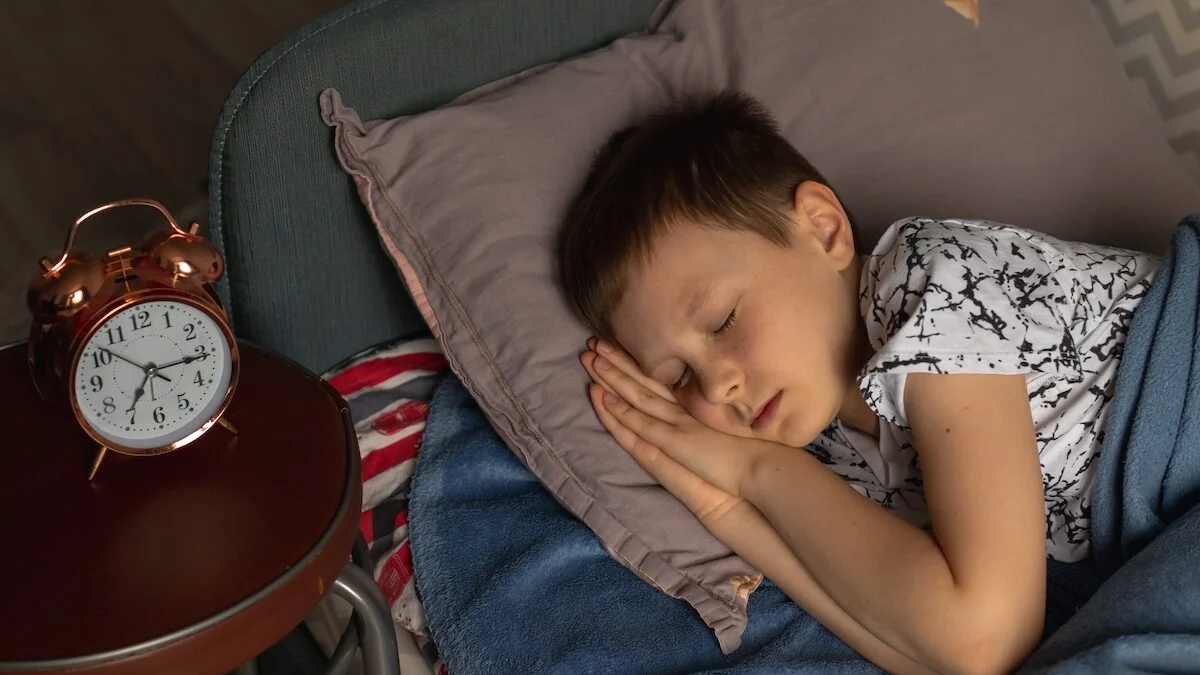
Did your child go to bed later during the holidays and the start of the school year is approaching? The answer is not a magic timetable by age: bedtime is calculated backwardsstarting from the actual school wake-up time, then adding a margin for falling asleep.
Pediatrician Dr. Gabrina Dixon of Children’s National Hospital says getting enough sleep helps children learn and function during the day. Public Health France gives the benchmarks to be used as a priority in France.
The right bedtime depends first on the time you wake up
To set a realistic time, start from the morning constraint: what time should the child get up to go to school, eat breakfast and get ready without constant running around? From there, work backwards by age.
The French markers indicate:
- 10 a.m. to 1 p.m. sleep between 3 and 5 years
; - 9 to 11 a.m. between 6 and 13 years old;
- and 9 to 10 a.m. between 14 and 17 years old.
These durations remain benchmarks: some children are naturally smaller or heavier sleepers. In kindergarten, you must also take nap time into account, because the total is counted over 24 hours.
Sleep isn’t just about avoiding yawns the next day. Public Health France highlights its role in memory, concentration, attention and mood. We cannot promise better grades thanks to going to bed earlier, but a suitable pace supports the necessary conditions for learning.
To wake up at 7 a.m., here are the times to aim for
If the child has to get up at 7 a.m., the benchmarks provide practical ranges.
- For a child ages 6 to 13, the goal is to get enough sleep between about 8 p.m. and 10 p.m.;
- For a teenager aged 14 to 17, sleep should begin around 9 p.m. to 10 p.m.
These are not bedtime orders to be applied on the fly. They assume the child is actually sleeping soon after. Better then allow for time to fall asleepespecially if summer has shifted habits.
For 3-5 year olds, the calculation is less mechanical. A child who still naps will not always need the same length of night as another of the same age who no longer naps. The benchmark remains the total day + night and the state of the child upon waking.
In adolescents, avoiding snap judgments is helpful. Going to bed late is not just a question of will: the internal clock shifts during puberty, and evening habits, particularly screens, can amplify this shift. If you want to better identify a lack of sleep in children, certain signs such as drowsiness, irritability or difficulty concentrating should be monitored over time.
Pick up the pace before the start of the school year, without arm wrestling
For the 2026 French school year, set for Tuesday, September 1, starting a few days to two weeks before can help, especially if vacation times were very late. The most effective is often to gradually reintroduce going to bed and getting up rather than changing everything the day before.
Dr. Nitun Verma, spokesperson for the American Academy of Sleep Medicine, also advises exposing the child to daylight in the morning or during the day: this signal helps the biological clock to reset. In the evening, he compares the routine to a gradual deceleration, to lighten the mental load before sleeping.
Concretely, a few simple actions can make falling asleep more predictable:
- Gradually bring forward bedtime and get up time if the pace is very different;
- Keep the sequence calm and short: shower, story, hug or reading;
- Avoid a heavy meal just before going to bed;
- Provide a screen break in the evening, ideally 1 to 2 hours before bed;
- Take your phone, tablet, console or computer out of the bedroom at night.
If the child is dreading the start of the school year, Dr Gabrina Dixon recommends finding out what is concretely worrying them: new school, fear of not meeting their friends, unknown route. A site visit or a meeting before the start can sometimes make the first day less impressive.
Occasional difficulty falling asleep around the start of the school year is common. On the other hand, a lasting sleep disorder or significant drowsiness during the day It is worth discussing it with a doctor, especially if it affects daily life. To investigate sleep disorders in children, professional advice is preferable to improvised solutions. And before giving a sleep product, it is better to find out: the use of melatonin in children must be discussed with a health professional.