
Your nails are splitting after each application of gel, but you can’t imagine giving up the manicure? Between semi-permanent, capsules or acrylic, the nail often ends up thin, soft, marked with streaks. In this context, a new product has appeared, BIAB nails, presented by professionals as a reinforcing alternative.
In institutes, this acronym is establishing itself as the star active ingredient for nails in 2026, to the point that some clients no longer swear by it to grow their natural lengths. But beyond the buzz, what is really different about this builder gel from a classic varnish or a gel placed in a pot?
BIAB nails: a builder gel in a bottle that coats the natural nail
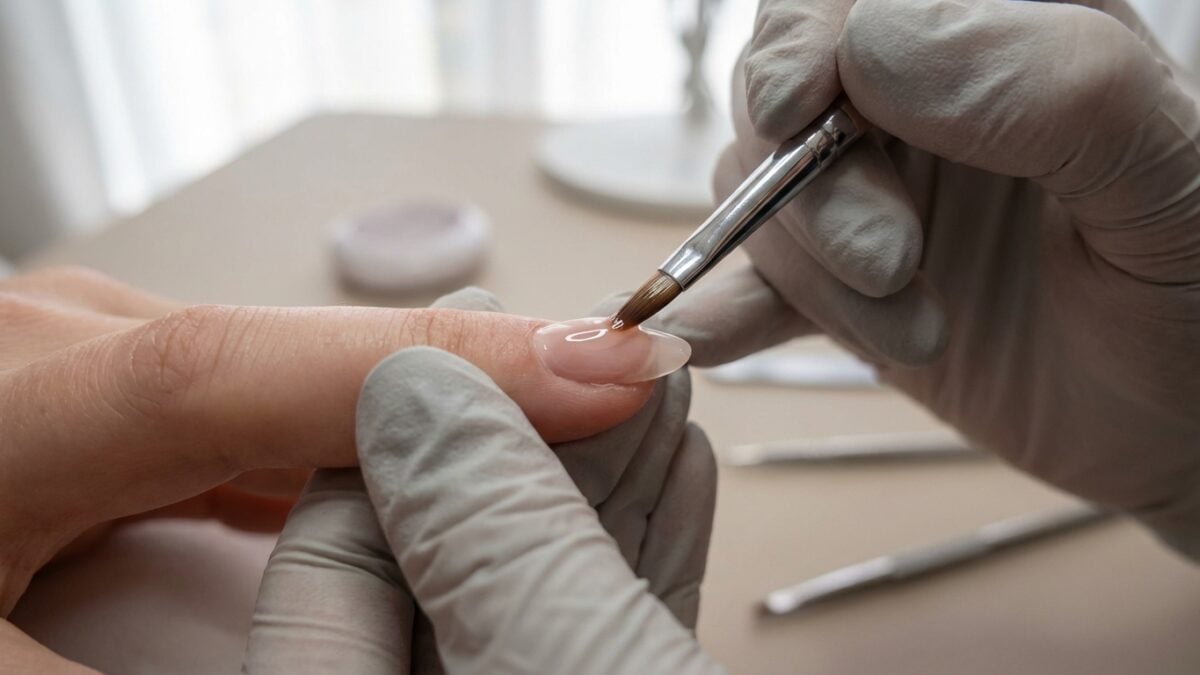
BIAB stands for Builder In A Bottle: a building gel in a bottle that is applied with a brush like a semi-permanent then hardens under a lamp. Its texture is thicker than a classic gel. For nail technician Deanna Rattanavong, this product “provides a protective layer that helps prevent excess bending or breakage of the nail“, she explains to Byrdie magazine.
Concretely, BIAB is used to build a flexible shell around the natural nail, creating a slight curve which absorbs shocks and fills irregularities. It can be worn alone for a clean nude look or as a base under color. Experts direct it especially towards fragile, thin, brittle or porous nails, to limit breakage and let the length gain little by little.
Outfit, protocol and maintenance: how the BIAB strengthens over time
Another key BIAB promise: performance. Fans report manicures that stay sharp for about 3 to 4 weeks, a length of time that varies depending on lifestyle and the initial condition of the nail. Instead of removing everything at each appointment, the technician keeps part of the structure and fills it. Over three to six months, this protocol limits repeated shocks of intensive filing and acetone.
Between two sessions, a few actions make the difference: cuticle oil, gloves for cleaning or washing dishes, avoid scratching or tearing the material. Many ranges highlight vegan, cruelty-free formulas, and especially BIAB without HEMA and without TPO, after the inclusion of the photo-initiator TPO on the European list of cosmetic ingredients banned in 2025.
BIAB nails: for whom, how much does it cost, and how it is different from a semi-permanent
The BIAB mainly targets those whose nails split, break as soon as they extend beyond the tip of the finger, or have been refined by repeated capsules and acrylics. It can also serve as a barrier to bitten nails, while remaining a cosmetic product and not a medical treatment.
Conversely, in the event of very damaged nails or a suspected allergy, professionals recommend taking a break and, if necessary, seeking medical advice. In the salon, a BIAB manicure includes gentle preparation, several coats with domed, catalysis and top coat, for an appointment of approximately 60 to 90 minutes. The service costs around €55 to €70, slightly more than a semi-permanent, in exchange for a thicker and more flexible structure designed to support the regrowth of the natural nail.