
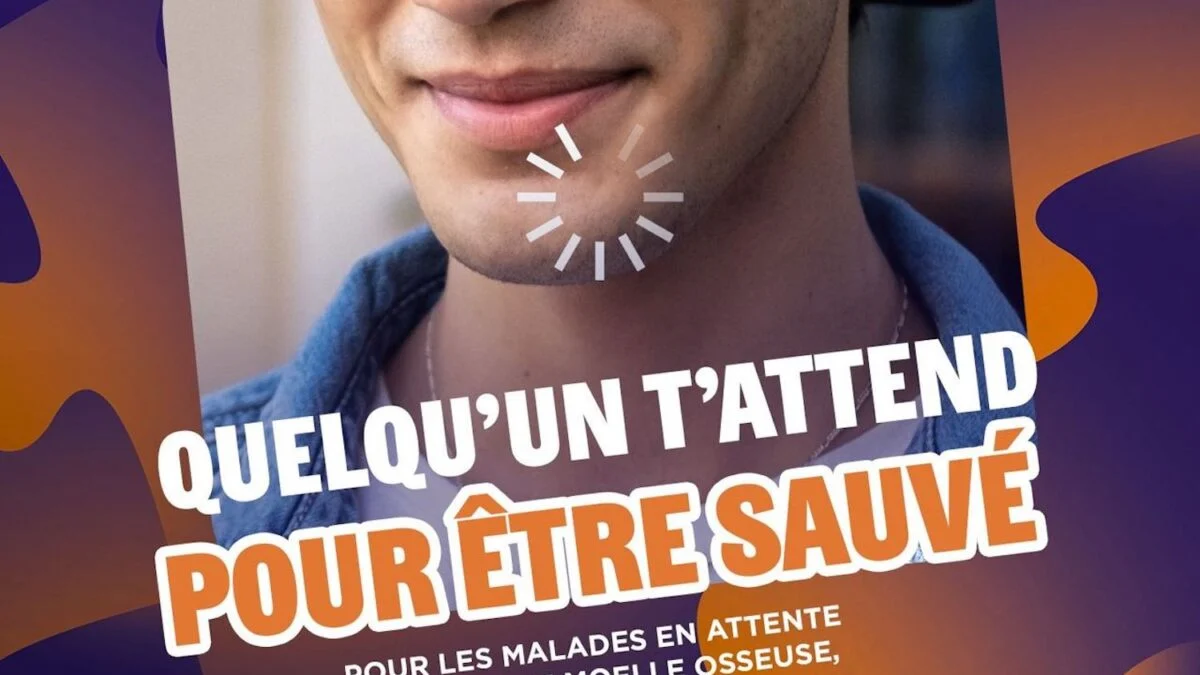
Behind the numbers, there are lives dependent on biological compatibility. Although the French registry now has more than 451,000 donors, certain origins still remain insufficiently represented. An issue that goes far beyond the sole question of bone marrow donation: it directly affects equal opportunities in the face of illness.
When a transplant can become the last hope
For a person with leukemia, aplastic anemia, sickle cell disease or another serious blood disorder, a bone marrow transplant can be much more than a treatment: sometimes it is the last chance for a cure.
The bone marrow produces the cells essential for the functioning of the blood: red blood cells, white blood cells and platelets. When it no longer functions properly, the consequences can be serious, even life-threatening.
You still have to find the right person… For a transplant to be possible, the donor must have immunological characteristics very similar to those of the patient. They are determined in particular by the HLA system, a sort of biological identity card specific to each person. HLA characteristics are partly linked to family genetic history and population migrations.
In other words, the compatible donor is sometimes compared to a “genetic twin”.
And the rarer this profile is in the registers, the more difficult the search can be.
More than 451,000 donors… but not yet enough diversity
France today has a register which continues to progress. In 2025, 34,764 new donors registered. In the first half of 2026, 33,578 additional people joined the register, an increase of 260% compared to the same period of 2025. As of June 30, 2026, 451,095 voluntary donors were registered in France.
A particularly encouraging mobilization, reinforced since the beginning of March by nearly 70,000 registration requests on the site dondemoelleosseuse.fr.
But numbers are not enough.
Because an effective registry is not measured solely by its size. It must also reflect the genetic diversity of the population. In 2025, approximately 35% of new donors contributed a new HLA phenotype to the registry. Encouraging data, which shows the importance of continuing to broaden the profiles represented.
Historically, voluntary donor registries have mainly developed in the Northern Hemisphere, where populations of European origin are in the majority. The HLA profiles encountered more frequently in people from sub-Saharan Africa, the Maghreb, Asia or Oceania, but also in people of mixed race, remain less represented.
For the patients concerned, this under-representation can have a very concrete consequence: waiting longer before finding a compatible donor.
“Registering on the register is not only a gesture of solidarity that saves lives. It also means acting against health inequalities by concretely contributing to offering each patient, whatever their history or origin, the same chances of accessing a bone marrow transplant.”underlines Dr Catherine Faucher, hematologist and director of hematopoietic stem cell collection and transplants at the Biomedicine Agency.
A rare gift, but a commitment that can last for years
Registering on the register does not mean being immediately called to give. The commitment takes place over time.
On average, the time between registration and donation is four years. Some donors will never be requested, simply because they will never be identified as compatible with a patient.
But when a compatibility appears, the process takes on its full meaning: a person who has been registered, sometimes for several years, can suddenly become the one who offers the possibility of healing to a patient they do not know.
In 2025, 2,338 patients received a bone marrow transplant in France, including 1,365 from an unrelated donor.
The donation is completely anonymous. The donor does not choose the person to whom his cells will be intended.
Bone marrow: how does the donation actually take place?
Contrary to popular belief, donating bone marrow does not necessarily mean undergoing surgery.
In approximately 80% of cases, the sample is taken from the blood, using a method comparable to donating platelets. The operation lasts between three and four hours. The donor can then read, listen to music or watch a series.
In other cases, the cells are taken directly from the pelvic bones, under anesthesia.
The Biomedicine Agency specifies that no risk of paralysis is associated with these two sampling methods.
To be able to register, you must be in perfect health and be between 18 and 35 years old. The first step consists of answering a medical questionnaire on the site dondemoelleosseuse.fr, before taking a biological sample, by saliva sample or blood test, to establish the biological profile of the future donor.
The Biomedicine Agency is particularly looking for male donors. This priority is explained by immunological factors: women can naturally develop antibodies during a pregnancy, including when it is not carried to term, which can complicate the aftermath of the transplant for the recipient. Women, however, remain fully eligible for donation, with a preference for young profiles.
Basically, the issue comes down to a simple idea: the more varied the profiles present in the registry, the more the possibility of finding the right donor increases for each person.
Behind an inscription, there is therefore no certainty of one day being called. But there is the possibility, one day, of being the person someone was waiting for without even knowing it.