
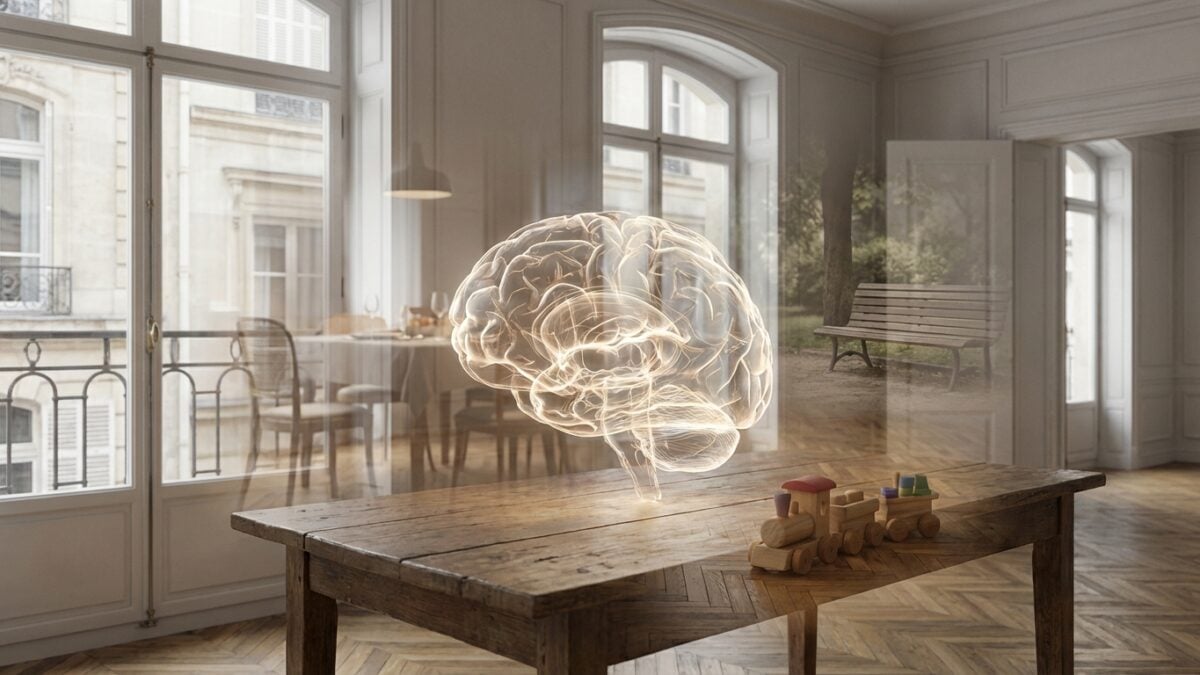
Your last birthday party comes to mind, but your sister doesn’t remember the same scene. Who is right? Neuroscience suggests that the question is poorly posed. Because our autobiographical memory does not replay an intact film, it reconstructs a story from traces scattered in the brain.
A large review conducted by the University of East Anglia on nearly 200 studies shows how this episodic memory, which allows us to relive a trip or a breakup, transforms over time. Memories remain linked to a truly experienced event, but each evocation discreetly reshapes them. Enough to understand why our memories change over time.
How the seahorse assembles our memories
This memory relies on a network of brain structures, including the hippocampus, amygdala, neocortex and prefrontal lobe. “The hippocampus is a bit like the conductor of this network.” It receives information from immediate perception, connects it to the context, to emotions, then helps store it in the long term, explains the Brain Research Foundation. When a family photo reappears, the hippocampus reactivates the visual, auditory and emotional areas used during the original scene.
Researchers describe memory “traces” that can remain silent until a cue – a smell, a place, a phrase – wakes them up. “These conscious representations of our past are typically a combination of information retrieved from the original experience, general knowledge about the world, and information relevant to the current situation,” explained Louis Renoult, in a press release from the University of East Anglia. In other words, as soon as a memory arises, it mixes an episode experienced, general culture and the present situation.
Why our memories change over the years
For Louis Renoult, “To be considered a real memory, a memory must be linked to an experienced event“, but this link does not guarantee a faithful copy. Over time, old memories go through a process of “re-encoding”: with each recall, the brain updates them. Certain details are erased, others become generalized, until they are transformed into more schematic knowledge – for example “our childhood summers at the sea” rather than a specific day. “Memories can and will change”, continues the researcher.
Forgetting plays a central role here. “A condition of the health and life of our memory: it is forgetting“, wrote Théodule Ribot, cited by the B2V Observatory of Memories. Our brain sorts information according to attention at the time it was experienced, its novelty, the associated emotion and the sleep that follows. The least useful elements disappear or are inhibited, which leaves room for a simpler and more coherent story, but also one that is further removed from the raw facts.
Between false memories and traumatic memory
When this reconstruction goes too far, it can give false memories. The B2V Observatory defines them as follows: “A false memory (distortion or memory error) is the recollection of an event which, in whole or in part, never took place, but therefore the subject “remembers” with certainty.“Imagination, associations of ideas or even leading questions can inject erroneous details into a real memory, or even fabricate a credible autobiographical episode from scratch.
Strong emotions also modulate the precision of what we remember. “The greater the emotion aroused by the smell, whether pleasant or unpleasant, the more precise the memory.” declare the researchers from the Lyon research center, cited by the Foundation for Brain Research. In post-traumatic stress disorders, this emotional hypermnesia blocks the usual distancing: the memory remains vivid, invasive, as if it refused to evolve. Between memories which smooth over time and others which remain fixed, neuroscience describes the same dynamic memory mechanism, but pushed to very different extremes.