
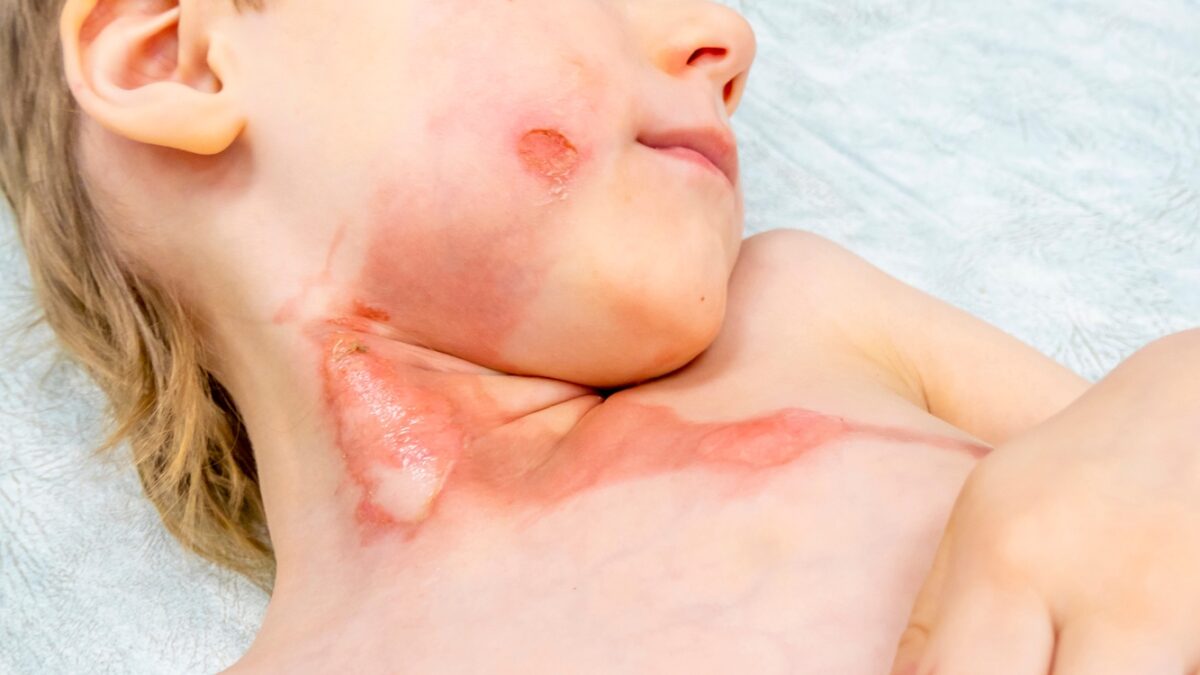
While the tragedy of Crans-Montana was a brutal reminder of the violence of these accidents, specialists are warning: the after-effects of burns still too often remain underestimated, despite major therapeutic advances.
When the burn doesn’t stop healing
Every year in France, nearly 400,000 people suffer burns. Behind this figure, an often banal reality – a domestic accident, too hot a liquid, inattention – but sometimes with irreversible consequences. Among them, around 8,000 require hospitalization. Children, who are particularly exposed, pay a heavy price for these daily accidents.
However, the story does not end when he leaves the hospital. It even begins, for many, at that moment.
“A burn almost always leaves a mark. It can lastingly transform patients’ lives.”explains Dr Sylvie Meaume, dermatologist at Rothschild Hospital (AP-HP), member of the French Society of Dermatology.
Because even when it seems moderate, a burn can lead to a cascade of consequences: visible or invisible scars, chronic pain, loss of mobility, profound alteration of self-image… So many after-effects which take hold over time and reshape daily life.
Gradually, the patient must learn to live with a modified body, sometimes stigmatized, often painful. A slow reconstruction, physical as well as psychological.
Understanding the burn: a complex injury with many faces
Not all burns are the same. Their severity depends on one key element: their depth. From simple painful redness to total destruction of the skin, each degree has a different prognosis.
The severity of a burn is mainly based on its depth, which determines both the treatment and the risk of after-effects. There are several levels:
- Superficial burns (1st degree): They result in painful erythema (like a sunburn) and generally heal within a few days without after-effects;
- Superficial 2nd degree burns: They are characterized by the presence of blisters (blisters), they remain painful and heal in one to three weeks if they are correctly taken care of;
- Deep 2nd degree burns: They are less painful but heal with difficulty and often require specialized treatment, sometimes surgical;
- Third degree burns: They destroy the entire skin, are often painless and require treatment in a specialized center, with grafts or reconstructive surgery.
Superficial burns usually heal without leaving any marks. But as soon as the deeper layers are reached, the risk of after-effects increases considerably. THE third degree burnsthey destroy all of the skin and require major interventions, such as grafts.
Contrary to popular belief, a burn scar is not fixed. It evolves, sometimes for years. It can become thick, inflammatory, retractile. The cause: complex biological mechanisms, combining chronic inflammation and excessive collagen production.
Added to this diversity is that of causes. Domestic accidents, sunburns, cosmetic procedures (laser, peels), medical treatments such as radiotherapy: dermatologists face increasingly varied situations.
“The dermatologist is often confronted with very different situations, ranging from superficial burns to much more complex, sometimes late lesions.specifies Dr Sylvie Meaume.
Some burns, particularly related to treatments, can appear years after initial exposure. Silent at first, they evolve slowly, sometimes reaching deep tissues. Their care then becomes particularly delicate.
Treat, repair, rebuild: real progress but still unevenly accessible
Faced with these complex lesions, treatment has changed considerably. Today it is based on a global approach, combining reconstructive surgery, medical devices (silicone dressings and gels or hydrocolloid dressings), pressotherapy/mechanotherapy (in collaboration with expert physical medicine and rehabilitation centers), lasers, injections and functional rehabilitation.
But one of the most significant advances lies in the emergence of skin substitutes, sometimes called “artificial skins”. These technologies make it possible to recreate, temporarily or permanently, the different layers of the skin, promoting healing and improving the aesthetic and functional appearance.
Certain recent innovations, introduced in Europe, offer better resistance to infections and speed up the treatment of severe burns. A discreet, but decisive revolution.
“These technologies change care, but require specific expertise and an adapted organization of care.”underlines Dr Sylvie Meaume.
There remains a more contrasting reality: despite this progress, many patients still feel alone in the face of their after-effects. Because burns don’t just affect the skin. They profoundly affect social, professional and intimate life.
The gaze of others, the difficulty in reclaiming one’s body, the persistent pain: so many invisible obstacles which prolong the trauma.
A silent public health emergency
The Crans-Montana drama acts as a brutal revealer. He reminds us that burns are not just one-off accidents, but chronic pathologies with lasting repercussions.
For specialists, the priorities are clear: better prevention, better training, better support. Structuring care pathways, facilitating access to innovations, finally recognizing the weight of after-effects.
“A burn is not a one-off accident. It is a pathology whose consequences can last a lifetime.”concludes Dr Sylvie Meaume.
Behind every scar, there is a story. And behind each story, a necessity: no longer reduce the burn to emergency, but recognize, finally, the long time of reconstruction.