
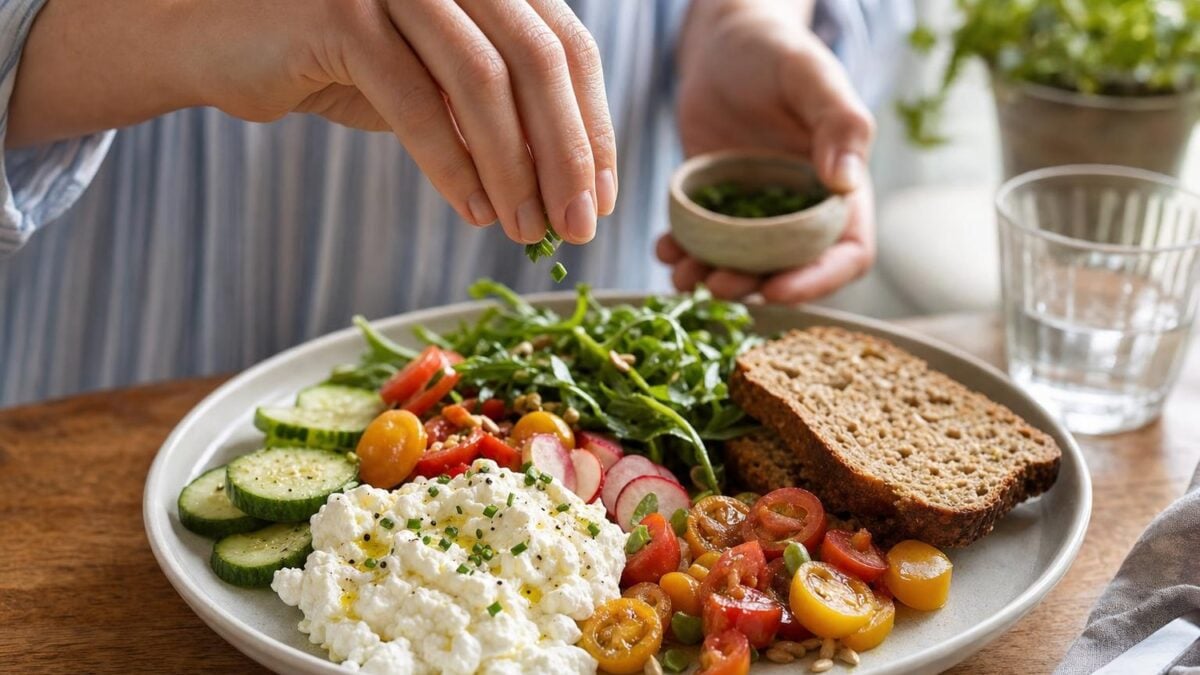
You’ve swapped Camembert for Faisselle, swapped cheese platters for creamy burratas, and stocked your fridge with ricotta and cottage cheese. On paper, the calculation seemed obvious: less fat, lighter, therefore better for the figure. However, despite these changes, the scale barely moves. A question then comes up very often: does cream cheese really make you gain weight less?
For the Spanish nutritionist doctor Magda Carlas, interviewed in the podcast Respuestas que alimentan, this belief is mainly based on a confusion between “less calorie” and “slimming food”.
“We would all like fresh cheese not to make you gain weight. It would be great if a cheese as good as this did not make you gain weight. But it’s always the same thing: the only food that does not make you gain weight in a diet is water, which does not make you lose weight either”she recalls.
Clearly, fresh cheese can be lighter than certain mature cheeses, without becoming a food without consequences for weight.
Why cream cheese seems lighter than other cheeses
Under the name “fresh cheese”, we actually find very different products: faitselle, ricotta, cottage cheese, cream cheese, mascarpone or even burrata.
Their common point is to be little or not refined and above all very rich in water. This high humidity content, often between 60 and 80%, mechanically reduces their caloric density.
The most recent nutritional data shows that a classic fresh cheese generally contains between 180 and 220 kcal per 100 g. For comparison, a traditional matured cheese is around 360 kcal for the same quantity. The gap therefore does indeed exist.
But Magda Carlas insists on an essential nuance. “Fresh cheese contains more water than mature cheese, for example, and therefore provides less energy. But that obviously doesn’t mean it doesn’t make you gain weight. If we eat the same quantity of both, fresh cheese will logically make you gain less weight..
In other words, in equal portions, fresh cheese provides less energy, but it remains caloric.
The specialist also points out that certain so-called “fresh” products are far from trivial. A generous burrata can quickly exceed 250 kcal per serving, while some cream cheese or mascarpones approach 280 kcal per 100 g. A reality often masked by their “healthy” image or their presence in recipes deemed balanced.
Calories, proteins, calcium: what really changes with cream cheese
There’s more to cream cheese than just its calories. Its nutritional composition also differs from mature cheeses. A standard fresh product generally contains between 7 and 8 g of protein per 100 g and around 17 to 20 g of fat. Some low-fat versions even fall around 110 kcal.
Other references, such as certain Burgos cheeses very popular in Spain, display nearly 15 g of protein per 100 g, while maintaining a moderate lipid content. This high protein content can promote satiety, especially when combined with fiber-rich foods.
But here again, Magda Carlas tempers the ideal image of cream cheese. According to her, its high water content makes it less concentrated in micronutrients. “It provides us with fewer vitamins and calcium than mature cheese“. Hard pasta therefore often remains richer in calcium and vitamins despite its higher caloric intake.
The question is therefore not only whether fresh cheese makes you gain weight, but above all in what quantities it is consumed and in what dietary context it fits. Because a lower-calorie product can easily become problematic when the portions explode.
Burrata, cream cheese, ricotta: mistakes that quickly add up to calories
The example of burrata perfectly sums up this nutritional trap. Many consider a tomato-burrata salad to be a light meal. However, the caloric reality can be very different.
“Thinking that a salad with a large burrata and a few tomatoes is a light meal is a misconception.”warns Magda Carlas.
The nutritionist also reminds us of a simple rule to better manage your cheese consumption: “The more fat and salt a cheese contains, the smaller the portions generally need to be.”. In practice, several dietitians recommend portions of around 30 to 40 g for the richest cheeses, two to three times a week.