
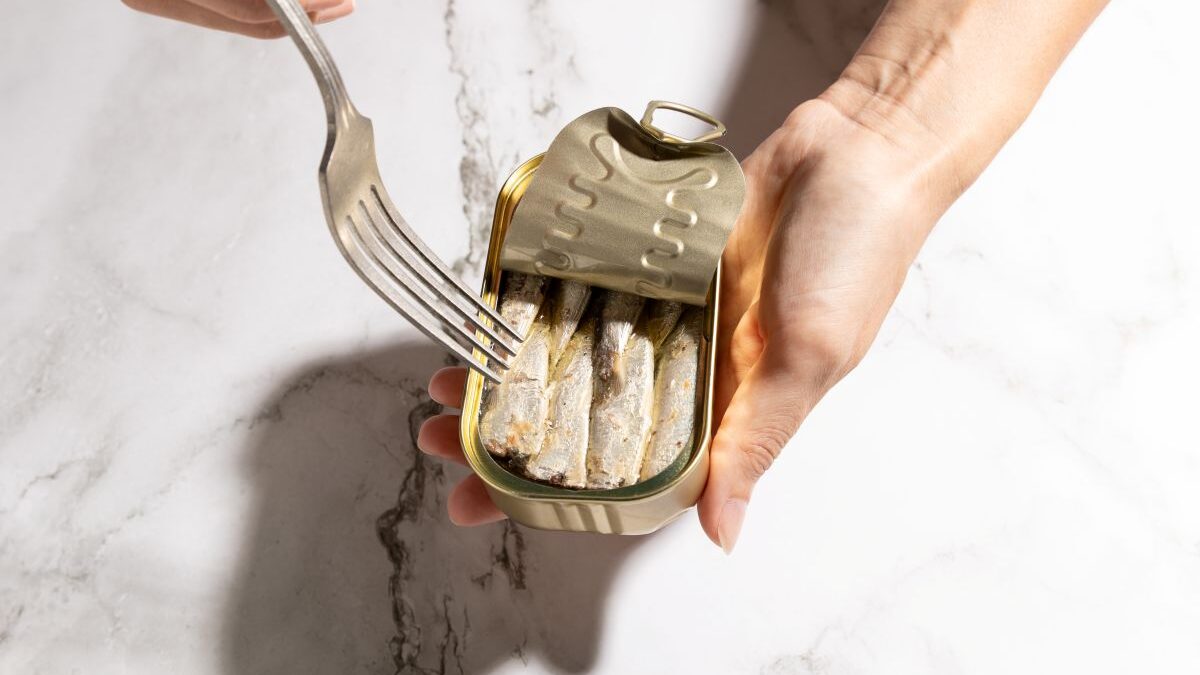
Faced with the growing popularity of sardines, the question of its optimal conservation raises many questions. Between good ideas and health risks, the margin for error can be tricky. To shed light on safe practices and maximize the virtues of this superfood, dietician Claire Trommenschlager shares her professional expertise with us.
The absolute ban on freezing a closed box
While this is a tempting tactic for storing surpluses, placing a still-sealed can directly in the freezer is a serious mistake. Under the effect of extreme negative temperatures, the liquids present inside the box undergo a phenomenon of physical expansion. This increase in volume exerts considerable internal pressure, capable of deforming the metal or weakening the packaging welds.
The Canned Food Information Center (CIEC) also points out that canned goods are stored at room temperature, maintaining their tightness and sterility sometimes for many years. Breaking this chain by freezing the steel or aluminum container exposes itself to micro-cracks invisible to the naked eye, irremediably compromising the quality and safety of the product in the open air.
The method for freezing leftovers after opening
Once the box is opened, the situation changes radically. If you do not consume the entire product, freezing becomes a valuable ally to avoid waste, provided you ban the original metal box from the storage process.
The health authorities formally insist on this point: opened food must never remain in its metal box in order to prevent any risk of oxidation and the appearance of unpleasant metallic tastes.
Dietitian Claire Trommenschlager guides us on what to do.
“For canned sardines, if you have leftovers, the ideal is to take them out of the can and put them in a small airtight container. If they are in oil or a sauce, keep this liquid well, because this will greatly help to keep them better in the refrigerator, for 24 to 48 hours maximum. You can definitely consider freezing them, but you should know that the extreme cold will alter the texture of the flesh a little.”
For successful freezing, carefully transfer the sardines and their juice into a freezer bag from which you have removed the air, or into a small, perfectly suitable airtight box.
How to cook your defrosted sardines?
While it is true that sardines tolerate freezing very well thanks to their natural richness in fat, going through the freezer slightly modifies the appearance of the flesh, which tends to become a little more crumbly after defrosting. If their visual appearance loses a little of its splendor when tasted raw on a slice of bread, their taste and nutritional qualities remain intact.
“As freezing slightly modifies the texture of the fish, we will rather use the thawed sardines in elaborate culinary preparations. They will be absolutely perfect integrated into homemade rillettes, mashed fish, quiches or even savory tarts” explains the dietician.
To preserve their taste, it is recommended to consume your sardines within two to three months. Finally, the absolute golden rule of food safety applies here as elsewhere: never refreeze a product after defrosting, otherwise it will encourage dangerous bacterial proliferation.
A nutritional treasure to preferably consume naturally
Beyond their practical aspect, sardines constitute a real nutritional pillar to be urgently included in our menus. This small blue fish at the start of the food chain has the immense advantage of being significantly less exposed to heavy metal pollution than large marine predators such as salmon or tuna.
“Sardines are small fish that are extremely rich in protein, typically averaging 20 to 25 grams per 100 grams. These macronutrients are essential for maintaining muscle mass, supporting our immune system, as well as for multiple enzymatic functions and the regeneration of our tissues, including skin and hair.”
No need to choose oil!
The expert also highlights their exceptional richness in omega-3, fatty acids essential for good cardiovascular functioning, visual acuity and brain development in children. Including fatty fish in your menu once a week is ideal, especially for young children and women in their last trimester of pregnancy.
In addition, if you eat sardines with their bones (made very soft by canning), they prove to be a major source of calcium for your bone mass, as well as vitamin D, the famous fat-soluble vitamin for the immune system. Since sardines are an oily fish by nature, the oil content in canned fish is actually superfluous.
“As it is naturally an oily fish, there is no need at all to opt for sardines bathed in oil to benefit from their virtues. My favorite advice is to choose them natural. This is more than sufficient and avoids the need for additional fat.” concludes the specialist.