
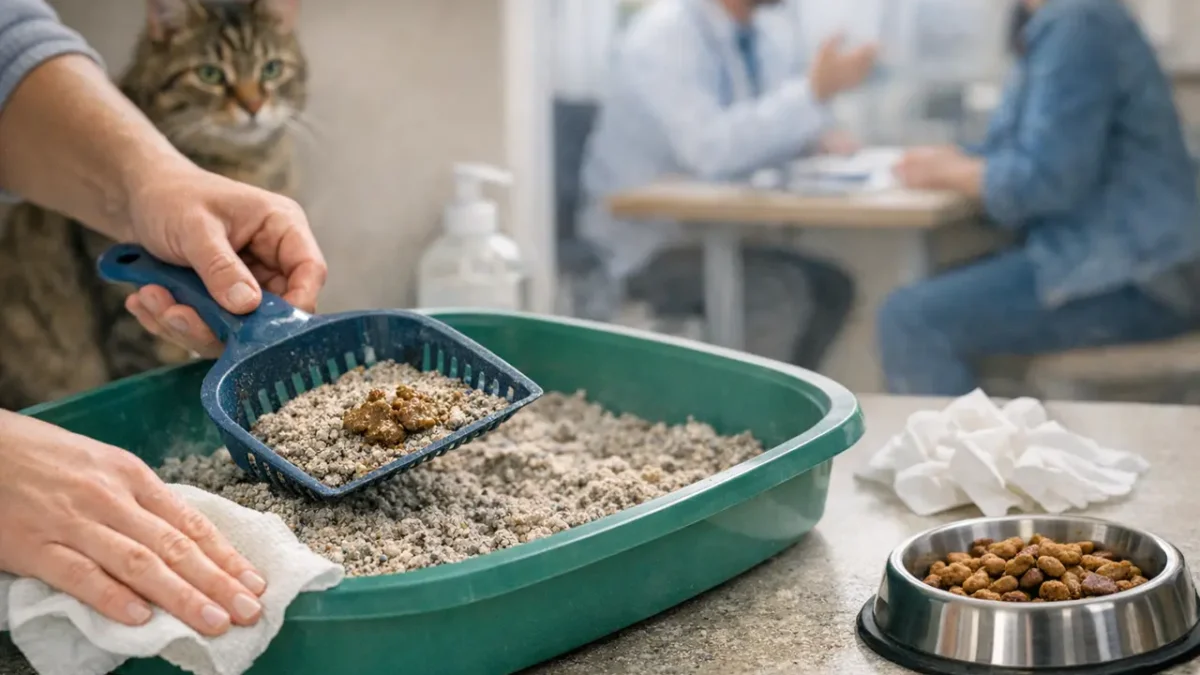
You change your cat’s litter box, then you touch a handle, your phone, or prepare dinner without thinking about it. It is in this very banal gesture that the risk mentioned here lies:
carry germs present in stool on your handsthen put them in your mouth if you do not wash your hands. A study notably sheds light on Giardia, an intestinal parasite found in some of the cat stool samples analyzed in the United States and Canada.
But the message is not to fear your animal: it is to adopt good hygiene reflexes. Even a cat that appears healthy can, in some cases, shed germs in its stool. The American health authorities, the CDC, however, point out an important point: Catching Giardia from a dog or cat remains unlikely. In other words, the litter box is not a permanent threat, but it must remain separate from actions related to eating.
What are the real risks when changing the litter box?
The mechanism to be aware of is simple: we are talking about possible fecal-oral circulation. Contaminated stools can soil the litter box, the scoop, the box, the surrounding floor, or the hands of the person cleaning up. If the hands are then brought to the mouth, or if they touch food, infection becomes theoretically possible.
Giardia is an intestinal parasite that can cause giardiasis, with digestive problems such as diarrhea, abdominal pain or nausea. In cats too, diarrhea can be a warning sign, but it can have many causes. This is why we must not conclude too quickly, nor administer treatment haphazardly.
The right attitude consists of keeping the situation in its rightful place: living with a cat does not mean living with danger. On the other hand, cleaning your litter box is not a trivial action in the same way as filling your bowl. It deserves systematic hand washing and a little method.
What does the new study show on Giardia in cats?
The study analyzed 157,616 stool samples from domestic cats sent to a commercial reference laboratory in the United States and Canada, between March 2022 and August 2023. Result:
6.3% of samples were positive for Giardia duodenalis.
The researchers then looked more precisely at the positive samples. Among them, 18.5% presented assemblages A or B, that is to say types of Giardia considered likely to also infect humans. This is an interesting point for public health, because it shows that certain parasites found in cats belong to potentially zoonotic groups.
But this result must be read with caution. The study does not follow any owner and does not demonstrate that a cat infected a human. It also concerns samples sent to a laboratory, and not a random sample of all pet cats, even less of cats living in France. We cannot therefore generalize these figures to all cats..
What actions should you take at home?
The useful tips are simple, and they are especially useful when cleaning. First, regularly remove stools from the litter box, then clean the soiled objects or surfaces: shovel, box, litter mat, floor if necessary. If your cat is being treated for Giardia or another digestive infection, ask the veterinarian about precautions to take at home.
Then, the central reflex remains hand washing. After handling the litter, stools, shovel, bin or soiled equipment, wash your hands with soap and water. This gesture is particularly important before cooking, eating or putting your hands to your mouth.
Finally, if your cat has diarrhea that persists, make an appointment with a veterinarian. Diarrhea can be linked to Giardia, but also to diet, other parasites, an infection or a digestive disease. The diagnosis makes it possible to avoid unsuitable treatments and to know whether it is necessary to reinforce certain hygiene measures at home.
The guideline to keep is therefore very concrete: you can share your daily life with your cat without considering it a threat. A good habit is to maintain a clear separation between cleaning the litter box, potentially soiled surfaces and preparing meals.