
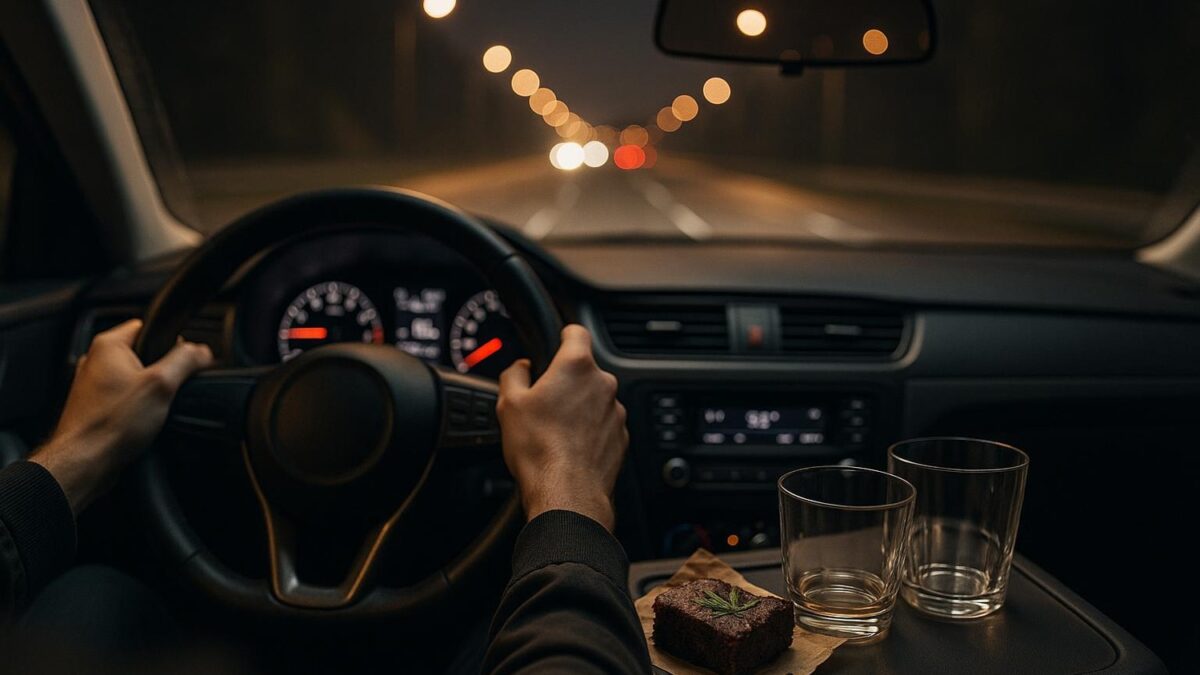
A new clinical study carried out on 25 adults implicates a seemingly banal mixture, which combines sweet cannabis with a few glasses of alcohol, and which impairs driving well beyond what the legal limits provide. According to researchers at the Johns Hopkins University School of Medicine, this combination makes the driving simulator significantly more difficult to master than with alcohol alone…
THC Brownies and Alcohol: The Johns Hopkins Controlled Trial
In this crossover trial, 25 adults aged 21 to 55 participated in seven outpatient sessions. All participants reported excessive alcohol consumption in the past 90 days, previous concurrent use of cannabis and alcohol in the past year, and limited cannabis use (less than three times per week, with at least one use in the past year) to limit the influence of tolerance. No other recent illicit drug use was noted among participants, as confirmed by urine drug testing.
At each visit, they received a brownie containing 0, 10 or 25 mg of THC or a placebo, then a drink aimed at an alcohol level in exhaled air of 0.05% (which approximately corresponds to the limit in France of 0.25 mg of alcohol per liter of exhaled air), 0.08% or 0%. Johns Hopkins Medicine researchers then measured driving on a simulator, standardized sobriety tests and perceived effects.
According to their results, alcohol alone at 0.08% produced a level of driving impairment close to that observed with 10 mg of THC combined with 0.05%, while 25 mg of THC combined with 0.05% worsened performance even more than 0.08% alcohol alone. The team specifies that the alteration appeared approximately 1.5 hours after the brownie, peaked around 3.5 hours and could persist for up to 5.5 hours. “Our results indicate that the combined use of cannabis and alcohol produces significantly greater driving impairment and subjective intoxication than either substance alone.“, explains Professor Austin Zamarripa, assistant professor of psychiatry and behavioral sciences at the Johns Hopkins University School of Medicine and lead author of the study.
A real danger that sobriety tests don’t always see
One of the most confusing points concerns the standard American road sobriety tests which did not detect exceedance before the threshold of 0.08% for alcohol. The researchers also report that after 25 mg of THC orally, the average THC blood concentration reached only 3.21 ng/mL, a value lower than the thresholds adopted in certain countries.
According to the analysis published in JAMA Network Open0.05% alcohol corresponds to approximately two to three standard drinks drunk in one to two hours. With a brownie containing 10 or 25 mg of THC, this common evening situation can therefore result in an impairment of driving equivalent to “classic” drunkenness above the legal threshold, while road tests and blood tests give misleading signals. The authors point out that “space cakes” have a slower but longer rise than smoked cannabis, which encourages the underestimation of the effects when driving again.
Towards new rules for edible cannabis and drunk driving?
In their conclusions, the authors call for a review of policies that rely solely on blood alcohol content or a THC threshold. “We designed this study because people are increasingly using alcohol with cannabis edibles, but controlled research has largely focused on smoked cannabis. This is the first controlled study to examine how cannabis edibles and alcohol interact, despite their growing combined use“, says Tory Spindle, principal investigator of the study and associate professor of psychiatry and behavioral sciences at the Johns Hopkins University School of Medicine. She and her team are pleading with her team for new tools to detect impairment and for clear information to the public about this still largely invisible risk.
It is important to note that in France, unlike some American states where cannabis is legalized, driving after consuming narcotics such as cannabis, ecstasy, cocaine, opiates or LSD is strictly prohibited. This prohibition applies regardless of the quantity of drug ingested. In addition, in the context of accompanied driving, the person who accompanies the learner driver is also subject to this ban.