
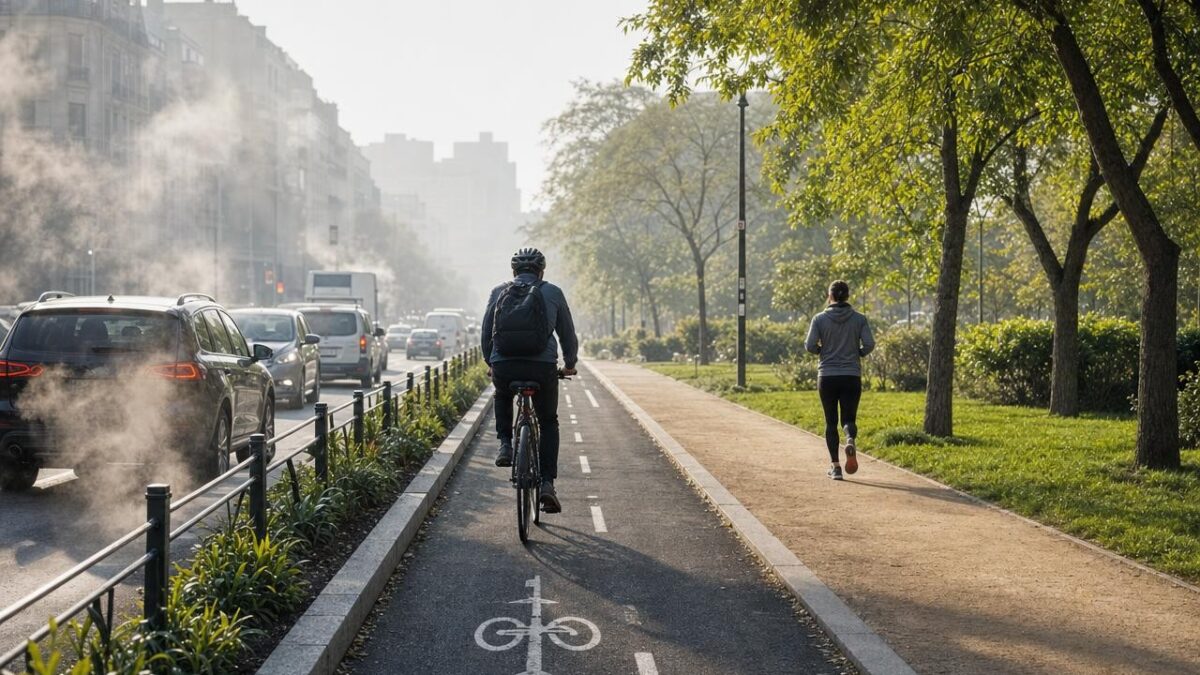
Running on a busy boulevard or cycling around town sometimes hurts the eyes, and it’s not just an impression. According to the World Health Organization (WHO), 99% of the world’s population breathes polluted air, responsible for around 6.7 million premature deaths per year. However, stopping sport is not the solution: the real question is how to limit the amount of dirty air that we inhale during each session.
In BBC News, researcher Audrey de Nazelle, from Imperial College London, summarizes: “The good news is that the benefits of exercising in polluted cities outweigh the risks“, provided you organize yourself a little. The key idea is inhaled dose : it depends on the concentration of pollutants, the time spent outside and the quantity of air inspired, which explodes during exercise. By adjusting the route, schedule and intensity, we can already significantly reduce this dose.
Why exercise increases the pollution you inhale
In the city, the air contains a cocktail of fine particles
PM2.5nitrogen dioxide (NO₂) and sometimes ozone (O₃) at ground level. These pollutants affect the heart, the lungs, but also the brain. Epidemiologist Haneen Khreis from the University of Cambridge reminds us: “When the particles are this small, they can cross the blood-brain barrier, damaging the vessels and the barrier, but also end up in your brain“.
During exercise, ventilation explodes. Airparif estimates that the quantity of air inspired can be around eight times higher during intense activity than at rest, which increases the dose of pollutants. Running or riding along a saturated axis therefore exposes a lot. And the car does not always protect: pulmonologist Rudy Sinharay emphasizes that “personal exposures when you’re cycling are actually lower than when you’re sitting in a car“, because the air stagnates there.
Itinerary and timetables: your best allies against pollution while doing sport
The simplest lever remains the journey. According to Audrey de Nazelle, moving one or two streets away from heavy traffic reduces exposure by around 20 to 30%, and traveling through secondary streets can reduce it by 50%. The American Thoracic Society (ATS) notes that pollutant levels drop significantly within a few hundred meters of major roads. Avoiding “canyon streets” lined with tall buildings also helps, because the fumes get stuck there.
Timing matters almost as much. APPA (Act to improve air quality) advises avoiding rush hourtypically 7:30 a.m.–9 a.m. and 5 p.m.–6:30 p.m., where traffic jams create real “pollution clusters”. In summer, ozone forms especially on very sunny afternoons; the City of Paris and Health Canada therefore recommend favoring the morning or the evening, or even a shaded park rather than a boulevard in full sun.
What to do on days when the air is really bad for exercising
Before leaving, a look at the Atmo France type clues helps you decide. It is possible to do outdoor sports when the air quality index (ATMO index) is good or average, but it is advisable to reduce or avoid intense efforts in the event of heavy pollution. Here are the recommendations according to the ATMO index:
- Good to Average (1 to 5): You can continue your usual physical activities outside. Although the volume of air inhaled increases during exercise, the benefits of sport to counter a sedentary lifestyle outweigh the risks;
- Degraded to Bad (6 to 8): Reduce the intensity of your sessions. Avoid intense efforts and opt for a moderate pace;
- Very bad to Execrable (9 to 10): It is strongly recommended to avoid strenuous physical activity outdoors or to postpone training indoors.