
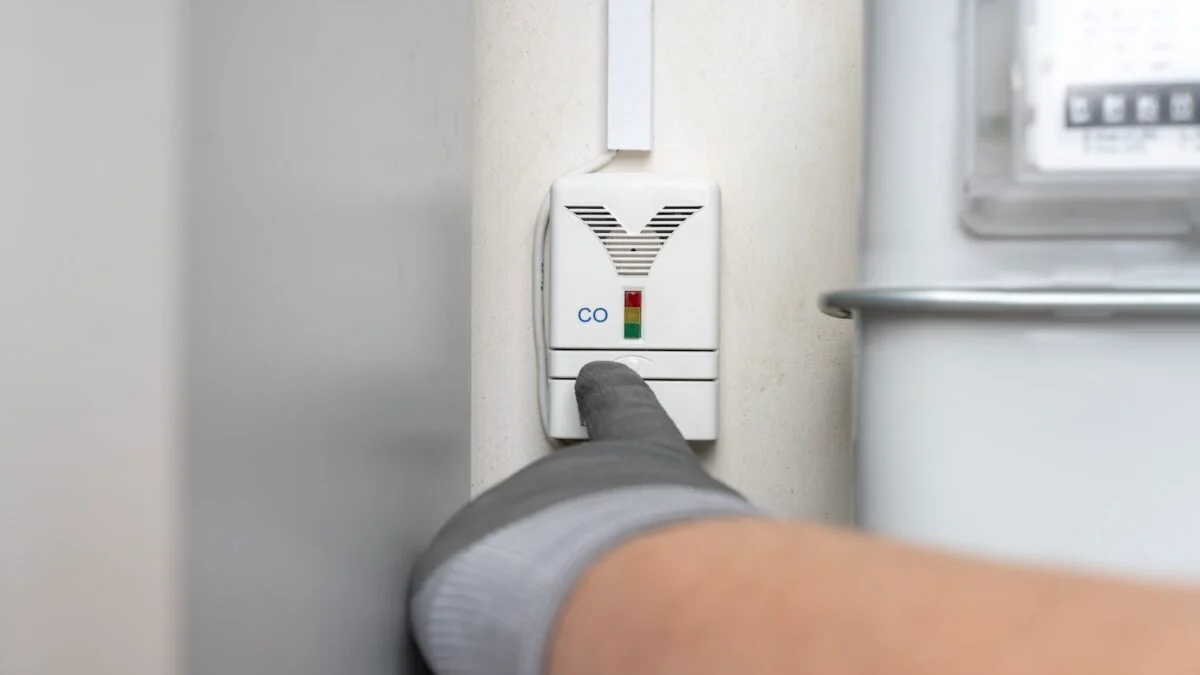
To better prevent these accidents, the National Health Safety Agency (ANSES) was interested in a device that is still rarely found in French homes: the autonomous carbon monoxide warning detector. In a study published on November 23, 2026, the agency highlights an encouraging result: when the device is triggered, the poisonings seem significantly less serious.
An invisible gas that turns the home into a trap
Carbon monoxide (CO) has a formidable characteristic: unlike smoke or an odorous gas leak, there is nothing to identify it with the naked eye or by smell. It forms during incomplete combustion, particularly when heating or hot water production devices malfunction or smoke evacuation is defective.
Boilers, water heaters, fireplaces, auxiliary heaters, braziers or generators can thus become sources of poisoning. And the phenomenon particularly concerns housing. In its analysis of reports received by poison control centers in 2023, ANSES identified 714 carbon monoxide exposure events. Nearly 90% occurred at home, mainly due to malfunctioning boilers or water heaters.
The consequences can be misleading at first. Headaches, dizziness, unusual fatigue, nausea or vomiting are the first possible signs. In the most severe situations, poisoning can lead to convulsions, coma and death. Of the events studied, 85% caused symptoms in at least one exposed person. Sixteen people died as a result of their poisoning.
It is precisely this difficulty in detecting the danger early enough that makes the system studied by ANSES particularly interesting.
ANSES figures show the interest of the detector
To measure the benefit of this equipment, the researchers compared the severity of poisonings depending on the presence of a detector and its possible triggering. The results are particularly telling.
- When the detector was triggered, 34.3% of those exposed showed no symptomscompared to only 7.3% in the absence of a detector.
- The difference also appears for poisonings of average severity: they represented 9.3% of situations when the alarm had sounded, compared to 29.1% without a detector.
- Even more encouraging, ANSES observed no serious cases or deaths in situations where the detector was triggered. In the absence of a detector, these events represented 6.7% of the poisonings studied.
How can this gap be explained? The audible alarm would allow occupants to become aware of the danger more quickly, to leave the premises and to seek help before exposure causes more serious consequences.
Dr Gérald Kierzek, medical director of True Medical, explains how this device works:
“The carbon monoxide detector works mainly on an electrochemical principle. It contains an electrochemical cell which reacts to contact with CO in the air by varying an electric current. When a dangerous threshold is reached, it triggers a powerful audible alarm to alert the occupants of the accommodation..
A device which can therefore play a valuable role, especially during the night, when the occupants are sleeping and cannot spot the first symptoms. But ANSES provides an important nuance: a detector is not an absolute guarantee against intoxication.
In 17 events studied, exposure to carbon monoxide was confirmed even though the alarm was not triggered. Poor installation, lack of maintenance or a defective device could explain these malfunctions.
You must therefore know how to choose your detector and, above all, not place blind trust in it.
Where to install the detector and how to avoid errors?
First essential point: the carbon monoxide detector should not be confused with the smoke detector. The two devices do not perform the same function. “Sometimes some devices detect both smoke and carbon monoxide, but this is rare“, specifies Dr Gérald Kierzek in True Medical.
Its location is also decisive. The doctor recommends fixing it to the wall, near sources of combustion, especially in the kitchen, living room or bedrooms, at a breathing height, generally between 1 and 2 meters from the floor.
ANSES also insists on this point: unlike smoke detectors, which are placed at height, carbon monoxide detectors must be installed at individual height.
A few precautions then make it possible to preserve their effectiveness:
- Test the device regularly, ideally once a week, using the button provided for this purpose;
- Check the batteries or battery and replace them if necessary;
- Respect the lifespan indicated by the manufacturer, generally 5 to 10 years;
- Choose a model that complies with European standard NF EN 50291-1.
Dr Kierzek recommends in particular choosing devices certified to comply with European standards in order to guarantee their reliability.
However, even an efficient detector does not dispense with fundamental preventive measures. Anses reminds that heating and hot water production installations must be maintained every year, as well as flues swept. It is also essential to ventilate your home for at least ten minutes a day, even in winter, and to never obstruct the ventilation systems.
Finally, auxiliary heaters must not operate for more than two consecutive hours. Cooking appliances should never be used to heat a room. As for braziers, barbecues and generators, they should never be used in an enclosed space.
And if an alarm sounds, or if several occupants experience headaches, nausea or dizziness, you don’t have to wait. Open doors and windows immediately if this can be done without putting yourself in danger, turn off combustion appliances if possible, then evacuate the home. Then call the emergency services at 15 or 18. Do not return to the premises without professional advice.
The installation of carbon monoxide detectors is currently not compulsory in France. However, a bill aimed at making this equipment compulsory was tabled in the National Assembly in October 2024. It remains awaiting discussion.
While awaiting a possible change in the regulations, the ANSES results provide an additional argument in favor of this equipment. A small device does not replace either the maintenance of the installations or daily vigilance. But in a home where danger is invisible, being alerted in time can make all the difference.