
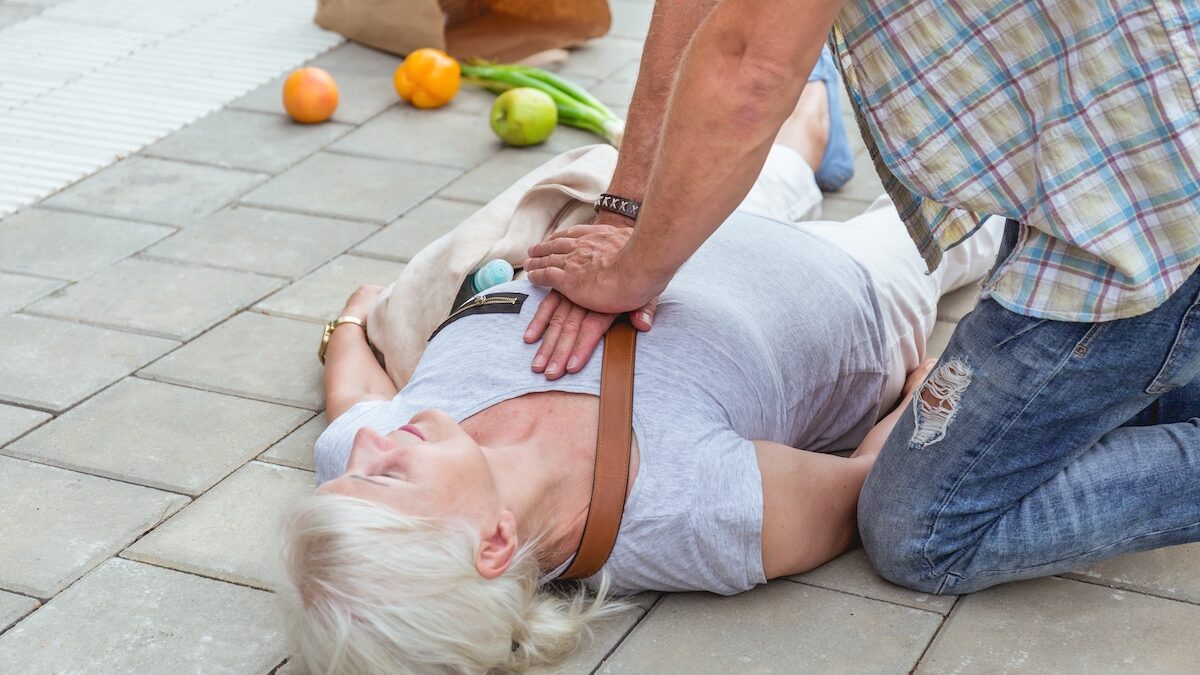
A person collapses. She’s not breathing anymore. In these decisive seconds, there is only one priority: act. However, when it comes to a woman, certain gestures are delayed. A moment of hesitation, sometimes imperceptible, but with dramatic consequences. Because in a cardiac arrest, every minute lost drastically reduces the chances of survival.
A vital public health issue
In France, 50,000 people suffer from cardiac arrest each year. And the observation is implacable: only 8% survive. A figure all the more striking since experts estimate that this rate could triple if witnesses adopted the right reflexes.
The French Federation of Cardiology has made this emergency a central axis of its 2026 campaign: to massively disseminate life-saving actions. Because contrary to popular belief, cardiac arrest often strikes without warning, including in people with no known pathology.
Recognizing cardiac arrest: a step that is still poorly mastered
Before even acting, we must recognize the situation. However, according to an Ifop survey, 67% of French people misidentify the signs.
However, they are unequivocal:
- An unconscious person;
- Who doesn’t respond;
- And who no longer breathes.
In this case, there is no doubt: action must be taken immediately.
In this scenario, three actions must be carried out without delay:
- Call 15 to alert the emergency services, who will guide the actions.
- Start cardiac massage
by placing the victim on the back and compressing the sternum at the rate of Staying Alive of the Bee Gees. - Use a defibrillator if a device is available nearby.
Doing nothing is the worst possible choice, recalls the Federation. Even imperfect, cardiac massage can save a life.
Chest modesty: the blockage that threatens women
But here again, we are not equal in the face of danger. A study carried out on more than 40,000 cases shows that 68% of men receive cardiac massage, compared to only 61% of women. Figures which reveal a disturbing reality: women are rescued less often than men in the event of cardiac arrest, particularly in public spaces.
This phenomenon has a name: chest modesty. It refers to the hesitation to touch a woman’s breast, even when her life is at stake.
Dr Gérald Kierzek, emergency physician, details the mechanisms at work:
“There are 4 reasons why the chest can potentially bring down the statistics in cardiac massage by a witness” :
- First of all, yes there can be modesty, therefore. “For a man on the ground to be rescued, all you have to do is open his shirt. For a woman, there are the chest, the bra, the clasps, which can give the witness the feeling of violating something.”
- Additionally, people trained in cardiac massage have learned on a breastless mannequin, which is the generalized form, even if it is a female mannequin.
- The benchmarks can also change: we learn that cardiac massage is done in the center of a virtual line drawn between the two nipples. However, this line can be different if it is a large chest or a small chest.
- Finally, the volume itself can also prevent a witness from properly massaging the victim.
These elements show that the problem is not only cultural, but also educational and technical.
Train differently to save more
The lack of realistic representations in training is now being singled out. Most of the models used remain modeled on male body types.
To try to correct this bias, an initiative emerged: in June 2022, a Swedish nurse designed a mannequin with breasts, allowing training in conditions closer to reality.
A promising step forward… but still marginal. This type of tool is not yet widespread in training, leaving a gap between learning and reality to persist.
Overcoming taboos can save lives
Behind chest modesty, several psychological obstacles remain:
- The fear of hurting;
- The fear of a gesture perceived as inappropriate;
- The gaze of others;
- Or even uncertainty about the female body.
But it is essential to remember one thing: cardiac massage is not an intimate or gendered gesture. This is a vital gesture for everyone.
It can be done without removing clothing, as long as it is not too thick. It’s not about touching, it’s about saving.
“Chest modesty is an invisible barrier, but its consequences are very real. It reveals a blind spot in our society: even in the face of death, certain social reflexes persist. Changing them is an emergency. Training more, representing all bodies, freeing speech: so many levers for changing behavior” indicates the Federation.
Want to train? Find on the website of the French Federation of Cardiology, the Cardiology Association or the nearest Heart and Health Club to benefit from a free initiation to learn life-saving actions.