

For four years, researchers from Inserm, CNRS and Université Paris-Saclay followed more than 600 adolescents to understand how violence experienced in childhood influences brain development. Their results reveal persistent changes, associated with greater psychological vulnerability. New proof that protecting children also means protecting their future health.
When invisible wounds continue to speak in the brain
Some injuries cannot be seen. They do not always leave marks on the skin, but they can profoundly disrupt a child’s construction.
Child abuse includes physical, sexual and emotional violence, but also emotional or physical neglect experienced before the age of 18. According to the World Health Organization, six out of ten children under the age of 5 worldwide, or around 400 million children, regularly experience corporal punishment or psychological violence.
For several years, researchers have known that these traumatic experiences increase the risk of developing certain psychiatric disorders, such as depression or behavioral disorders. But one question remained open: how does this violence influence the brain over time?
A French team today provides an important answer: certain brain changes observed in young victims of abuse seem to persist throughout adolescence.
A brain still under construction, but already marked by trauma
To understand these mechanisms, researchers from Inserm, CNRS, Université Paris-Saclay and ENS Paris-Saclay analyzed data from the large European Imagen cohort.
Their study, published in the journal European Psychiatryfollowed 634 adolescent volunteers between 14 and 18 years old. Among them, 105 had declared having suffered violence during their childhood.
The researchers used magnetic resonance imaging (MRI) to observe their brains at two key times: at 14 years old and then at 18 years old.
They were particularly interested in the limbic system, a set of brain structures involved in memory, learning, emotion management and stress response.
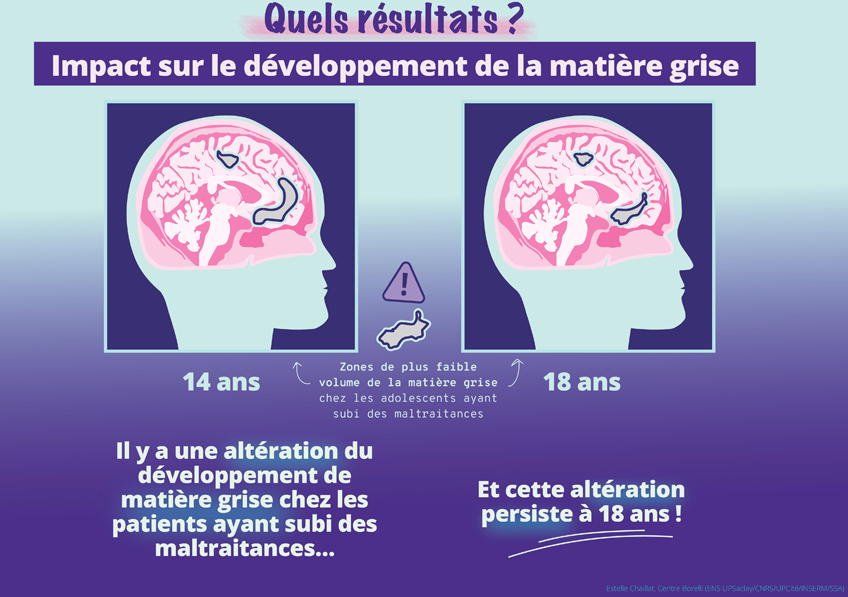
The results are striking: adolescents who had experienced maltreatment had a lower gray matter volume in several regions of this system, compared to adolescents who had not reported such experiences.
Importantly, these differences did not seem to disappear over time.
Between 14 and 18 years, the evolution of gray matter volume was similar in the two groups. In other words, the differences observed at the start of adolescence were still present four years later.
 © Estelle Chaillat, Borelli Center
Behind the images of the brain, lives and psychological fragilities
These results do not mean that young victims are “doomed” by their history. The brain remains an organ capable of evolution and adaptation. But this study shows that early trauma can influence certain mechanisms linked to emotions and stress.
Adolescents who reported abuse also showed more signs associated with depression at ages 14 and 18. At age 18, they had a higher risk of post-traumatic stress disorder (PTSD).
They also reported more emotional and behavioral difficulties: attention problems, symptoms of hyperactivity, more complicated relationships with others or even a lower level of prosocial behavior, that is to say attitudes aimed at helping or supporting others.
These observations are particularly important because the brain regions concerned have already been associated with several psychological disorders, including depression, difficulty feeling pleasure or post-traumatic stress.
Researchers therefore put forward the idea that brain changes linked to violence suffered during childhood could contribute to greater vulnerability to certain disorders.
Understanding to better protect: prevention as a collective emergency
This study constitutes, according to its authors, the largest longitudinal research carried out to date on “brain scars” in adolescent victims of childhood abuse.
But its objective is not only to measure the consequences of trauma. It is also to help better identify young people who need appropriate support.
“This is the largest longitudinal study conducted to date on “brain scars” in adolescent victims of childhood abuse. These results highlight the need to evaluate new prevention and support strategies targeted to at-risk adolescents who have been victims of mistreatment. In other words, prevention efforts should focus on young people with warning signs of risk to their mental or physical health.explains Jean-Luc Martinot, Inserm research director, co-last author of this publication.
Behind the scientific data, the message is profoundly human: a childhood marked by violence can leave an imprint, but this imprint is not inevitable. Better understanding these mechanisms makes it possible to imagine earlier, more adapted and more protective treatments. Because identifying invisible wounds is already starting to repair.