
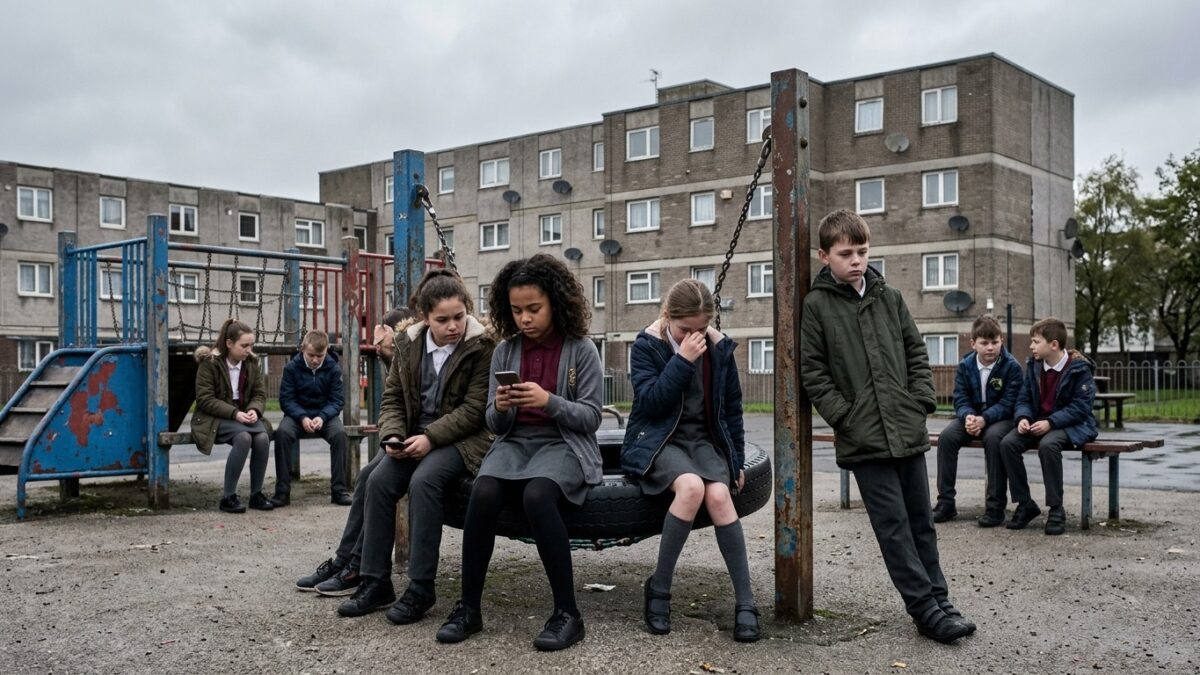
The UK’s children are growing up in one of the richest economies on the planet, but the latest international figures tell a different story. A new global dashboard on child well-being, led by UNICEF and several research organizations, reveals a sudden decline in the country, both materially and psychologically.
In the Innocenti report Report Card 19the UK ranks only 21st out of 36 rich countries for the overall well-being of minors, and 27th for mental health. THE
Good Childhood Report 2024 goes further: 25.2% of young British people aged 15 say they are dissatisfied with their life, compared to 16.6% on the European average. How did a rich country get to this point?
Child well-being: a rich country in sharp decline according to data
The UNICEF ranking is based on 43 OECD and European Union countries and assesses three dimensions: mental well-being, physical health and academic skills. The Netherlands, Denmark and France come out on top. UNICEF has also observed, since the Covid-19 pandemic, a decline in life satisfaction among adolescents, an increase in overweight and learning delays estimated at between seven and twelve months.
For the United Kingdom, the signals are particularly red: adolescents there are among the last in the rich world for life satisfaction, almost on a par with Chile, with only Turkey doing worse. In the clinical field, NHS England estimates that in 2023 a quarter of 17-19 year olds presented a probable mental health disorder, compared to around one in ten six years previously, which reflects rapid distress.
Mental health crisis, poverty, screens: what children are experiencing
THE Good Childhood Report 2024led by the association The Children’s Society, also describes strong economic pressure. Among 15-year-olds in the UK, 11% say they skip meals due to lack of money, and almost half say they give up activities or outings with friends for financial reasons. This material deprivation fuels a feeling of exclusion and undermines self-esteem from middle school.
School is seen as another source of stress: 14.3% of young people surveyed say they are dissatisfied with their school experience, with one of the highest rates of harassment in Europe. THE World Happiness Report 2026
finally points to the intensive use of social networks: 15-year-old girls who spend more than five hours there per day report the lowest levels of well-being, while those who stay for less than an hour do significantly better.
Why this alert also concerns France
France appears in third position in the UNICEF ranking, behind the Netherlands and Denmark, which may be reassuring at first glance. But the same report describes a clear deterioration since the pandemic: decline in life satisfaction among adolescents, rise in bullying and increase in overweight, against a backdrop of school delays and the cost of living crisis which also affects French families.