
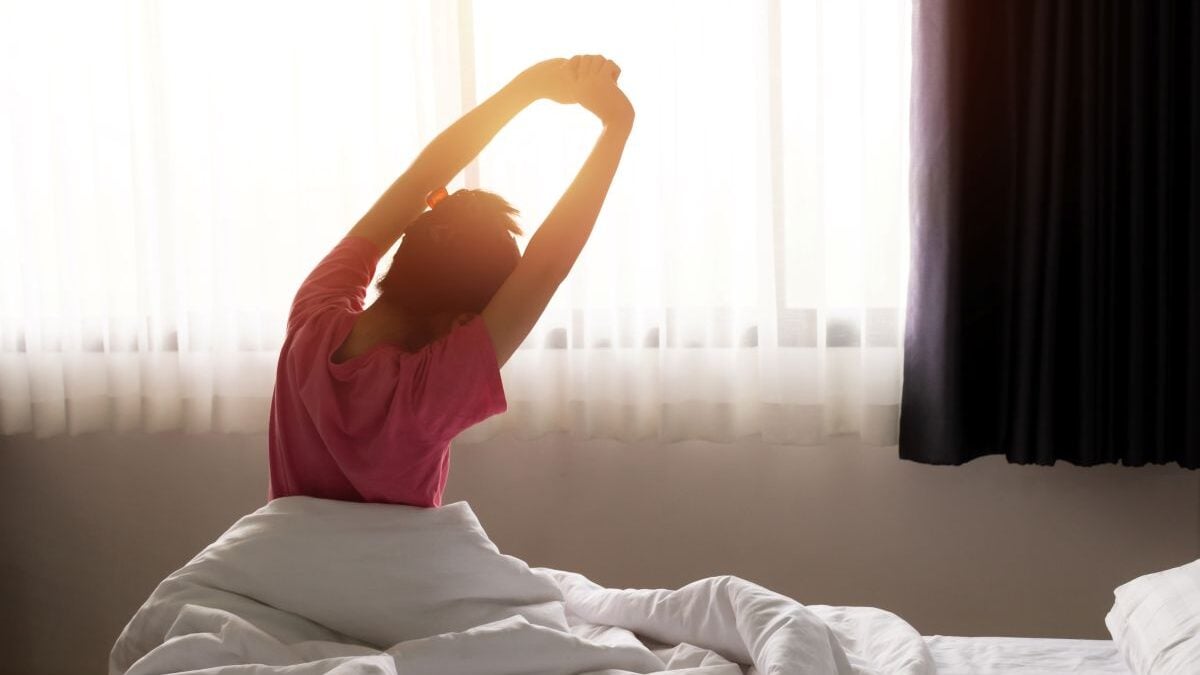
Are you leaping from bed before dawn, in great shape, but do you collapse as soon as nightfall? Or, on the contrary, you only manage to think clearly when everyone is sleeping, even if it means dreading the waking up in the morning? These rhythm differences translate what specialists call chronotype.
What is chronotype?
A chronotype corresponds to the natural inclination of the body to wake up and fall asleep at certain times. UCLA Health specifies that “Your 24 -hour daily cycle can coincide or not with sunrise and sunset, depending on the hour at which your body wishes to wake up and fall asleep. So your chronotype determines your moments of concentration, physical performance and creativity.“”
Melatonin, sleep hormone, plays a key role. “”Some genes associated with the circadian rhythm govern the time at which we naturally feel the desire to go to bed or that of getting up. This explains why some families have more or less birds in the morning or night “, underlines Julie Carrier, professor in the Department of Psychology at the University of Montreal.
“But our basic clock remains the same: a nightlife at 20 will continue to sleep late at 70, simply a little later than before”, specifies the specialist.
Dr. Breus test to identify your profile
The chronotype is therefore not a simple trait of character, but a real biological signature, influenced by our genes, our age and even the light that surrounds us.
To identify it, Dr. Michael Breus, psychologist and sleep expert, designed the “bio-time quiz (BTQ)”, published in his work when? Make your chronobiological revolution (Belfond, 2017). From hundreds of studies on sleep, Michael Breus identified four main profiles. This test combines each profile with an animal and allows you to adapt its daily habits.
- Bears (40 % of the population): wedged on the sun, more productive from 11 a.m. to 6 p.m.;
- Wolves (30 %): real night owls, effective in the evening and night;
- Lions (15 %): active at dawn, but tired around 9 p.m.;
- Dolphins (15 %): light and unstable sleep, often subject to insomnia.
“Listen to yourself and discover the mammal that is in you!” he sums up. Because, according to him, “There is an ideal moment for everything “and” science is categorical: if you listen to your internal clock, your life will improve notably“.
When the chronotype comes up against the social world
In a company settled on office hours and schools that start early, the Talit-Tard often undergo a “social gap”. Julie Carrier reminds us: “The challenge, especially for night birds, is to find a balance between their biology and their obligations.“”
The chronic lack of sleep that is the result can alter memory, concentration and, in the long term, be associated with more depression or anxiety. For their part, for their part, see their vigilance fall if their schedule forces them to watch late.
Can you adjust your chronotype?
If it is registered in our biology, the chronotype can be modulated by certain behaviors. Julie Carrier explains that “Exposing themselves to natural light in the morning helps night birds to advance their pace, while an evening exhibition allows the uptime to repel sleep asleep. “
The UCLA Health also advises to plan its activities at peak performance moments: physical exercise, meetings, or even social life. These adjustments do not erase the chronotype, but make it possible to reduce the gap with social hours.