
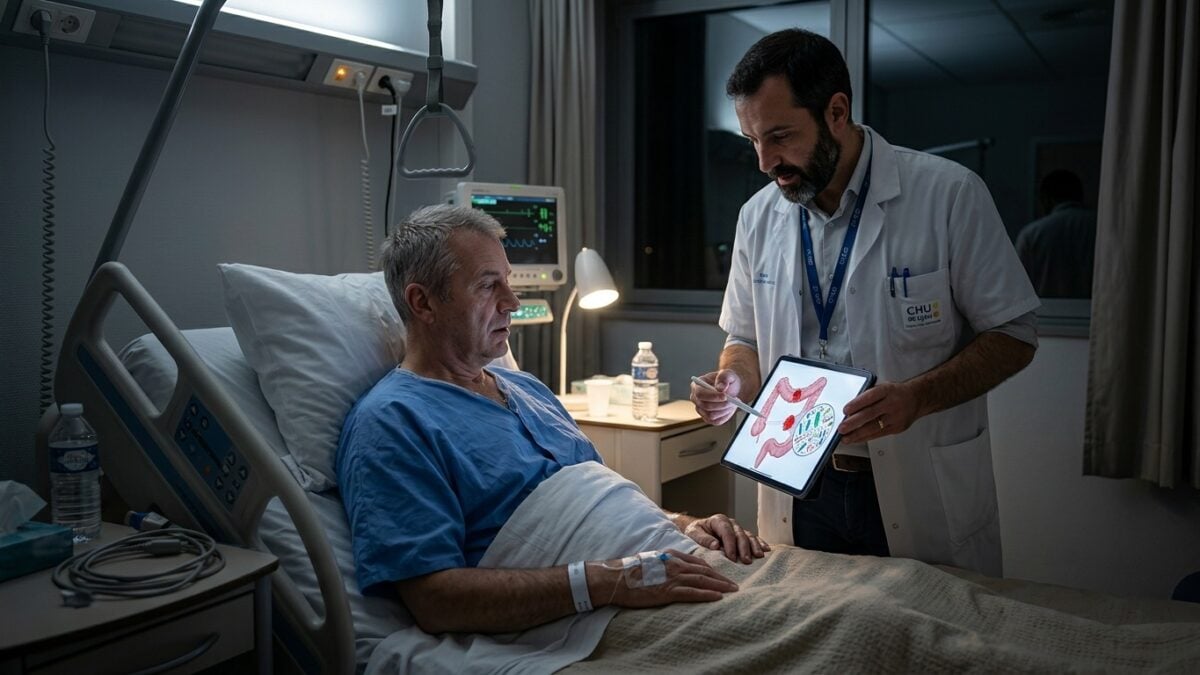
And if your shortened nights secretly influenced the evolution of a
colorectal cancer ? Researchers at the UF Health Cancer Institute show that the lack of sleep not only tires the body: it modifies the intestinal flora, disrupts immunity and makes tumors more difficult to treat.
This cancer is one of the most common, and it has become the deadliest among people under 50 in the United States. However, sleep disorders are omnipresent among patients. “Lack of sleep is very common in cancer patients, but it is often neglected in their care, and molecular evidence associating it with disease progression was lacking.“, explains Maria Hernandez, doctoral student in Christian Jobin’s laboratory, who presented the study on April 20 at the 2026 annual congress of the American Association for Cancer Research in San Diego. In the intestine, everything happens in silence.
Lack of sleep and intestinal microbiota: what new studies show
THE intestinal microbiota brings together billions of bacteria which constantly communicate with the immune system. The team of Maria Hernandez and Christian Jobin used mice subjected to chronic sleep deprivation. The stools from these animals were then transplanted into healthy mice devoid of flora, in order to isolate the role of the microbiota. Researchers tracked colorectal tumor growth and response to 5-FU chemotherapyreference treatment.
The results are striking: sleep-deprived mice have larger tumors, less effective chemo, and fewer immune cells capable of attacking cancer, while circadian clock genes are disrupted. “Lack of sleep modifies the composition of the microbiota and, moreover, we believe that it alters the behavior of bacteria“, describes Maria Hernandez. “We demonstrated that these changes have functional effects on cancer progression and anticancer therapies. Something is happening to the microbiome that leads to a reduction in the effectiveness of treatments“When this altered microbiota is transferred to healthy mice, the same problems appear.
From lack of sleep to the progression of colorectal cancer
This dysbiosis caused by
lack of sleep is not limited to a simple change in the list of bacteria. Researchers are observing a decline in cytotoxic T lymphocytes and NK cells, two key sentinels against tumors, and increased resistance to 5-FU. The internal biological clock goes awry, just like that of bacteria, which promotes chronic inflammation conducive to the progression of cancer.
In humans, a 2019 study from Nova Southeastern University in Florida, conducted on 40 young men followed for 30 days, goes in the same direction: those who slept well had a more diverse flora, while poor sleep had lower diversity. “Sleep is in a way the ‘Swiss army knife of health’. Good sleep can improve health, while a lack of sleep can have harmful effects“, summarized Jaime Tartar, director of research at the NSU College of Psychology and co-author of the study published in PLOS One. Other work in patients with colorectal cancer also finds links between sleep quality and the composition of the colon flora.
Can we protect the intestinal microbiota of patients with colorectal cancer?
For Christian Jobin, Gatorade professor emeritus of medicine at the University of Florida School of Medicine, the good news is that the microbiota remains adjustable by lifestyle. “We know so much about the microbiome that it is essential to start taking care of it, treating it with respect.
As your mother said, it is important to sleep well and eat well. We understand this holistically, but we now know that it could be through the microbiome. It could be a lifestyle factor.”. His team is exploring ways to rebalance this flora, for example by restoring “good bacteria” or by developing drugs derived from molecules produced by the microbiota, capable of strengthening the effect of anti-cancer treatments.
In practice, researchers advocate integrating sleep into patient monitoring: collecting nighttime data in the same way that we already monitor weight or blood pressure, then relating them to the evolution of the microbiota. Ultimately, the objective is to design targeted strategies, ranging from simple adjustments to sleep hygiene to medicinal or probiotic approaches, to correct dysbiosis linked to lack of rest and limit the progression of colorectal cancer while supporting the effectiveness of 5‑FU.