
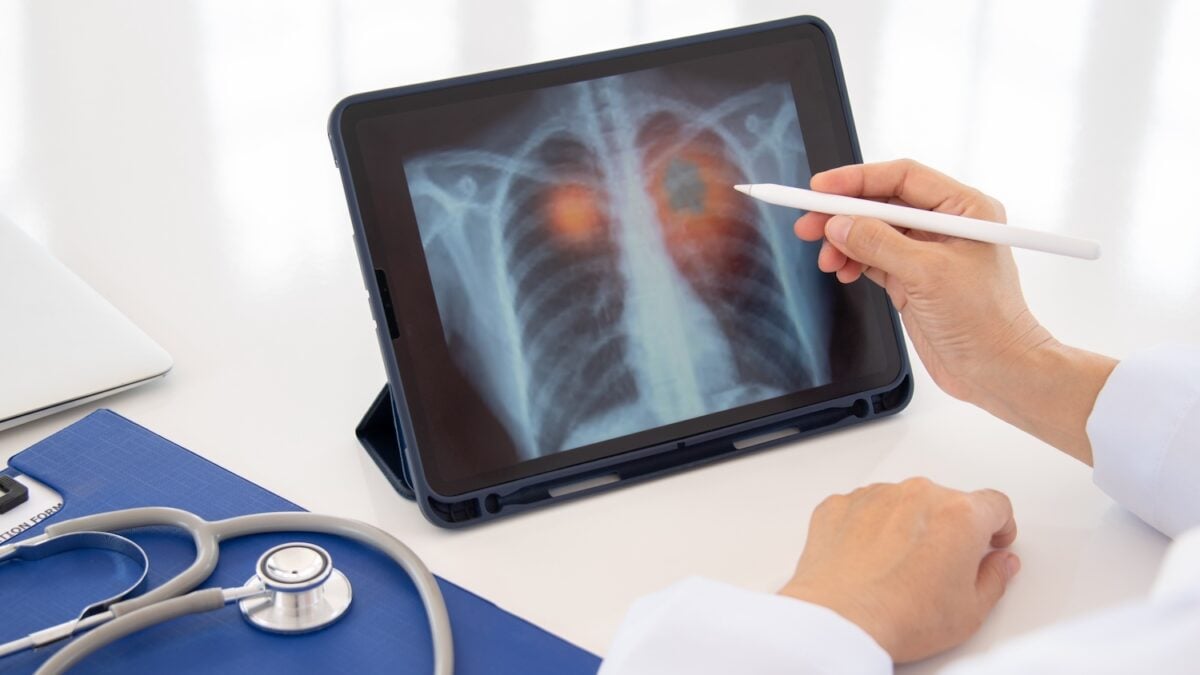
Since the pandemic, a new concern has emerged: could infection with SARS-CoV-2, years later, increase the risk of
lung cancer ? American and Israeli teams analyzed medical records, lung tissue and animal models to evaluate this possible “delay effect” of the virus.
Their results, published in Frontiers in Immunology
and other reviews, all point in the same direction: the
Covid-19 would leave in certain patients a more inflammatory, more scarred lung, therefore more conducive to the formation of tumors. It remains to be measured the real extent of this additional risk, especially for smokers.
Covid, tobacco and lung cancer: a modest but measurable additional risk
In the international TriNetX database, the study compared more than 166,000 people cured of Covid-19 to similar never-infected controls. It finds a relative increase of around 22% in the risk of lung cancer (hazard ratio 1.50), particularly marked among smokers
current, while no excess appears for cancers of the mouth or bladder.
In practice, the increase remains low in absolute value: among smokers, 1.7% of people who had Covid developed a lung cancercompared to 1.4% among those not infected; among non-smokers, 0.21% versus 0.18%. “Our results suggest that COVID-19 could have more significant effects than just the onset of acute illness: it could also create biological conditions in the lungs that could increase long-term cancer risk.,” said Prof. Wei Li, Ph.D., professor of biomedical sciences at the Joan C. Edwards School of Medicine and co-senior author of the study.Understanding these mechanisms is essential to continue our research into the long-term health effects of the virus.“.
And as the researchers point out in their study, the key question was whether the virus itself, and more particularly its spike protein, could create the conditions conducive to the development of cancer.
In the lungs, an inflammatory cascade conducive to tumors
Clinicians note that after an infection, almost a quarter of patients present with pulmonary fibrosis at three months, another 14% at one year. These deep scars already increase, in normal times, the risk of
lung cancer. The study shows that the Spike protein activates an enzyme, thymidine phosphorylase (TYMP), which fuels inflammation, promotes micro-clots, fibrosis and signaling pathways linked to lung tumors. The researchers found that this interaction could activate STAT3, a signaling pathway well known to promote cancer. This metabolic pathway drives processes associated with cancer growth and alters the lung immune environment, which could promote tumor formation.
In mice expressing the human ACE2 receptor, injection of Spike into the trachea, followed by a carcinogen, caused tumors in 50% of the lung lobes, compared to 10% in the control group; in the absence of TYMP, this rate fell to 18%.
These results reveal a potential domino effect: Spike protein → lung injury → TYMP activation → STAT3 signaling → fibrosis and immune remodeling → tumor development
In conclusion, this study reveals that TYMP constitutes a key point by which the Spike protein of the Covid virus promotes lung damage, fibrosis and the development of cancer. By identifying TYMP as both a biomarker and effector of the pathology induced by the Spike protein, these results open new therapeutic perspectives and highlight the urgency of assessing the risk of cancer in people convalescing from COVID-19, particularly for people with existing risk factors such as smoking.
Who should especially be wary of the risk of lung cancer after Covid?
Another team, at the University of Virginia, found in 75.9 million adults an excess of approximately 24% of lung cancers after severe forms of Covid-19while no additional risk appeared after mild forms.
The data converges: the excess risk remains modest for each individual, but it mainly concerns already fragile profiles, in particular smokers and ex-smokers who have suffered a severe form of Covid-19sometimes with persistent fibrosis. For them, researchers recommend increased attention to respiratory symptoms and more vigilant reading of chest scans. Conversely for this last study, in non-smokers who had a mild infection, no clear increase in the risk of lung cancer was demonstrated at this stage.
If individual risk remains low, this work sends a clear message: Covid-19 could act as an aggravating factor among already vulnerable profiles. For smokers and patients who have suffered from severe forms, vigilance is now required in the long term, between reinforced medical monitoring and increased attention to respiratory signals.