
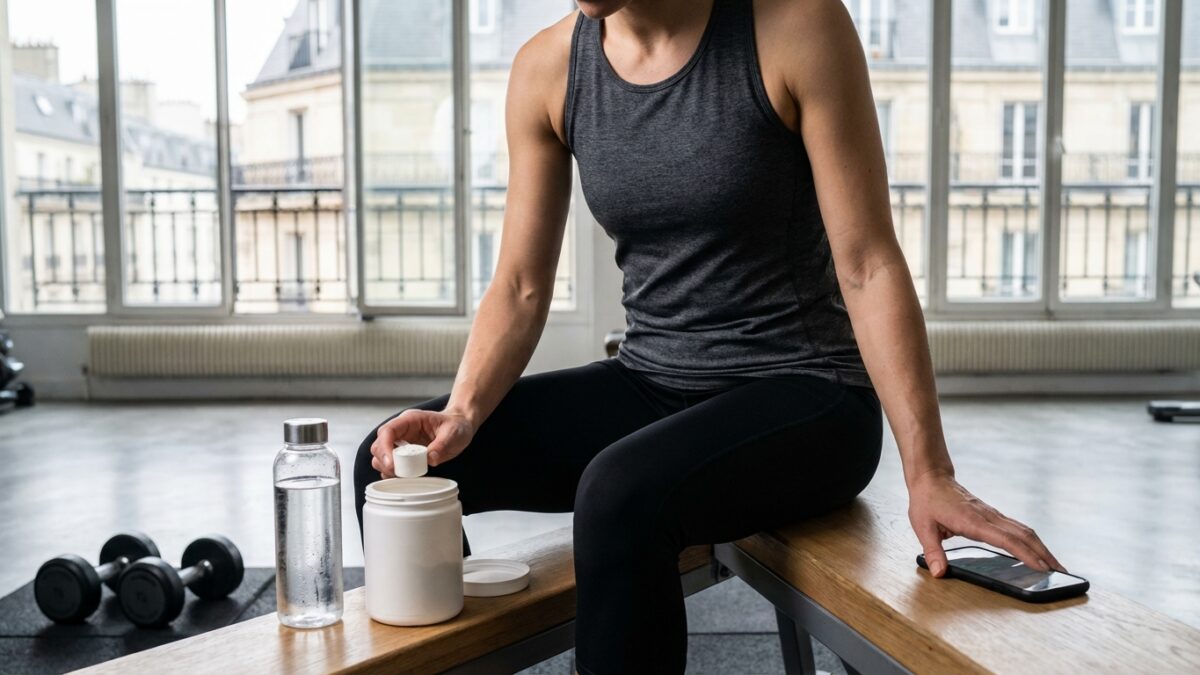
In gyms, creatine is often found in men’s bags. However, this supplement is among the most studied in the world. The International Society of Sports Nutrition even concluded that creatine monohydrate is “the most effective ergogenic nutritional supplement currently available for increasing high-intensity exercise capacity and lean mass during training“. What happens when women take it?
For a long time, most trials focused on male athletes. Recent research finally focuses on the
creatine for women : performance, muscle maintenance after 40 years, bone density at menopause, but also memory, mood or sleep. All with results that are often more marked than in men, which raises a real question.
Creatine for women: how does this supplement work in the body?
Creatine is made from amino acids and stored mainly in muscles, but also in the brain. Dr. Stacy Sims describes it as “an amino acid stored in the muscles, brain and intestine, necessary for all fast, intense and demanding activities of the body“, she explained, quoted by the magazine Women’s Health. The body uses approximately 2 g to 4 g per day; food (meat, fish) is not always enough, especially among women who eat less animal products.
During short, intense efforts, creatine serves as a small battery that very quickly recharges ATP, the energy currency of cells. Limited reserves result in faster fatigue; supplements allow you to do more repetitions or sprints, with performance gains of around 20% when taken regularly. Studies show that a daily intake of 3 g to 5 g of creatine monohydrate gradually increases stocks; a loading phase at 20 g per day for 5 to 7 days remains another option.
Creatine for women: benefits from muscle to brain
Work carried out on female athletes reported up to 15% improvement in performance after 10 weeks of creatine, compared to 6% in men subjected to the same protocol. In middle-aged women, combining resistance training and 3 g to 5 g of creatine per day improves strength and helps limit muscle loss. In post-menopausal women followed for 12 months, creatine at 0.1 g/kg/day with weight training helped preserve the mineral density of the femoral neck, while it fell by approximately 3.9% in the placebo group.
A meta-analysis of 16 randomized trials in adults showed a significant improvement in memory and a reduction in the time needed for attention and processing speed tasks, with a particularly clear effect in women for processing speed. In a trial where women suffering from major depression received an antidepressant (escitalopram) with 5 g of creatine, responses to treatment were twice as fast and remissions more frequent (52.0% versus 25.9% on placebo). Other studies suggest that a daily intake of 5 g improves mood after a short night and sleep quality in perimenopausal women.
Creatine for women: who can take it and under what conditions?
The available data points to several profiles which seem to benefit in particular from creatine:
- Athletes practicing strengthening or HIIT several times a week;
- Women over 40 wishing to preserve muscle and bones;
- Vegetarian or vegan women, often with low intakes of dietary creatine;
- Women in peri or post-menopause with fatigue, loss of strength or cognitive “fog”.
Usual doses of 3 g to 5 g per day of creatine monohydrate appear to be well tolerated in healthy adults, with no kidney damage reported in studies. Mild digestive problems sometimes occur, especially in the event of a large dose at once. Hair loss is not reflected in the data: “there is no literature showing that hair loss is a side effect of creatine supplementation“, said Dr. Stacy Sims.
Creatine is not a silver bullet, and clearly more research on women is needed. Nonetheless, studies to date indicate that a low daily dose of creatine, combined with a balanced lifestyle and resistance exercise, could improve various aspects of women’s health.
Caution remains necessary in the event of kidney disease, during pregnancy or breastfeeding, where personalized medical advice is required before any supplementation.