
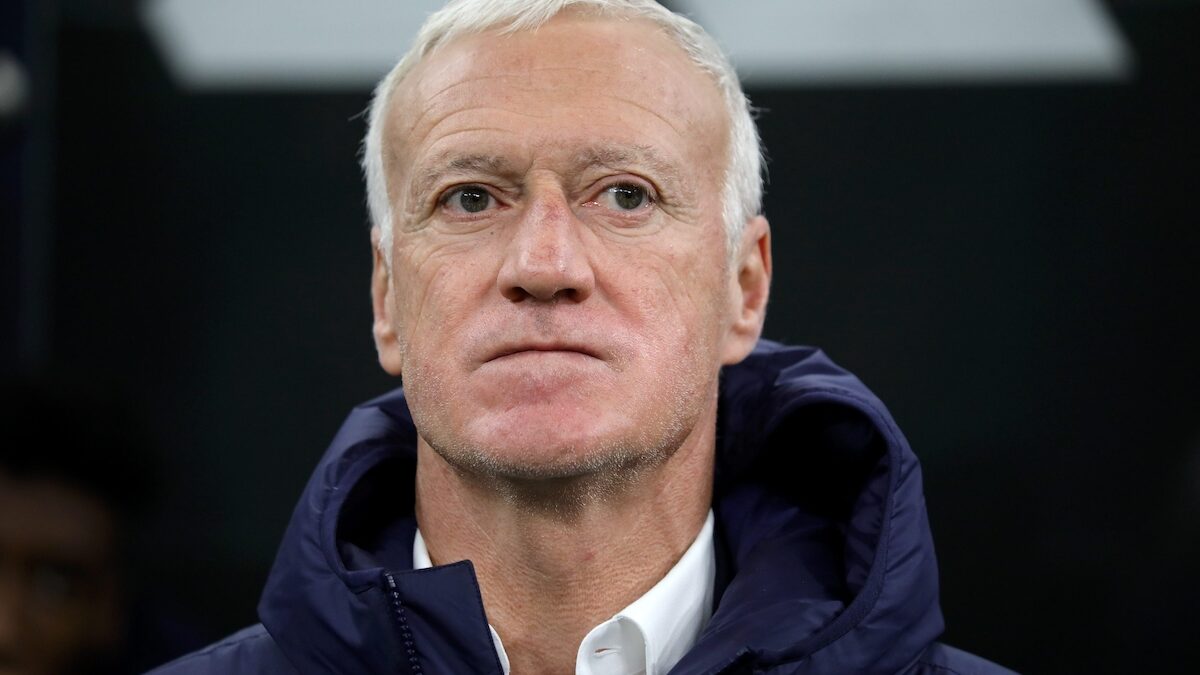
Monday, in the United States, the French team validated its ticket for the round of 16 of the World Cup by winning against Iraq. But a few hours later, a personal tragedy struck Didier Deschamps: his mother, Ginette Deschamps, died in the Basque Country.
Always very discreet about his private life, the coach has not spoken publicly. In a statement, the French Football Federation said he had returned to France to attend the funeral. He will miss several training sessions as well as the Blues’ next match against Norway.
To the immense grief linked to the loss of a parent is added here a particularly complex situation: the geographical distance, the urgency of the competition and the impossibility of completely cutting oneself off from one’s professional responsibilities.
“Sometimes circumstances dictate that we continue”
“Losing a parent is always an earthquake, whoever you are”immediately recalls Amélie Boukhobza, psychologist to whom we presented the case.
In the collective imagination, mourning is often associated with suspended time: a moment when we stop, where we cry, where we gather with loved ones. However, the reality is sometimes quite different. “Sometimes circumstances dictate that we continue. To work. To ensure. To move forward despite everything“, explains the psychologist.
This is precisely what some people experience when faced with a death while they are abroad, on a business trip or involved in a major mission.
Mourning at a distance: an often ambivalent experience
Being away from loved ones at the time of a death can cause conflicting feelings.
“Distance in mourning can be very ambivalent. It can protect temporarily, by creating a form of airlock between oneself and the violence of the news. But it can also complicate things“, analyzes Amélie Boukhobza.
Not being with one’s family, not sharing the first moments of sadness or not immediately participating in rituals sometimes makes the psychological integration of the loss more difficult. “We are not immersed in these moments which gradually make the loss real“, she specifies. In fact, the shock can also be harsher.
When the brain goes into “autopilot”
However, there are many cases, like that of Didier Deschamps, which do not allow everything to be stopped. How can we continue to function when such a shock occurs? According to the psychologist, our brain has a remarkable capacity for adaptation.
“The brain can temporarily put certain emotions at bay when the emergency requires us to continue to act. This is not necessarily denial, and certainly not indifference. It’s a way of holding on“, she explains.
Some people continue their activities for several days, even several weeks, as if on “automatic pilot”.
“The emotion is present, but it remains in the background as long as the mind is engaged by an important goal“, continues Amélie Boukhobza.
Between mourning and competition: a difficult psychological gap
In the case of Didier Deschamps, the situation appears even more complex. The coach will attend his mother’s funeral… before quickly returning to his team to continue the competition.
“Psychically, this can create a form of in-betweenness. During the competition, a part of him remains focused on the loss of his mother. And during the funeral, the competition still continues to exist in the background, with the deadlines and responsibilities that await it.“, underlines the psychologist.
In other words, it can be difficult to be fully available, both for the work of mourning and for the professional mission. “He is neither completely in one nor completely in the other“, she summarizes.
Why some emotions may appear later
The main risk is not necessarily more difficult mourning, but rather a delay in the expression of emotions.
“Grief doesn’t always like to be postponed“, says Amélie Boukhobza.
When funerals are experienced in a hurry or professional obligations remain omnipresent, some people describe a strange sensation: they know intellectually that their loved one has died, but still struggle to fully feel it. Emotions can then arise later, once the pressure has subsided.
“It is often when the mind feels it has enough security to relax its vigilance that sadness, emptiness, fatigue or tears that were previously absent can appear.explains the psychologist.
There is no one way to grieve
But finally, it’s difficult to put yourself in the coach’s place. Amélie Boukhobza reminds us that no mourning is like another.
“Grief is not a perfectly linear process. Everyone moves at their own pace, with their own movements, flashbacks, periods of calm and moments of greater pain.”
Although we frequently find certain major stages – shock, anger, deep sadness then the gradual acceptance of the loss – their succession and intensity vary considerably from one person to another.
“Grief does not always follow the timeline of events. It especially follows the moment when the mind feels it has enough security to allow what had been kept at bay to emerge.“, concludes the psychologist. In the meantime, Didier Deschamps probably knows: with a team at his side throughout the World Cup, he will never really be alone in his pain.