
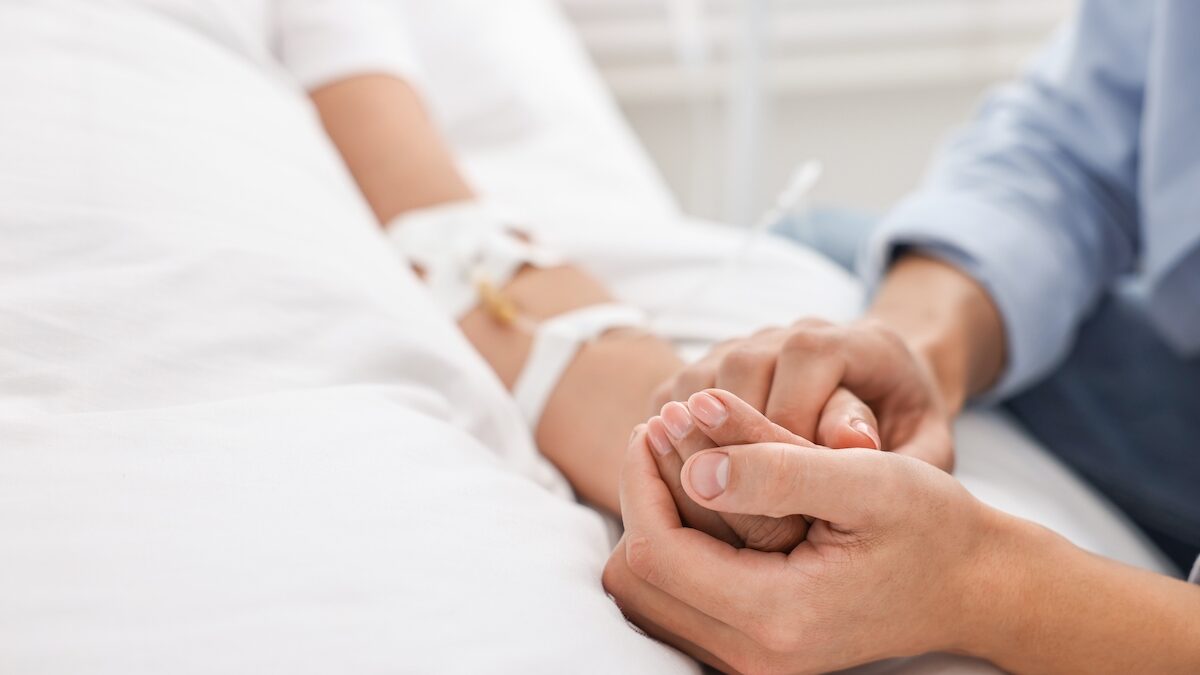
In palliative care services, a question comes up again and again, often fraught with anxiety for a patient’s loved ones: how much time does he have left? Despite advances in medicine, the last hours of life remain extremely difficult to predict. Doctors rely on known signs — irregular breathing, altered consciousness, bluish skin — but these clues remain imperfect. But today, another little sign could prove valuable and a little more precise: the blink of an eye, or rather its absence.
A study that highlights a key indicator
Published in the journal BMJ Supportive & Palliative Carea study looked at 112 patients with advanced cancers, whose life expectancy was estimated at one or two weeks.
Medical teams observed a very simple reflex in patients: the corneal reflex, this automatic blinking of the eye when its surface is lightly touched. Tested several times a day with caution, it allows you to assess basic neurological activity. However, in those who no longer have this reflex, death occurred most frequently in the following days with a significantly increased risk of dying within 24 hours.
Around 70.7% of them died the next day, with a risk more than five times higher than that of patients whose reflex was still present.
What the disappearance of the reflex reveals
This phenomenon is explained by the role of the brainstem, which controls vital functions such as breathing and consciousness.
According to Dr. Kang, author of the study, it’s about being precise:
“The absence of the reflex may strongly suggest imminent death, but its presence does not exclude it.”
However, according to him, “The disappearance of the corneal reflex may reflect a progressive deterioration of brainstem functions, as part of the natural end-of-life process.”. In other words, when this reflex disappears, it is often a sign that the body is entering its terminal phase.
Promising results, but still limited
However, some experts urge caution. Dr. David Hui, of MD Anderson Cancer Center, quoted in the DailyMail, emphasizes that the results are consistent with other already known end-of-life signs, while recalling that the study remains limited to a restricted group of patients with advanced cancer.
The researchers themselves recognize these limitations and call for broader work to confirm the reliability of the test in other medical contexts.
A valuable step forward to better support
But why is this detail important? Beyond medical performance, the interest of this test is profoundly human. Being able to anticipate the final hours allows loved ones to prepare, be present, and support the patient in their final moments.
In a context where uncertainty dominates, this tool could offer caregivers clearer benchmarks and facilitate discussions with families, often looking for concrete answers.
Towards a more dignified end of life in the blink of an eye
Ultimately, however, this test could become a valuable complementary tool, particularly if it is associated with other indicators such as sedation and vigilance scales. Future research could also refine these predictions.
But the goal is not to predict death for its own sake. As Dr. Kang points out, “Improving end-of-life care is just as important as prolonging survival.”
From this perspective, such a simple gesture could help transform the last moments into a better accompanied, more dignified moment, and perhaps a little less uncertain.