
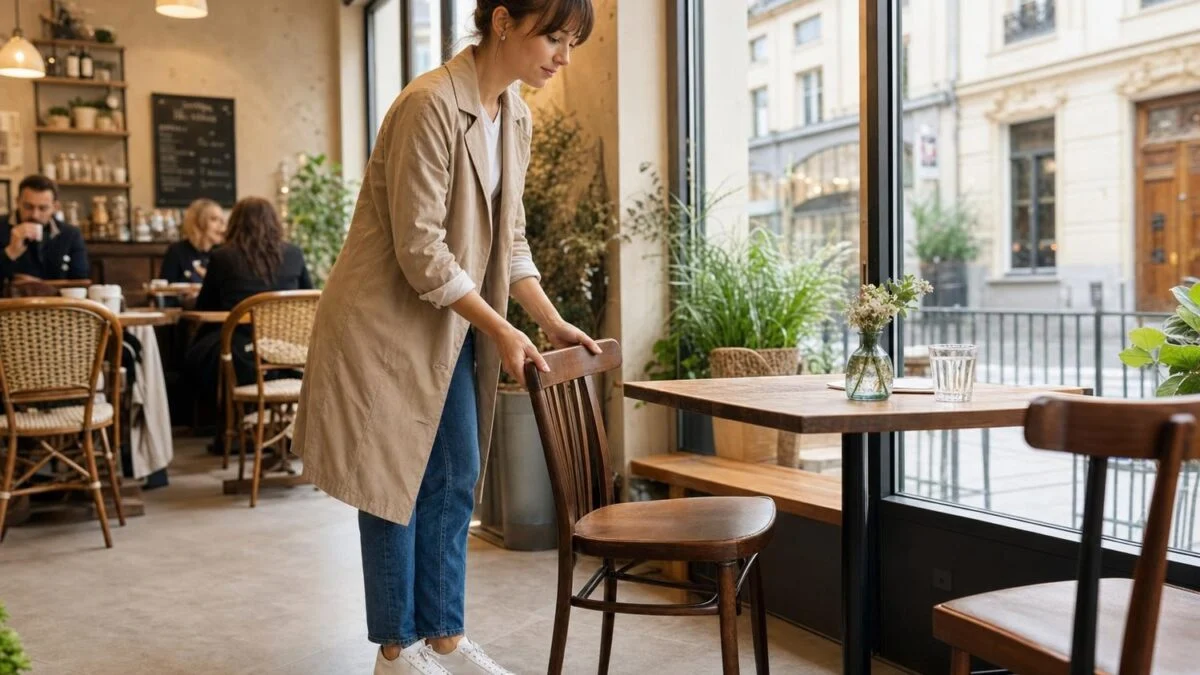
In a café, some people get up, leaving their chair and bag in the middle. Others take a few seconds to put everything back in place before leaving. A seemingly insignificant detail… which sometimes says more than we imagine. In a country where two thirds of French people believe that good manners are being lost, this little reflex intrigues sociologists and psychologists alike.
People who push back their chairs often have common traits: they are attentive to details, considerate, organized and responsible. Psychologists are not talking about a simple mania, but rather an expression of a personality trait called conscientiousness. It refers to the way a person feels responsible for their actions, including in a shared space.
What does pushing your chair back reveal?
In the model of the five big personality traits, presented in the NEO-PI-R manual, conscientiousness occupies an important place. As the Psychologies site explains, “This refers to the sense of rules, organization, reliability, attention to the consequences of one’s actions.” In other words, putting your chair back in place can reflect a certain relationship to order and respect for others.
The Grazia site, which relays the analyzes of several clinicians, also emphasizes that “Psychologists see it as a clue revealing certain personality traits.” People who systematically put their seat back in place would show particular attention to the shared space and a form of discipline, which goes beyond simple rules of politeness. They are often the same people who close a cupboard that has been left open, tidy up a meeting room after a meeting or make sure not to bother anyone before leaving a place.
The ten traits associated with this reflex
Among the characteristics that come up most often are:
- attention to their environment;
- a form of thoughtfulness towards others;
- an education based on respect;
- a strong sense of responsibility;
- the taste for order;
- a calm temperament;
- rigor in small daily tasks;
- sometimes, past experience in catering or commerce;
- the desire to facilitate the work of others;
- a low need for recognition.
These people do not tidy up to be praised. They do it simply because it feels natural to them. A discreet gesture which can be seen as a small mark of respect towards the place… and towards those who work there.
A gesture to be observed… but which does not define who we are
Psychologists are unanimous: a single micro-behavior can never sum up a personality. Context, education, habits or even certain traits such as social anxiety or the need for control can also explain this type of behavior.
Conversely, not pushing your chair back does not make you rude or selfish. This little reflex is simply one avenue among others to better understand one’s way of occupying a shared space and interacting with others.