
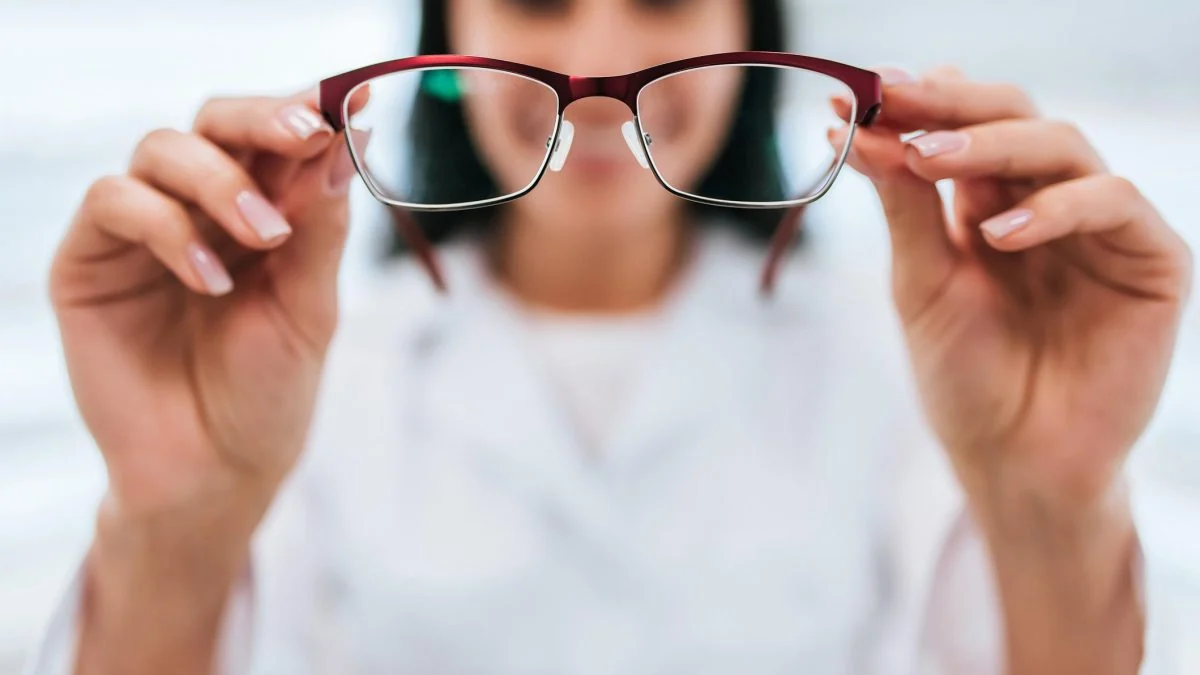
On Instagram, Dr. Ygal Boujnah, ophthalmologist (@dr.boujnah.ophtalmo), points out that being myopic does not prevent you from becoming presbyopic. Myopia can sometimes help with near reading without distance correction, but it does not treat presbyopia. After 40 years, the correction is therefore chosen according to visual needs.
Myopia can compensate, but only optically
There is a common misconception: since a myopic person often sees well up close, they would escape presbyopia. An idea received according to Dr Boujnah:
“One false thing that people often tell me in consultations is that if you are myopic, you will not become presbyopic.”
In reality, myopia and presbyopia do not refer to the same mechanism. Myopia especially hinders distance vision: the image is formed in front of the retina, which makes distant objects blurry. Presbyopia generally appears from the age of forty and corresponds to an increasing difficulty in focusing up close.
The important point is this: for some myopes, removing glasses or lenses that correct distance vision can allow them to read more comfortably. This is what the video summarizes by explaining that, with distance correction, near vision can become annoying, whereas without correction it can remain possible. But it is an optical compensation, not a treatment.
Presbyopia continues to evolve, because it is linked to the normal aging of the lens. This gradually loses its flexibility, which complicates accommodation, that is to say focusing closely. The ophthalmologist also emphasizes this point: presbyopia is normal aging of the eye.
The compensation effect depends on many elements: the degree of myopia, age, reading distance, screen work, both eyes and expected visual comfort. We should therefore not conclude that myopia, even moderate, guarantees that you will never need glasses at close range.
After 40 years, what options should be discussed for its correction?
When presbyopia becomes noticeable in a myopic person, the right choice is not automatic. It depends on distance correction, lens tolerance, daily activities and expectations. The most useful thing is to distinguish three situations to discuss with a vision health professional.
- Correct distance vision and add near help : some people maintain an effective correction for driving or seeing in the distance, with an adaptation for reading or screens;
- Use the myopia effect for certain tasks up close : removing your glasses from a distance can help some myopic people to read, but it is not comfortable or suitable for all activities;
- Discuss monovision, also called tilt
: one eye is favored for distance vision, the other remains a little myopic to help with near vision. This strategy can be done in lenses and sometimes in a surgical project, but it must be tested because not everyone adapts to it.
Monovision is precisely one of the nuances mentioned in the text accompanying the video: around the age of 40, it may be considered not to completely correct one eye in order to preserve aid for near vision. But this is not a standard solution. It can reduce the perception of relief, hinder certain fine tasks or still require glasses in certain situations.
Another important point if a myopia operation is being considered: an intervention intended solely to correct distance vision does not restore the flexibility of the lens. It therefore does not make presbyopia disappear. After 40-45 years, a close correction may still be necessaryunless specific strategy discussed with the ophthalmologist.
Refractive surgery is not a trivial procedure: the result cannot be guaranteed, additional correction may sometimes be necessary, and undesirable effects such as dry eyes, halos, glare or nighttime discomfort may occur. Options for correcting presbyopia in myopic patients must therefore be evaluated individually, without promising complete independence from glasses.
In practice, the real question is not whether myopia cancels out presbyopiabut how to obtain the best balance between distance vision, near vision and everyday comfort.