
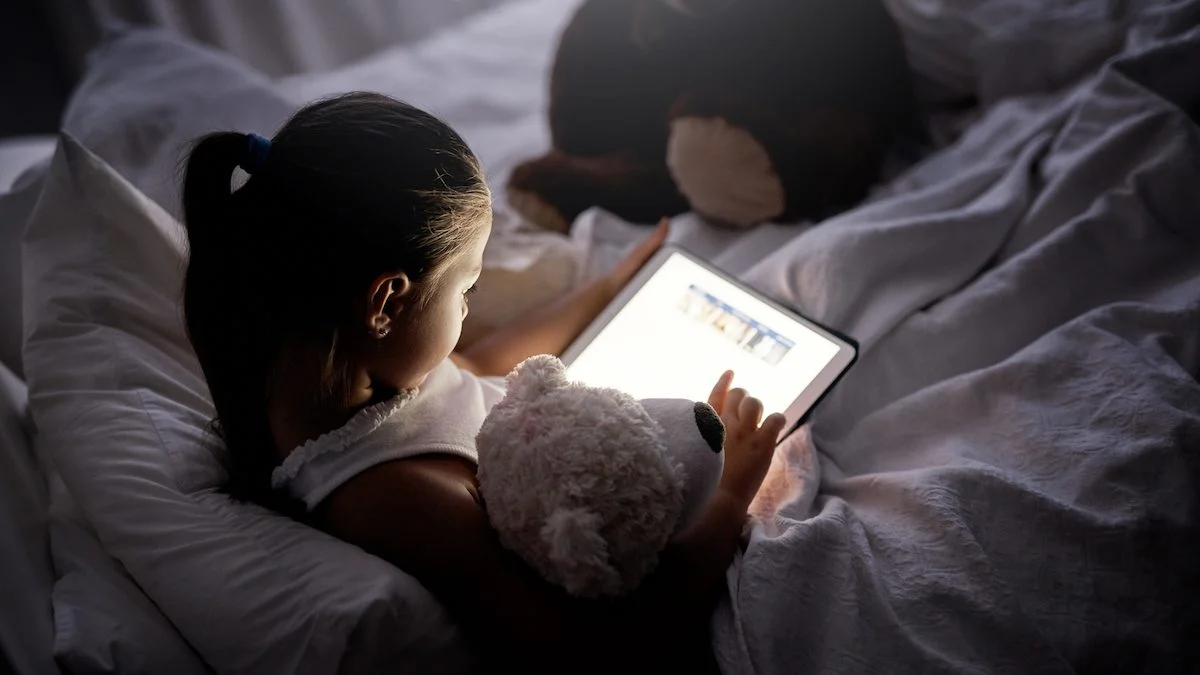
Myopia, hyperopia, astigmatism, strabismus or amblyopia: certain disorders are better managed if they are detected early. The French Society of Ophthalmology also emphasizes the importance of outdoor activities and regular breaks in front of screens.
A child can see poorly without even realizing it
For a child, seeing poorly is not necessarily synonymous with complaint. He can learn to compensate for an imperfect vision without knowing that another reality is possible. This is one of the difficulties of pediatric vision screening. The child does not always know how to express a loss of vision and certain disorders can therefore remain silent for several years. They are sometimes discovered only when academic demands increase.
The SFO believes that nearly one in five children now have a visual problem in France. Poor vision can affect learning, academic performance and, more broadly, quality of life.
Myopia is particularly a concern. It causes blurred vision at a distance and most often appears between the ages of 6 and 16. It can progress until the end of growth, around 20 to 25 years old. Worldwide, nearly one in three people are myopic today and projections estimate that one in two people could be myopic in 2050.
“Myopia is not just a simple correction with glasses. In its most severe forms, it can promote the appearance of sometimes severe ocular complications in adulthood, such as retinal detachment, myopic maculopathy or glaucoma.underlines Professor Arnaud Sauer, ophthalmologist at Strasbourg University Hospital.
Other disorders are also worth noting. Significant hyperopia can cause visual fatigue, headaches or difficulty concentrating and promote strabismus. Astigmatism causes blurred or distorted vision.
Amblyopia, nicknamed “lazy eye”, affects 2 to 4% of children. Detected early, it can be corrected in the majority of cases. Without treatment, however, it risks causing lasting vision loss.
The first years count double
Because certain disorders can leave after-effects, the timing of screening is decisive.
The SFO recalls several stages of surveillance:
- At birthto check for possible anomalies;
- Between 9 months and 1 year in children at risk; around 3 years oldparticularly to detect amblyopia and strabismus;
- Then around 6 years oldwhen learning to read and write;
- Between 11 and 13 years oldmonitoring makes it possible in particular to identify the appearance or development of myopia.
This vigilance can prevent visual difficulties from being interpreted as a lack of attention or a problem concentrating. A child who sees poorly may read less easily, become more tired and encounter learning difficulties.
Visual health then also becomes a question of equal opportunities.
Screens: the right reflexes to adopt
Changing lifestyle habits also worry ophthalmologists. Children spend more time in near vision and less time outdoors, in a context of progression of myopia.
“Recent studies suggest that beyond about an hour of daily screen time, the risk of developing myopia gradually increases. If screens are not the only ones responsible for this development, limiting screen time, combined with regular breaks and daily exposure to natural light, constitutes a recognized prevention measure.specifies Professor Guylène Le Meur, ophthalmologist at Nantes University Hospital.
The SFO recommends no screens before 3 yearsthen limited and accompanied use between 3 and 6 years. She also advises avoiding screens in the bedroom and before bed.
Another reflex: the rule of 20-20-20. Every 20 minutes, look for 20 seconds at a point about 6 meters away. The reading distance must be at least 30 cm and the lighting suitable. Above all, children must be able to practice outdoor activities on a daily basis and benefit from natural light.
Seeing well is also better learning
Behind a pair of glasses sometimes much more is at stake than visual comfort.
When a disorder is not identified, the child may become tired, struggle to read or have difficulty following in class without the cause being understood. The consequences can then affect educational success, social inclusion and equal opportunities.
At the start of the school year, certain signs may therefore merit particular attention: a child who moves very close to his book, squints his eyes to look into the distance, regularly complains of headaches or seems very tired when reading.
None of these signs alone can make a diagnosis. But they can encourage parents to talk to a health professional.
For children, time counts. Detecting early, correcting when possible and monitoring vision regularly gives everyone the best chance of learning well and growing with preserved vision.