
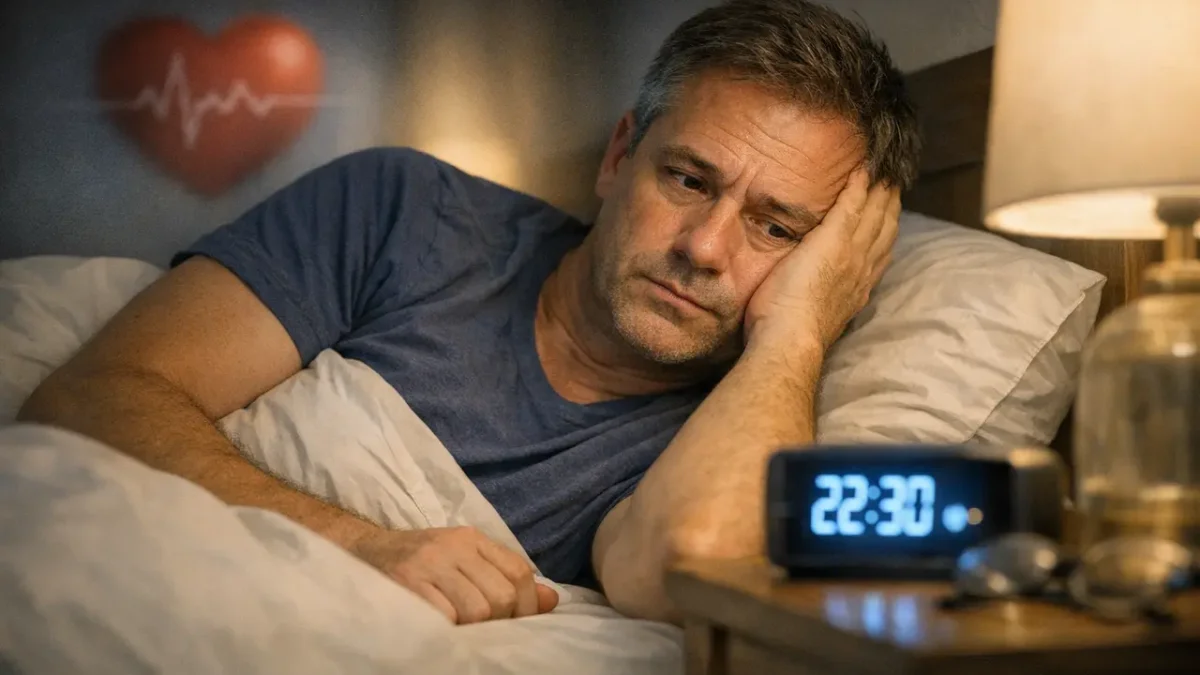
Should you go to bed earlier to protect your heart? In the program “The advice of Doctor Kierzek”, broadcast on ICI, the chronicling doctor explains that a window stands out: between 10 p.m. and 11 p.m.falling asleep is associated with the lowest cardiovascular risk in a cohort. But the useful answer is not the establishment of a curfew: it is above all regularity.
Between 10 p.m. and 11 p.m., a lower risk observed in a cohort
The study cited by Dr Kierzek corresponds to the UK Biobank cohort published in
European Heart Journal – Digital Health by Shahram Nikbakhtian et al. It analyzed 88,026 adults, aged on average 61 years, equipped with a wrist accelerometer for 7 days, then followed for an average of 5.7 years for cardiovascular events.
Dr Kierzek notes an important methodological point: the time of sleep was not only declared by the participants, but recorded by bracelet, which limits approximations. In this study, falling asleep between 10:00 p.m. and 10:59 p.m. serves as the reference group and corresponds to the lowest cardiovascular incidence.
Compared to this window, falling asleep before 10 p.m. was associated with a higher relative risk of around 24%, and falling asleep after midnight with a higher relative risk of around 25%. These figures must be read correctly: they concern a composite criterion of cardiovascular disease, not just heart attacks or strokes. The association appeared more marked in women, without this allowing a specific recommendation to be drawn.
“Be careful, here again, this is observation. There is no cause and effect link.”
This reservation of Dr. Kierzek is central. A observational study can show that a bedtime and a risk evolve together, without proving that changing one’s bedtime directly protects the heart. He also points out that people who go to bed very late may also work night shifts, experience more stress, suffer from depression or have a different lifestyle.
Why sleep regularity matters as much as the time
To explain the association, Dr. Kierzek highlights the internal clock, or circadian rhythm, which organizes many of the body’s cycles. During the night, blood pressure normally tends to drop, by around 10 to 20% in many people; he presents this phase as a form of cardiovascular recovery. A very offbeat rhythm could disrupt this organization, without the mechanism itself proving causality.
To remember, therefore: there is no proven cause and effect link between the correct bedtime and the reduction in cardiovascular risk. The practical message he favors is simpler and more realistic: go to bed and get up at roughly fixed timesduring the week and on weekends, when personal and professional life permits. This benchmark is in line with the idea of regulating your circadian rhythm without transforming 10 p.m. to 11 p.m. into a universal medical rule.
In the column, he also advises aim for around 7 to 9 hours of sleep in adults, with needs that remain individual. If this volume imposes schedules that are impossible to keep, it is better to look for a regular organization compatible with your daily life than to aim for a perfect time at the cost of additional pressure.
Simple actions to take in the evening and morning
The practical advice cited by Dr. Kierzek all points in the same direction: helping the body find regular signals. Several overlap with Ameli’s guidelines for sleeping better as an adult and can complement adopting a regular sleep schedule.
- Expose yourself to the morning light, outside if possible; the 10 minutes cited in the column are a practical benchmark, not a universal medical threshold;
- Turn off screens in the evening before sleeping, especially if falling asleep is difficult;
- Eat a light dinner, approximately 2 to 3 hours before bedtime;
- Avoid coffee at the end of the afternoon, with a threshold to be adapted according to your sensitivity and your bedtime;
- Be wary of alcohol, which can make it easier to fall asleep but degrade the quality of sleep;
- Keep a room cool, around 18°C, or at least not overheated.
Last point of vigilance: if a person snores loudly, if their spouse observes breathing pauses during the night, or if these signs concern the spouse, Dr. Kierzek recommends consulting. According to Ameli, the symptoms and diagnosis of sleep apnea require medical advice and, if necessary, sleep recording. Loud snoring and nocturnal breathing pauses should therefore be consult a doctorwithout concluding a diagnosis yourself.