
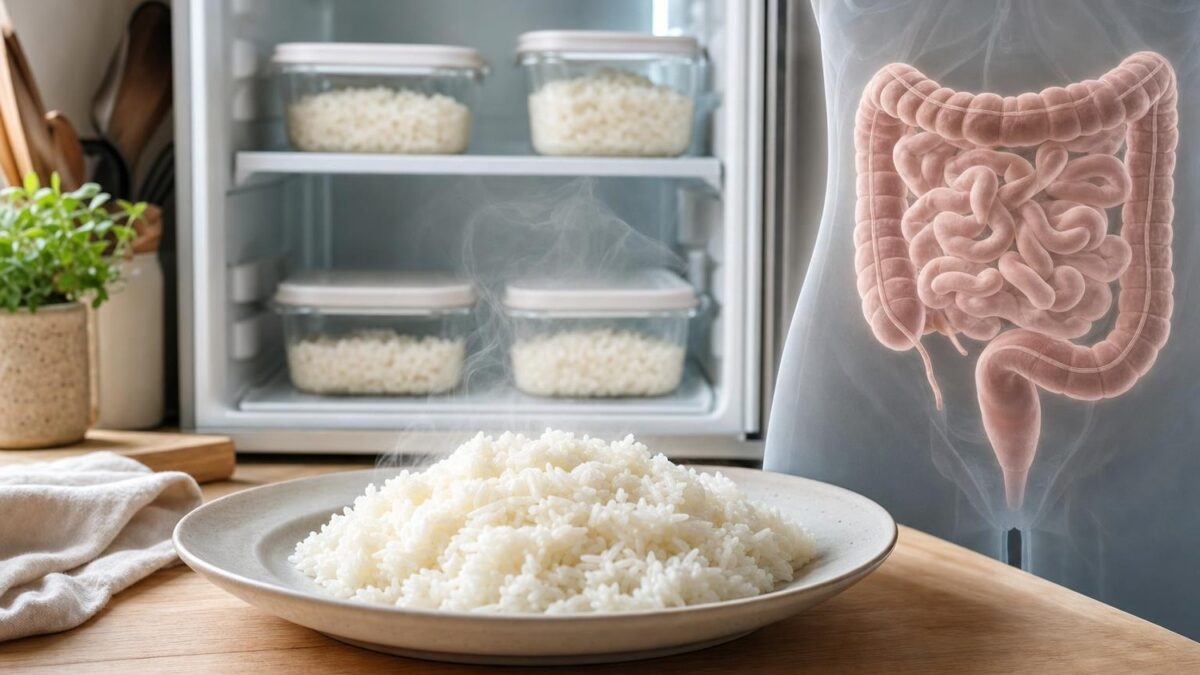
Changing the texture of a starchy food without affecting the portion and making the meal feel lighter, the idea speaks to all those who monitor blood sugar or weight. Every day, millions of people eat rice without knowing that a simple change in cold weather can change the way the body uses it. A Spanish gastroenterologist explains how rice that is cooled and then reheated no longer behaves like freshly cooked rice.
For Doctor María Muñoz, specialist in the digestive system at the Hospital Virgen de la Arrixaca in Murcia and member of the Spanish Society of Digestive Endoscopy, this is not a viral fad but a well-known effect on resistant starch. “Did you know that cooked and then frozen rice can have fewer calories? It’s not magic, it’s science and it has to do with how your body digests starch,” she explains in an interview with the Spanish media The Confidential.
Rice cooled then reheated: what changes on the plate
When rice is cooked and then cooled in the refrigerator or freezer, part of its starch is reorganized into more compact structures: a fraction becomes resistant starch, which the small intestine digests very poorly. “Result: fewer calories absorbed and less impact on glucose peaks”assures María Muñoz.
“This resistant starch is not digested or absorbed like glucose, but passes through the colon like a fiber, having a prebiotic effect,” she explains, recalling that it nourishes the good bacteria of the microbiota and the production of short-chain fatty acids.
Why this reheated rice can make the meal “lighter”
Concretely, this change in starch can make a dish of cooled and then reheated rice less brutal on blood sugar than a bowl of rice straight out of the pan, as several nutrition studies have shown. “Freezing and reheating rice changes its effect in your body. Sometimes small things add up to big benefits,” summarizes María Muñoz. Researchers also observe that this resistant fraction participates in certain satiety signals, which can help you feel full with the same portion.
The feeling of a “lighter” meal therefore does not come from a magical drop in calories, but from the fact that part of the carbohydrates behaves like fiber intended for the colon. Its benefit remains modest on the scale of a day, yet this small cooking adjustment can take place, without major effort, in a plate already balanced in vegetables, proteins and good quality fats.
Bacillus cereus: safety rules for cooled rice
There remains one point that the gastroenterologist considers crucial: the safety of reheated rice. “Improperly stored rice can cause poisoning by bacillus cereus, a bacteria that does not disappear only when heated and can cause diarrhea”warns María Muñoz. She recommends not leaving cooked rice for more than an hour at room temperature, cooling it quickly in flat containers, then consuming it in less than forty-eight hours if it is in the refrigerator or freezing it, never mixing already cooled leftovers with freshly cooked rice.