
For women who continue to attempt medically assisted procreation after the age of 35 or 40, the diagnosis often comes back: it’s not the hormones that are the problem, it’s the eggs that age too quickly… But an international team now claims to have succeeded in “rejuvenating” them in the laboratory by directly attacking chromosomal defects, without affecting the rest of the body. The idea seems like science fiction, but it is based on a very real protein.
This work, carried out at the Max Planck Institute in Göttingen and supported by the start-up Ovo Labs, was unveiled at the British fertility conference in Edinburgh and published as a preprint on Biorxiv. Professor Melina Schuh summarizes the observed impact: “Overall, we can almost halve the number of oocytes with chromosomal abnormalities. This is a considerable improvement“. It remains to be understood what “rejuvenating the eggs” means, very concretely.
Why do eggs age poorly after age 35?
The researchers point out that theaneuploidythese errors in the number of chromosomes in the egg, increases sharply with age and is among the main causes of infertility, failure of
IVF and miscarriages. In the UK, the average birth rate per embryo transferred is around 35% in patients under 35, compared to just 5% between 43 and 44. The quality of the eggs, more than the quantity, then becomes the limiting factor.
In an egg cell, meiosis must properly separate 23 pairs of chromosomes in the shape of an X. In old eggs, these Result: embryos with too many or too few chromosomes, some of which are at risk of trisomy 21. Melina Schuh’s laboratory had shown that this fragility is linked to the progressive loss of a protective protein, Shugoshin 1.
A little reminder on meiosis for those who would like to review their SVT lessons…
Shugoshin 1, a kind of glue to rejuvenate eggs
In the preprint, the authors describe how Shugoshin 1 acts as a chromosome bodyguard, capable of protecting cohesion at centromeres. With age, mouse or human oocytes gradually lose this protein. The team therefore tested a simple idea: reinjecting Shugoshin 1 into eggs, just after their puncture in the clinic. “Most women in their 40s have eggs, but almost all of them have chromosomal abnormalities. This is what motivated us to tackle this problem“, Professor Melina Schuh told the Guardian.
Eggs donated by patients at the Bourn Hall clinic in Cambridge received microinjections of Shugoshin 1, returning them to levels close to those of “young” eggs. The rate of oocytes with defects then increased from 53% in the control group to 29% in the treated group. Among women over 35, the same trend appears, from 65% to 44%, despite a limited number of eggs analyzed (and therefore a statistically insignificant result). For the company Ovo Labs, this is an avenue to simplify the journey: “Currently, faced with female infertility, the only solution accessible to most patients is to resort to IVF several times in order to gradually increase their chances of success. Our goal is to enable many more women to conceive from the first IVF cycle“.
What might change for IVF tomorrow?
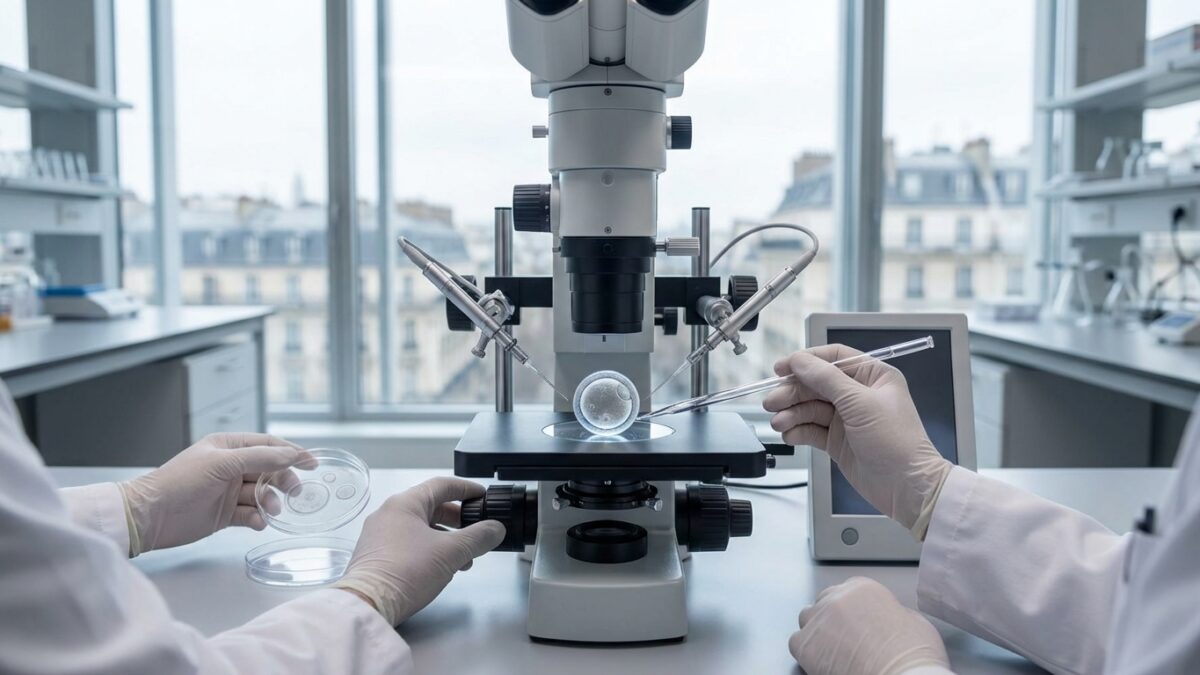
On a practical level, this approach would add a laboratory step between the puncture and fertilization: a single microinjection into the egg, a bit like sperm injection in ICSI, but with a protein. The authors emphasize a key point: this strategy does not create new eggs and does not prolong fertility beyond menopause, it only aims to reduce chromosomal abnormalities in the oocytes still present.
The results remain preliminary for the moment, published as a preprint and awaiting peer review, while discussions are underway with regulators for a clinical trial. A major unknown remains: whether this reduction in chromosomal defects will actually result in more pregnancies carried to term and fewer miscarriages. For now, the idea of rejuvenate eggs remains confined to laboratories, but it opens a much-awaited new path for women who arrive late in the assisted reproduction process.