
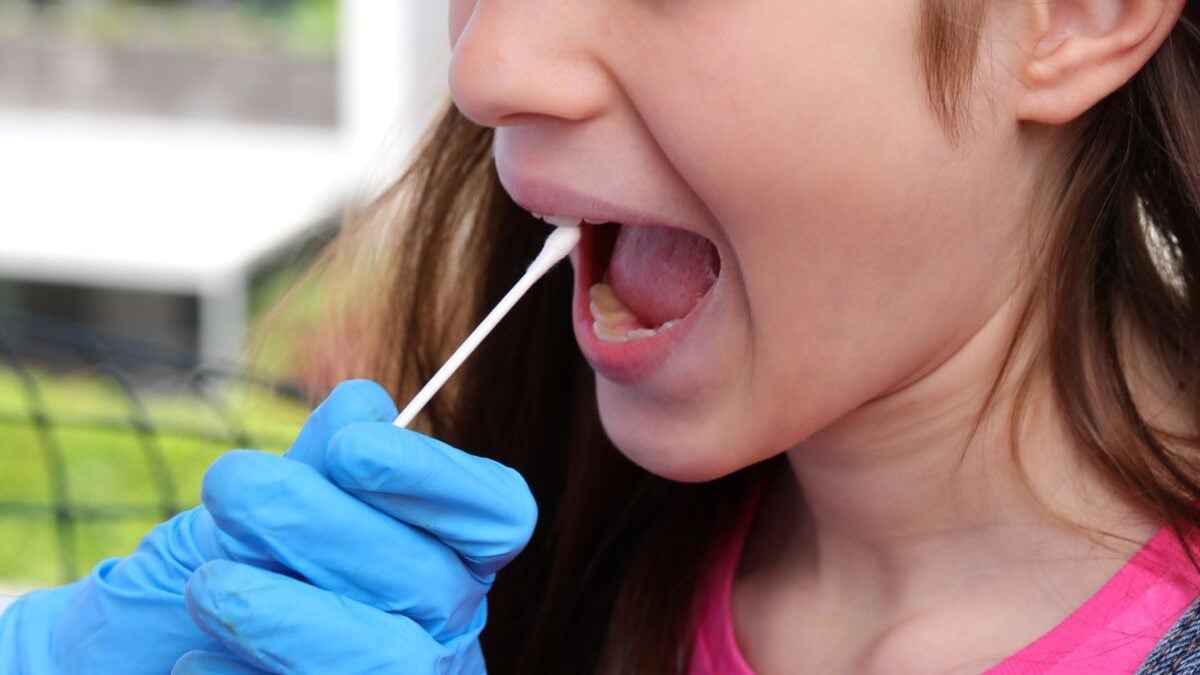
The diagnosis of endometriosis can take up to seven years on average. Faced with this trying wait for patients, the endotest, the saliva test developed by the Lyonnaise start-up Ziwig, has established itself as a symbol of progress. This test promises a rapid and non -invasive diagnosis. But today, some experts alert to major scientific uncertainties.
The promises and modalities of the salivary test
The endotest is based on the analysis of micro-ARN in saliva, coupled with artificial intelligence tools. This technology would be able to “revolutionize” the diagnosis of endometriosis. Ziwig, said in 2022 that it allowed “Early detection of all forms of endometriosis, even the most complex “.
For the National College of French Gynecologists and Obstetricians (CNGOF), this is decisive progress: “It is a major advance for patients who sometimes wait seven years a diagnosis. “
Critics and scientific doubts
The government finally decided to invest in early 2025 to deploy the test nationwide. However, many researchers point to major uncertainties, in scientific studies on the subject.
Kevin McConvay, British statistician, believes that Ziwig’s first study published in 2022 “was really just a starting point “and that the following in 2023 represented “than a step forward“Insufficient to validate its effectiveness.
Some specialists also criticize the size and representativeness of cohorts, too weak and composed exclusively of Caucasian women.
“”Can we generalize a tool that has only been based on a population? “ S “question Bianca Schor, researcher in artificial intelligence applied to health, at the University of Amsterdam, whose remarks are reported by 20 minutes.
Others recall the contrast between the funds released for Ziwig (around twenty million Euors in terms of innovation package) and the restricted funding granted to public research on endometriosis (11 million within the framework of the women’s health research program). “”This will not help other companies to develop technologies that may have a beneficial impact tomorrow “estimates Ludivine Doridot, professor at Inserm.
Faced with these criticisms, the president of Ziwig, Yahya El Mir, defends his test: “There is no product on a global scale which has this quality”. According to him, the samples selected are sufficient to bring “strong certainties” and justify the diffusion of the test.
No return to the high authority of health, for the moment
The High Authority for Health (HAS) validated the reimbursement of this test, despite everything. “”We have no solid data on the performance of this test under real practice conditions “ had she written, recalling that an independent study was “necessary to demonstrate clinical utility“.
The authority therefore recommended an “innovation package”, for a reimbursement reserved for certain patients even when the data is still insufficient. This framework also makes it possible to complete the necessary research and remains much more restrictive than the initial promises of Ziwig.
Instead of early detection, the test is no longer envisaged only after clinical examinations and unsuccessful imaging, to avoid surgery. Scheduled for around 25,000 patients, its cost is estimated at 21 million euros for health insurance.