
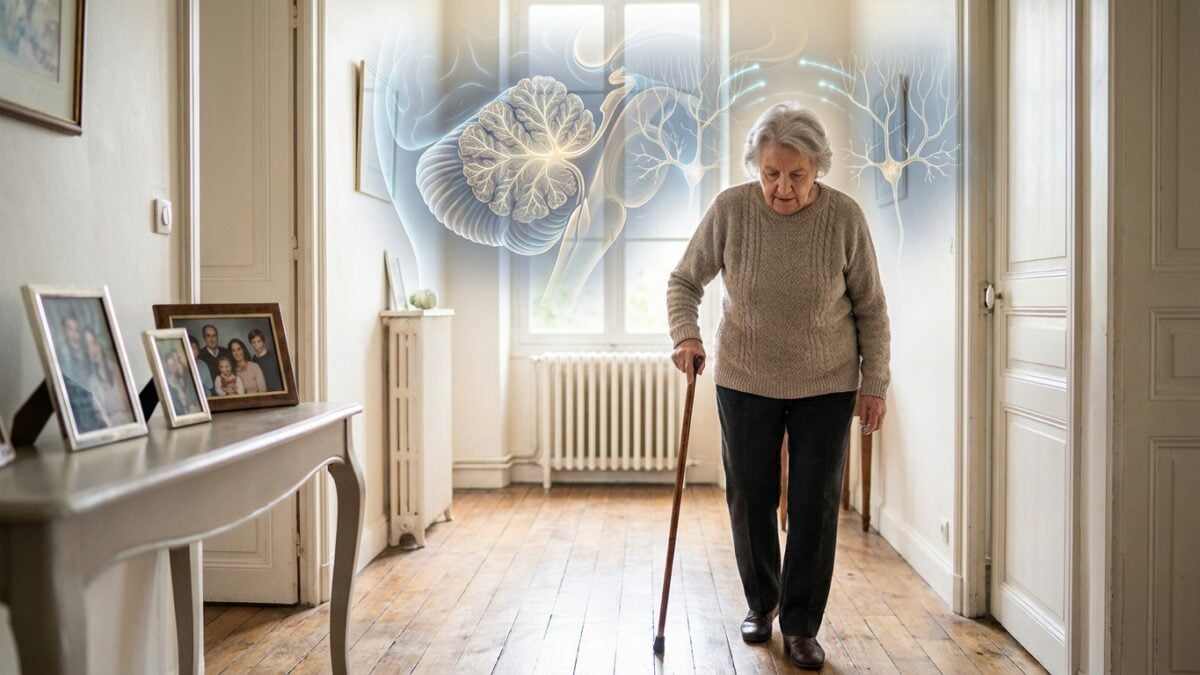
Every year in France, the fall of an elderly relative disrupts already fragile life trajectories. Behind these all-too-frequent accidents, a Canadian team identifies a specific slowdown in the activity of key balance neurons. A discovery that is still experimental, but brings hope.
When a fall turns your life upside down
Sometimes all it takes is one wrong step. A poorly judged step, a poorly fixed carpet, a furtive dizziness. In France, around a third of those over 65 and almost one in two people over 80 fall each year, according to the Ministry of Health. The consequences are serious: fractures, hospitalizations, accelerated loss of autonomy, sometimes entry into an institution. The human cost is immense; the economic cost approaches 2 billion euros per year.
Fall prevention has become a national priority. But to act effectively, we still need to understand what, with age, alters our ability to walk straight, to stand up straight, to correct an imbalance. Why does the body hesitate where it was once safe?
This is the question that a team from McGill University, in Canada, wanted to answer. Their hypothesis: motor aging does not depend only on muscles or joints, but also on a discreet and long underestimated cerebral conductor.
At the heart of the brain, these neurons which control our balance
Located at the back of the skull, the cerebellum acts as a remarkably precise regulator. With each step, it compares the intended movement to the movement actually performed, then adjusts in real time. An extremely fine system, of which Purkinje cells constitute the pivot.
These neurons, among the most active in the brain, receive sensory information and transmit the final command which refines the gesture. Fascinating feature: they are capable of spontaneously generating electrical impulses. As long as these signals remain rapid and regular, coordination is smooth.
To explore the impact of aging, the researchers studied mice aged 2 to 18–24 months — a classic model for mimicking human aging. Older rodents showed lower performance in demanding tests: crossing a high beam or holding onto a rotating rod (the “Rotarod” test). Tests which, transposed to humans, evoke the progressive loss of stability and confidence in walking.
But the most striking thing happens on a microscopic scale. By recording the electrical activity of Purkinje cells, the team observed a significant decline in their discharge frequency with age: from 81.5 pulses per second at 2 months, it dropped to 61.1 pulses per second at 18 months. Notable fact: this reduction occurs without massive loss of neurons. The cells are there, but they “fire” less quickly.
For Eviatar Fields, lead author of the study, the stakes are high:
“By demonstrating the cause and effect link between the changes that occur in Purkinje cells with age and the alteration of gait, coordination and balance, our work opens new perspectives for treatments that can prevent or delay motor aging. We thus hope to be able to extend healthy lifespan and improve the quality of life and independence of elderly people.”.
To test this causal link, the researchers used a genetic targeting tool called DREADD, which allows the activity of these neurons to be selectively slowed down or accelerated.
“When we used DREADD to slow the firing rate of Purkinje cells in young mice, and thus mimic the behavior of cells from older individuals, we observed that the mice stayed on the rotating rod for less time than mice whose cell firing rate had not been altered.explains Eviatar Fields.
Conversely, by increasing neuronal activity in aged mice, the latter improved their performance on the rotating rod. Targeted modulation was therefore sufficient to influence motor coordination.
Professor Alanna Watt emphasizes the importance of this work:
“Motor coordination is an aspect of aging that is neglected. However, it is essential to study it, because the decline in coordination is accompanied by an increase in the risk of falling, and falls can have catastrophic repercussions on quality of life..
Towards new strategies to preserve autonomy?
For now, these results remain confined to the animal model. We are still far from a treatment available in geriatric consultation. But the perspective changes dimension: if motor decline is not only linked to irreversible degeneration, but also to a functional slowdown of specific neurons, then there is room for action.
In France, the prevention of falls is already based on proven approaches: adaptation of the home, adapted physical activity, correction of visual disorders, review of medication treatments. Ultimately, therapies targeting the activity of Purkinje cells could complete this arsenal.
Beyond falls, this work could shed light on neuronal disruptions observed in certain neurodegenerative diseases, such as Alzheimer’s disease. Understanding how and why these circuits slow down could open up other avenues of research.
Nothing is acquired. Scientific caution is required. But this discovery places the brain, and more precisely the cerebellum, at the center of thinking about motor aging. And behind these experimental data, a profoundly human question remains: how can we enable everyone to age upright, for as long as possible, without the fear of falling restricting the scope of daily life?