
Alcohol during pregnancy, lifelong cognitive disorders for the child, increased vulnerability to addictions: the
fetal alcohol syndrome remains one of the great preventable tragedies of neurology. No molecule is currently validated to repair this damage. A Spanish-Finnish team has however tested an unexpected avenue, coming from cannabis.
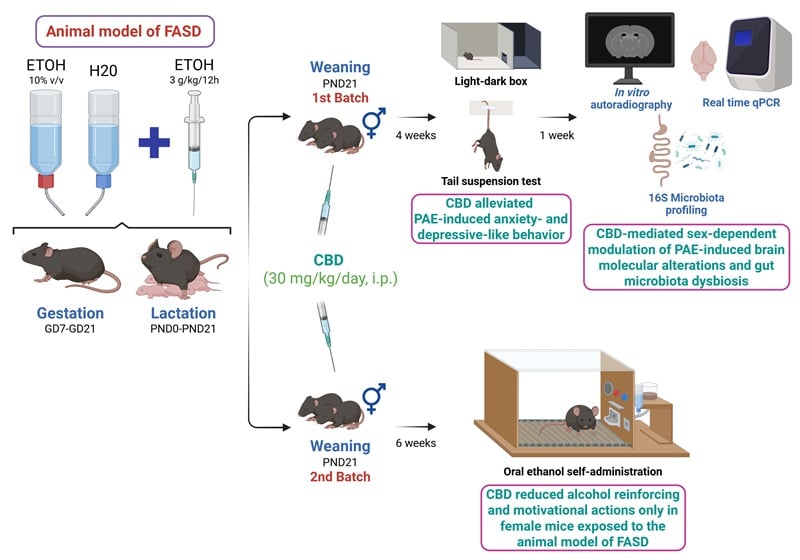
In a mouse model of fetal alcohol syndrome (FAS), researchers administered CBD to babies exposed to alcohol before and just after birth. Published in 2025 in Biomedicine and Pharmacotherapytheir results show marked changes in the brain, behavior and microbiota.
CBD and fetal alcohol syndrome: what the experiment in mice reveals
FAS refers to disorders of learning, emotions and behavior caused by alcohol on the developing brain, regardless of the time of pregnancy. “Despite its enormous social and health impact, there are currently no approved pharmacological treatments that address the root of the disorder. Only symptomatic interventions are available“, explains Jorge Manzanares, principal investigator of the study and head of the laboratory of translational neuropsychopharmacology of neurological and psychiatric diseases at the Instituto de neurosciencias (Alicante).
“Cannabidiol, or CBD, a non-addictive compound derived from cannabis, modulates the endocannabinoid system (disrupted in FAS) and has demonstrated neuroprotective, anti-inflammatory and anxiolytic properties in other models of neurological injury“, explains the UMH professor. “We therefore set out to determine the emotional effects of perinatal exposure to alcohol in mice, to identify biomarkers making it possible to quantify the impact of alcohol on the brain and to analyze the influence on the composition of the intestinal microbiota, before testing chronic CBD treatment administered from weaning and evaluating its effects..
To test an intervention, his team used laboratory mice. Mothers received 3 g/kg of ethanol orally twice daily from day 7 of gestation until weaning on postnatal day 21. Their pups were then treated for 5 to 10 weeks with a daily injection of CBD at 30 mg/kg or with a neutral vehicle.
Brain, addiction, microbiota: how CBD reverses the effects of FAS
Among youth exposed to alcohol, behavioral tests showed more anxiety and depressive behaviors in both sexes. Females also showed stronger motivation to drink alcohol in the self-administration test. “Early and prolonged administration of CBD normalized emotional alterations in both sexes“, specifies Jorge Manzanares, and in females the treatment brought the motivation to drink back to the level of controls.
 © Biomedicine & Pharmacotherapy
On the intestinal level, perinatal exposure to alcohol has profoundly unbalanced the flora, a sign of dysbiosis (imbalance or low diversity of the intestinal microbiota). Researchers point out that this flora constantly communicates with the brain via nervous, hormonal and immune pathways. CBD increased microbial diversity and enriched bacteria considered protective, profiles linked to a better emotional state and less motivation for alcohol.
A therapeutic avenue that is still distant in humans
The effects of CBD are not the same depending on gender. In males, the molecule normalized genes of the endocannabinoid system and dopamine. In females, it erased vulnerability to addiction. Professor Francisco Navarrete, first author of the article, emphasizes that these results suggest that certain sex-related differences in vulnerability to fetal alcohol disorders could have their origin in the intestine rather than in the brain.
The authors emphasize that this work “should in no way be interpreted as a recommendation for self-medication with CBD, nor as a way to counteract the effects of alcohol during pregnancy“, warns Francisco Navarrete, first author of the article.
This is a study in mice, with a high dose of CBD administered by injection in a strict protocol. At the same time, they are now considering work in animals combining CBD and targeted interventions on thegut-brain axis before possible clinical trials.
No authorization currently exists to use CBD to treat FAS in children. Researchers point out that fetal alcohol syndrome can only be prevented by completely abstaining from all alcohol consumption during pregnancy.