
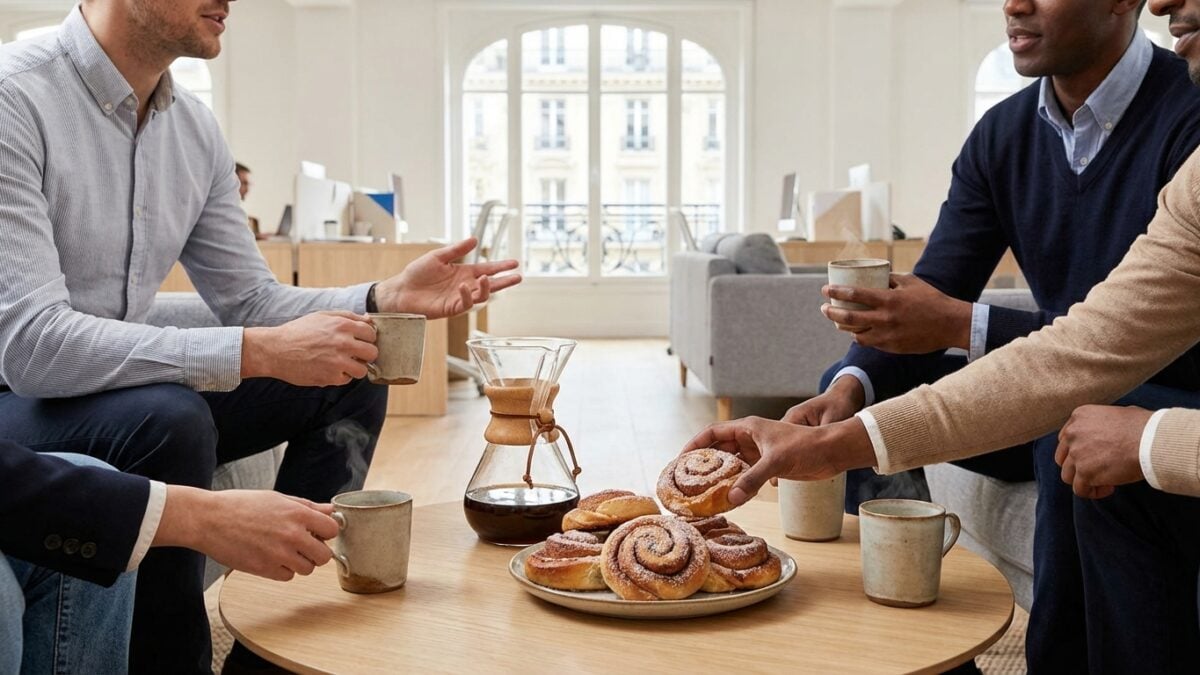
Stress at work, continuous notifications, coffees downed while standing in front of the screen: for many French people, the break is no longer really a break. In Sweden, this same coffee is transformed into a coded, almost sacred social ritual, which punctuates the day and whose virtues the inhabitants readily defend.
This ritual is called fikaa gourmet and social coffee break, which has become a symbol of the Swedish art of living. Behind this seemingly simple habit, researchers see a powerful tool for social connection, mental health and
well-being at work. What if this Nordic habit became your best ally at the office and at home?
Fika, the Swedish coffee break that structures the day
In Swedish, fika is both a noun and a verb: we can “take a fika” or simply “fika”. The word comes from the verlan of “kaffe”. It means a real break, around a filtered coffee and a sweet treat, often a cinnamon brioche, the famous kanelbullar. This moment can happen at any time, but in Sweden it usually comes twice a day, between 9 a.m. and 4 p.m., at work or at home, in a cafe or in nature. The Swedes are also the second largest consumers of coffee in the world after the Finns.
A social institution since the 1950s, the fika serves as an assumed pretext for seeing each other. “It is through fika that we interact with others, that we learn to know each other“, indicates Jonas Engman, ethnologist at the Nordic Museum in Stockholm, quoted by Madame Figaro. You don’t invite someone to lunch, but to “have a fika”; many stories of friendship and love begin there.
The benefits of fika on morale and health
For Caroline Nobilé, co-founder of the FIKA café at the Swedish Institute in Paris, quoted by Madame Figaro, “This break allows us to take a step back. We remember what the priorities are in life: being turned towards others and towards ourselves.” Fika is a “social break” where you put your phone away, which improves mental health and concentration, strengthens a sense of belonging and protects against emotional distress. According to the Passport Index from Global Citizen Solution, Sweden is the world leader in quality of life.
Social psychologist Christophe Haag, professor at EMLyon, recalls that socialization is a vital need, just like eating or drinking. “By investing time in others, with listening and kindness, we ourselves achieve a state of well-being and calm, it’s a mirror effect”. “The other can be a real natural anxiolytic“, he adds. Positive emotions are even “contagious”, promoting feel-good hormones and reducing stress.
World Happiness Report 2025 places Sweden in 4th place among the happiest countries, compared to 33rd place for France; a context where these collective rituals take on their full meaning.
At work, a break makes you more efficient
In Swedish companies, computers and telephones go to sleep around 10 a.m. and 3 p.m. for fika. “No point trying to contact a Swedish administration at 10 or 3 p.m., they will be on fika break!“, illustrates Annelie Jarl, lecturer at the University of Caen. We talk about everything, except the current file. For Christophe Haag, “The human brain needs to talk about something else to gain perspective on its current task“. Humor would activate areas of the brain linked to more creative and adaptive thoughts, which makes it easier to solve complex problems and lowers cortisol, the stress hormone.
Far from wasting time, this cut would improve performance. “Studies show that a break in work doesn’t mean you get less done. It’s quite the opposite“, insists Viveka Adelswärd, professor emeritus of communication at Linköping University, quoted by L’Élan blanc. “Work efficiency can be promoted by these informal meetings”. She adds: “Fika could also encourage creativity. It’s an opportunity to dust off our brains, fill them with inspiration from others, and test our ideas.”. This ritual would reduce hierarchical barriers, strengthen trust, commitment and cohesion: a simple coffee break, but with strong collective power.