
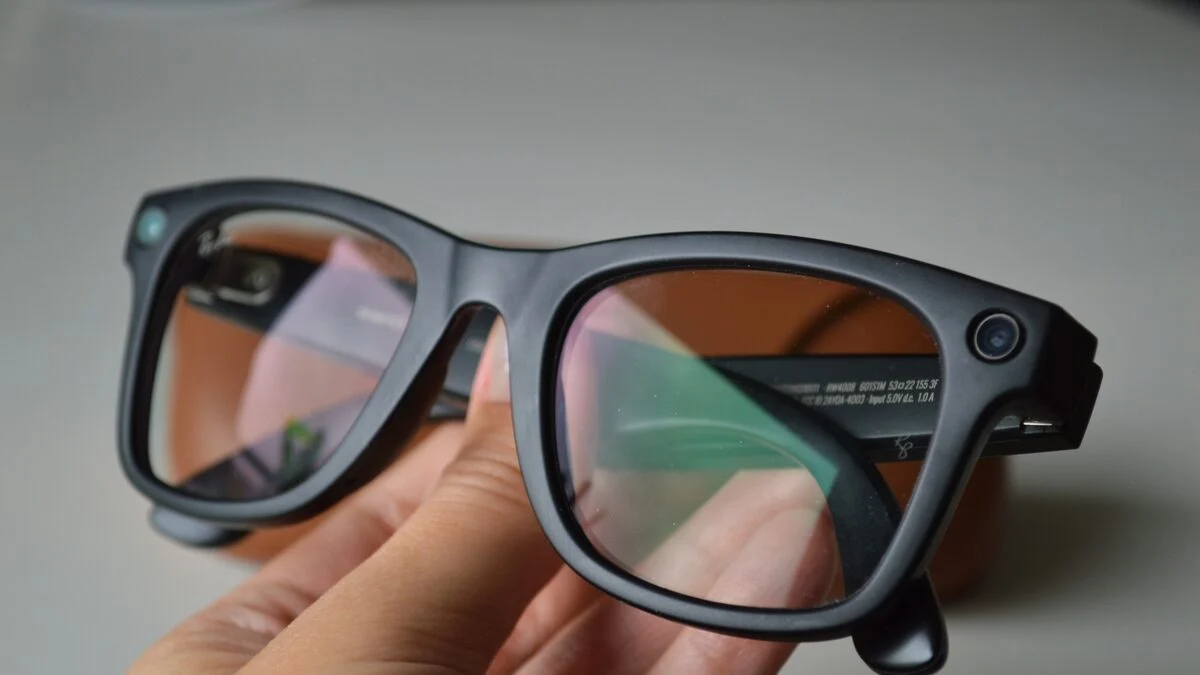
For several months, influencers have been using a strange device – connected glasses – to unknowingly film young women they approach in the street. Their goal? Capture their reactions, then broadcast these videos on social networks to create a buzz. Faced with these publications made without consent, several complaints were filed. But what happens when you discover that you have been filmed (and exposed to as many people as possible) without your consent? How to react correctly? Amélie Boukhobza, psychologist, answers us.
An invisible camera that steals more than your image
While it is easy to spot a camera pointed at you, it can now be hidden in a completely ordinary object, worn on the face. This is particularly the case for connected glasses, which are particularly discreet.
“We can therefore be filmed without knowing it, just a few centimeters away, during a conversation that we thought was private” says Amélie Boukhobza, who tells us that one of her sisters was recently a victim.
What is at stake then goes well beyond the question of broadcasting a video. The person could not decide whether they wanted to appear in the image, or under what circumstances.
“What is stolen is not just an image. It is above all the possibility of choosing what we show, to whom and in what context. It is an intrusion,” recognizes the specialist.
And this intrusion can be experienced as real psychological violence. Someone crosses a line without our consent.
“He enters a space that we thought was protected,” specifies Amélie Boukhobza.
Anger, shame, humiliation: why the shock can be so strong
When you discover that you have been filmed without your knowledge, discomfort can quickly set in. Anger, shame, feelings of humiliation… The reactions are numerous and varied.
“We are never quite the same when we know that we are being watched. In front of a camera, we control our posture, our gestures and our words more. Being filmed without our knowledge is therefore necessarily disturbing”, confirms Amélie Boukhobza.
Then, once the incident is over, many questions may arise. And with them, the need to mentally replay what just happened. “What did I say? How was I dressed? What did people see of me? Where are the pictures now?” explains the practitioner.
Added to this are very concrete questions: what happened to the images? Were they kept, sent to someone, published? Without an answer, it is difficult to know what happened to them and who can still have access to them. An uncertainty that can fuel a deep feeling of anxiety.
“The problem therefore lies in the loss of control and confidence. The mind hates what it cannot delimit or verify. Uncertainty can then become even more pervasive than the image itself. We do not know exactly what has been recorded, what has been preserved, nor what could be broadcast.” specifies the specialist.
Fortunately, not all situations produce the same effects. And not every invasion of privacy will necessarily traumatize you.
“But certain situations can be particularly violent. I am thinking of images taken in a home, during a consultation, a sexual relationship, a very personal conversation or a moment of vulnerability. Mass dissemination, mocking comments, harassment or the sexual nature of the images obviously aggravate the impact. Today, when we discover that we have been filmed, we immediately think of all that.” recalls the psychologist.
For some people, the event may also echo a past experience. In a person who has already suffered harassment, sexual assault, voyeurism or another violation of their limits, such an event can reactivate old suffering.
“But here, the body very quickly recognizes this feeling: someone has entered my intimate space without my authorization” confides the expert.
How to react when you have been filmed without your knowledge?
Often, we want to tear off the glasses, retrieve the device, threaten the person or immediately publish their name on social networks. But it is better to avoid a confrontation that could become violent or turn against you, advises Amélie Boukhobza.
“You must first clearly state that you do not agree to be filmed and request that the recording be stopped and that the images be deleted. If the situation allows, it may be useful to note the time, place and identity of the person, then collect any testimonies.” advises the practitioner.
Then, if images have already been published, it is better to keep the evidence – screenshots, address of the publication, messages received – before “request its removal and report the content to the platform”,
recalls the specialist.
These steps also allow us not to be left alone in the face of what has just happened. Because after such an experience, the feeling of helplessness can be particularly difficult to bear.
“The whole point is to put back limits where they have been erased”, says Amélie Boukhobza.
But once the steps have been taken, it is also necessary to monitor what the event produces in daily life. Being wary of everyone wearing glasses, avoiding certain places or constantly having the feeling of being watched can reflect anxiety that is taking hold.
“The risk, after having been filmed without their knowledge, is indeed that they will never again be able to forget the possible presence of a camera. If the person begins to scrutinize people’s eyes, to avoid certain places, to no longer speak freely or to feel observed everywhere, a psychological consultation may become necessary” warns the psychologist.
Consultation can then help to regain a feeling of security, without minimizing what happened. “Not to learn to put things into perspective. But to help rediscover what has been achieved: the feeling that one’s image, one’s body and one’s intimacy belong to us”, concludes Amélie Boukhobza.
What to do if you are filmed without your consent?
- Ask the person filming immediately
what she plans to do with the images and remind her that sharing your image may require your consent.- If the images are published onlinekeep proof of the broadcast: screenshots, URL, number of account subscribers, publication date, etc.
- In case of harma complaint may be considered. The amount of possible damages depends in particular on the visibility of the publication and the seriousness of the situation. A video that goes viral or shows a person in a compromising situation can therefore result in greater harm;
- Be careful of private places : filming, recording or transmitting without consent the image of a person who is in a private place constitutes a criminal offense, punishable byone year’s imprisonment and a fine of 45,000 eurosrecalls the CNIL.
Good reflex: If your image was distributed without your consent, do not delete the evidence before taking steps.