
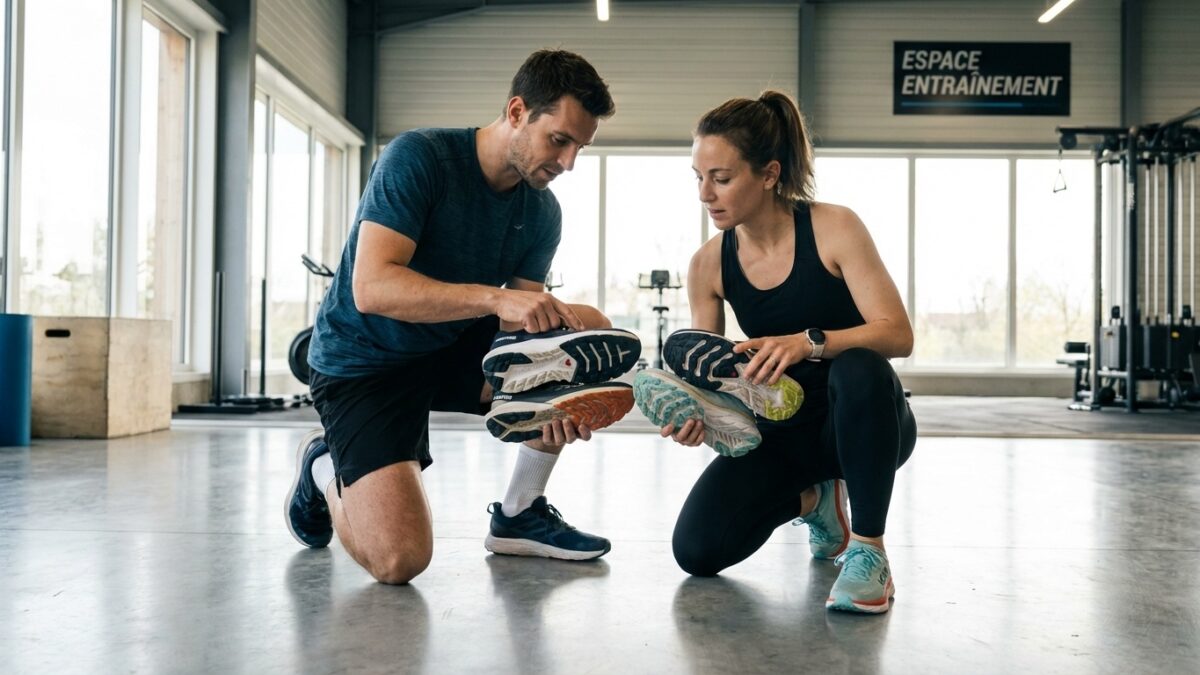
Knee pain after a HIIT class, blisters during the warm-up, fear of slipping near the treadmill… Often, the problem comes less from the intensity of the session than from a poorly chosen pair of sneakers. Many arrive at the gym with their running shoes or city sneakers, without realizing that they are not designed for fitness.
However, the good fitness basketball really depends on what you do: cardio, strength training, CrossFit, group classes or yoga. Each practice requires a level ofcushionedstability and flexibility different. The challenge is therefore to stick as closely as possible to your actual sessions, not to the label on the box. A detail that quickly changes the feeling of each squat and each jump.
Choose your fitness sneaker according to your training
If your program revolves around cardio (treadmill, rowing machine, HIIT, jump rope), choose a shoe with good cushioning at the rear, lightness and excellent grip. The idea: protect knees and ankles with each impact without weighing you down. Dynamic training models, like the Nike Free Metcon 6 or the Adidas Amplimove, offer a flexible sole, effective traction on different surfaces and a breathable mesh upper, practical when the session heats up.
For bodybuilding, CrossFit or heavy strengthening, the priority becomes stability. We are looking for a flatter sole, not very compressible, with a low drop, around 2 to 4 mm, to remain “anchored” to the ground. Ranges like Nike Metcon 10, Reebok Nano X5 or Under Armor TriBase Reign 6 illustrate this profile well. For more versatile use (group lessons, circuits, light reinforcement), shoes like the Adidas Amplimove offer a good cushioning/stability compromise. Yoga and Pilates, on the contrary, require a very flexible sole and close contact with the ground.
The key criteria for a good fitness shoe
An important point: running shoe
does not have the same mission as a fitness shoe. The first is designed to move straight forward, with generous cushioning and often high drop. In the gym, this “cushion” can affect balance during squats or lunges. The fitness shoe maintains moderate cushioning to withstand jumps, but has a wide and stable base for power movements and changes of direction.
Next comes the flexibility of the sole (essential for pivoting, lunging or doing burpees), multi-directional grip to prevent slipping, breathability and overall comfort. Ventilated mesh, a collar that doesn’t rub the ankle, sufficient arch support if you have sensitive feet: these details matter. Many training models weigh around 240 to 280 g in women’s size 40, with a drop of 2 to 5 mm, a good balance for most practitioners.
Budget, trials and mistakes to avoid
Around €70, versatile pairs like the Adidas Amplimove offer support and comfort. Between €100 and €140, the training ranges from Nike, Reebok, Under Armor or Puma target intensive practice, for men or women, with better durability and foot support.
When trying on, keep the space half a centimeter in front of the toes, without letting the foot float. Try a few squats, lunges, small jumps and lateral movements: the heel must not lift off, the foot must not slip. Classic mistakes to avoid: doing HIIT with your ultra-cushioned running shoes, taking “a size larger to be comfortable” or keeping the same pair for several years even though the sole is smooth and the cushioning is compacted.