
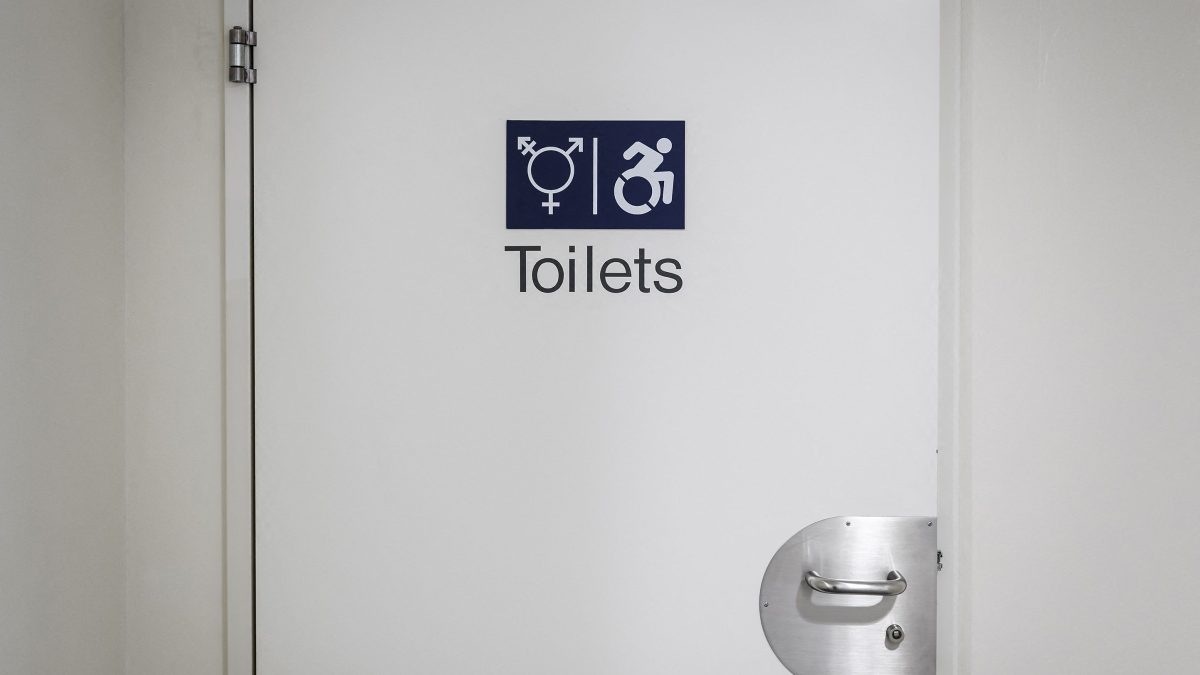
These symbolic images now tend to be replaced by others, more neutral, he explains in “At the bottom of the corridor on the left”, based on his collection of around 200 pictograms, photographed on the doors of toilets in various places, mainly in France and the United States.
Why pictograms?
Separate toilets developed at the beginning of the 20th century, when women began to take over public spaces, at a time when it was felt that they should be protected from men.
Initially, the words “men” and “women” are displayed on the doors, Serge Tisseron described to AFP. But for foreign travelers it was “difficult to find“. With the development of tourism, the idea of having “images that are read universally“so”made its way in the 1950s“.
The movement began in Japan: the country planned a universal visual language for visitors who would go there for the 1964 Olympic Games.
A stereotypical masculine vision
The first mass-produced pictograms represent stylized silhouettes of a man in pants and a woman in a skirt or dress. At the same time, many venue owners choose to create their own images, explains Serge Tisseron.
Characters in elegant outfits from different eras, portraits of ancestors, objects (delicate or basic gloves, revolver or heeled shoe) appear on the toilet doors. Main trend: masculine images with characters with “broad shoulders” and accessories such as a cane, inspire “strength”, while feminine ones “evoke either maternity, with an extremely large pelvis, or seduction“, analyzes the psychiatrist. Representations largely “made by men”.
A slow evolution
Throughout the 20th century, the habits and behaviors of both sexes changed considerably. For example, in terms of clothing, women have adopted pants, shorts and T-shirts.
“Fashion has evolved but representations of the masculine and feminine have had more difficulty keeping up“, comments Serge Tisseron. The pictograms are like this for a long time.”remained prisoners of traditional imagery“.
The main development during this period, according to him: the diffusion in the 1970s and 1980s of abstract pictograms, characters composed entirely of geometric figures. But always representing broad shoulders and a thin pelvis for sir, the opposite for madam.
Images that influence us
We only take a quick glance at them before pushing open the toilet door, but we are confronted with these stereotypical symbols every day.
However, the images that repeat themselves “mark our imagination”, points out Serge Tisseron. These pictograms “influence our representation of what a man and a woman are”, as do other visuals, for example advertisements.
Activists and associations have been denouncing stereotypical marketing and its impact for several years. This is the case, for example, of Pépite Sexiste, which denounces ordinary sexism, particularly on social networks. On the other hand, “until now, gendered toilet signage had not been singled out as bearing the same responsibility,” observes the psychiatrist.
Towards more neutrality
These stereotypical pictograms maintain “norms” which “no longer correspond to the state of society” today, notes Serge Tisseron. Result: they are starting to be replaced by new, more “neutral” symbols, either the indications “toilets” or “WC”, or images “which include the notion of gender diversity“.
New characters appear, some humorous: women in pants, half-man, half-woman people or even extra-terrestrials.
The toilets thus become mixed, a concept that is far from unanimous. Its defenders point out that it makes everyday life easier for transgender people, while its opponents fear that women will be less safe.